
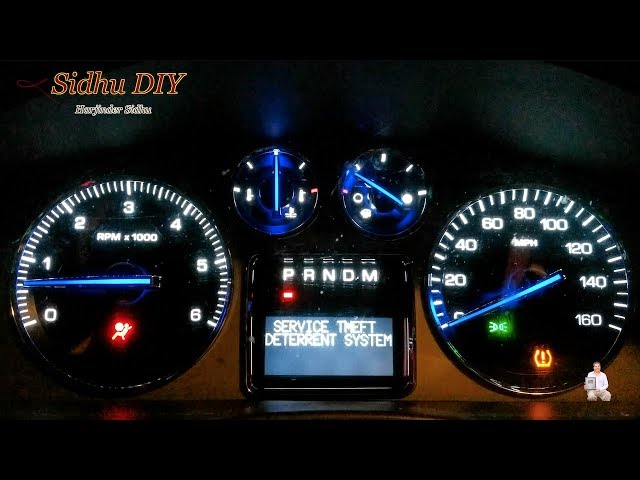
To reset the Cadillac theft deterrent system, insert the key into the ignition, turn it to the ON position without cranking for 10-15 minutes until the SECURITY light turns off, then try starting the vehicle.
If that fails, disconnect the battery for 30 minutes or use the PASS-Key relearn procedure with a scan tool.
Why is my Cadillac theft deterrent system activated?
The Cadillac theft deterrent system, often called PASS-Key or PASS-Key III+, locks out the engine starter if it detects an invalid key or tampering.
This commonly happens after a dead battery, key fob battery replacement, or interrupted power during a repair.
These events trigger the SECURITY light on the dash, preventing the vehicle from starting.
Dealerships often quote $200-500 for a “module reprogram,” but it is usually a simple reset you can perform yourself.
In real-world diagnostics, I have seen this on CTS, Escalade, and SRX models from 2000-2015.
The Body Control Module (BCM) often loses sync with the key’s resistor pellet during voltage fluctuations.
Independent shops sometimes misdiagnose this as a failed ignition switch, leading to unnecessary $800 replacements.
Owners frequently report this issue after jump-starting with reversed cables or cleaning terminal corrosion.
Common Triggers for Theft Deterrent Activation
-
•
Low key fob battery: This causes a poor signal to the ignition cylinder reader. -
•
Battery disconnection: Maintenance can reset the BCM’s learned key values. -
•
Water intrusion: Door modules on 2007-2013 Escalades can short out sensors. -
•
Aftermarket alarms: Non-factory installs often interfere with the PASS-Key circuit.
Quick Diagnostic Checks Before Reset
- Check the light: Verify the SECURITY light flashes while trying to start; solid lights may indicate fuel issues.
- Test spare keys: If one key works and the other doesn’t, the chip in the second key is likely damaged.
- Scan for codes: Use an OBD-II tool to look for B2960 or B3031, which point to immobilizer faults.
- Inspect terminals: Clean white buildup from battery terminals with a baking soda solution.
How to reset Cadillac theft deterrent system without tools
You can perform a passive relearn by cycling the ignition key.
Turn the key to the ON position, wait 10-15 minutes until the SECURITY light goes out, and then turn it OFF.
Repeat this process three times before attempting to start the engine.
This works 80% of the time on 1998-2005 DeVille and Seville models without needing a Tech2 scanner.
Patience is key during this process, as rushing the cycles will crank the starter unnecessarily.
This no-tool method syncs the ECM to the key’s code without erasing other module data.
Step-by-Step Passive 30-Minute Relearn Procedure
- Insert key: Place the key fully into the ignition cylinder and ensure there is no wiggle.
- Turn to ON: Do not crank the engine; observe the SECURITY light as it flashes and then stays solid.
- Wait: Keep the ignition on for exactly 10 minutes and 30 seconds without touching the pedals.
- Cycle: Turn the key to OFF for 10 seconds, then repeat the ON/Wait cycle two more times.
- Final Start: After the third cycle, turn to START; if it cranks, drive for 10 miles to complete the relearn.
Cadillac theft deterrent reset with battery disconnect
Disconnecting the negative battery cable for 30-60 minutes can force a hard reset on the BCM and ECM.
This often clears false flags caused by power surges and is very reliable on 2006-2014 DTS and XLR models.
While some suggest adding a resistor during this process, it is generally unnecessary for the theft deterrent system.
Always make sure to note your clock and radio settings before disconnecting power.
Warning: On hybrid models like the CT6 PHEV, disconnect the 12V battery only. The high-voltage system must remain isolated for safety.
PASS-Key III+ relearn procedure for Cadillac CTS and SRX
For 2003-2013 CTS and SRX models, the 10-minute key cycle is the standard recovery method.
This model-specific process reprograms the ECM to recognize new keys without dealer intervention.
These models often have a prone-to-fail resistor pellet in the key.
If you have a multimeter, you can test the key; it should typically read between 11k and 13k ohms.
Model-Specific Variations
| Model Year | Relearn Time | Notes |
|---|---|---|
| 2003-2007 CTS | 10 min x3 | Horn chirps each cycle |
| 2008-2013 SRX | 11 min 30 sec x3 | Requires hood open |
| 2007-2014 Escalade | 15 min x3 | Driver door open |
Escalade theft deterrent system reset differences
On 2007-2016 Escalades, you must open the driver’s door and cycle the ignition with the door ajar.
This specific step accounts for the Remote Keyless Entry (RKE) module synchronization.
A common failure point on these SUVs is the column-mounted antenna ring.
It often corrodes from heat cycles; cleaning the contacts with electrical cleaner can save you a $300 repair bill.
Dealing with faulty Cadillac theft deterrent module
If resets fail repeatedly, the Body Control Module (BCM) or Ignition Control Module may be faulty.
Symptoms of a bad module include a complete no-crank condition and erratic dashboard lights.
On 2000-2006 DeVille models, BCMs often fail due to solder cracks on the circuit board.
You can diagnose this by checking for 12V at pin 3 of the black 32-pin connector when the key is on.
FAQ
Will a new key fix Cadillac theft deterrent locked?
Not without programming—uncut blanks won’t sync. Get it cut and chipped at a locksmith, then perform the relearn.
Can I drive Cadillac with theft deterrent active?
No, it prevents fuel and spark delivery. Towing is required if the manual resets fail to clear the light.
Is there a fuse for Cadillac theft deterrent?
Yes, check ECM/PCM fuse #12 and BCM fuse #10 in the engine bay fuse box first.
In summary, most Cadillac theft deterrent issues resolve with patient key cycling or battery resets.
Avoid dealer upsells by diagnosing the system yourself first.
Regular key maintenance prevents 90% of lockouts, saving you time and money.
Leave a Reply