
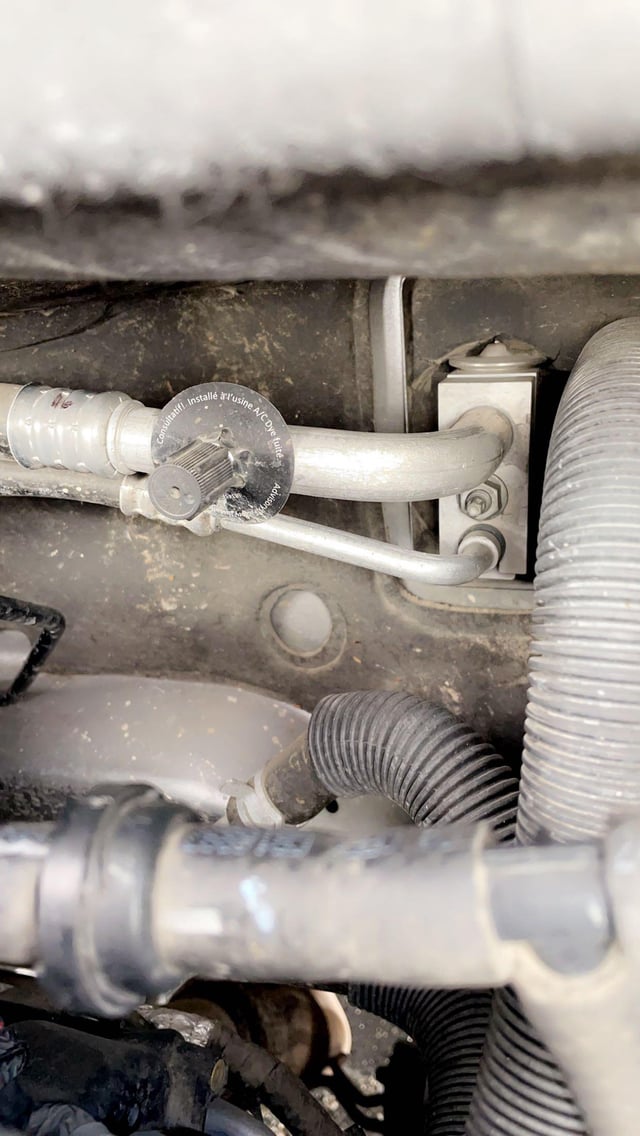
Yes, you can recharge the AC on your Dodge Caravan yourself with an R-134a kit from any auto parts store. However, you must first diagnose low refrigerant as the actual cause of your cooling issues.
Common leaks often occur in O-rings or the compressor clutch. Use a $20 manifold gauge set to check pressures before adding any refrigerant to avoid overcharging and permanent compressor damage.
How to Recharge Dodge Caravan AC: Step-by-Step DIY Guide
The low-side service port on most Dodge Caravans (2001-2020 models) is located on the larger aluminum AC line near the accumulator. It is typically capped with a blue or black plastic cover for easy identification.
Always recharge with the engine running at 1500-2000 RPM and the AC set to max. Keep the doors open during the process to ensure you get accurate pressure readings.
Dealerships often quote $150-300 just for a recharge without actually fixing the underlying leaks. Meanwhile, independent shops might miss the real issue half the time.
I’ve seen countless Caravans where owners add refrigerant repeatedly. Unfortunately, it often leaks out again from cracked O-rings or failing evaporators shortly after.
Tools and Materials You’ll Need
- Manifold gauge set: This is essential—don’t skip this; cheap analog ones work fine for DIY.
- R-134a refrigerant can: One 12oz can usually suffices for low systems; get one with leak sealer only if pressures confirm no major leak.
- Safety gear: Wear safety glasses and gloves because pressurized refrigerant can freeze skin instantly.
- Thermometer: Use a thermometer or infrared gun to check vent temperatures.
- Vacuum pump: This is optional but highly recommended for evacuating air and moisture after repairs.
Step-by-Step Recharge Process
- Park in shade, engine off: Let the system cool completely. Locate the low-side port, which is usually on the passenger side near the firewall.
- Hook up gauges: Connect the blue hose to the low-side port and the red to the high-side. Start the engine and set the AC to max with the blower on high.
- Read pressures: The low-side should be 25-45 PSI, and the high-side should be 150-250 PSI at 80°F ambient. If the low-side is below 25 PSI, proceed with adding refrigerant.
- Add refrigerant slowly: Shake the can, connect it to the blue hose, and open the valve in 10-15 second bursts. Rock the can side-to-side while monitoring the low-side as it rises to 35-40 PSI.
- Check performance: Vent temperatures should drop to 40-50°F. If the compressor clutch doesn’t engage, check for 12V power or a clutch gap of 0.015-0.025 inches.
- Disconnect and cap ports: Run the system for 5 minutes. Recheck for leaks using UV dye if it is available.
Expect a 12-18oz total capacity on 3.3L/3.8L engines. Overcharging “grenades” the compressor—I’ve replaced dozens from DIYers who ignored their gauges.
Dodge Caravan AC Not Cold After Recharge: Common Causes and Fixes
Does your AC blow warm minutes after a recharge? It’s rarely “just low” on Caravans; 90% of cases trace to leaks, weak compressors, or clogged components.
Always start with a full pressure and temperature test. Do this before you start throwing expensive parts at the vehicle.
Leak in O-Rings or Hoses (Most Common on 2008-2016 Models)
Aged O-rings dry out and crack from heat cycles, causing leaks at the fittings. Caravans also use Schrader valves that tend to weep; these should be replaced with every recharge.
- DIY Fix: Buy an O-ring kit ($10). Evacuate the system, replace seals, vacuum for 30 minutes, and then recharge using Nylog Blue sealant.
- Pro Tip: UV dye in a recharge kit reveals leaks. A blacklight will spot oily residue at the evaporator drains or the condenser.
Failing Compressor Clutch (Frequent on 3.6L Pentastar)
The clutch may fail to engage or slip under load as the gap widens from wear. You can test this with a direct 12V jumper to the compressor.
- Bypass pressure switch: Jump the pins on the cycling switch with a paperclip; the clutch should kick on immediately.
- Check gap: Use a feeler gauge to check the gap. Adjust it to spec or replace the clutch for about $100 as a DIY project.
- Full swap: Perform a full compressor swap if you hear internal rattles. This costs about $250 for aftermarket parts versus $800 at a dealer.
Clogged Expansion Valve or Orifice Tube
Debris from compressor varnish can clog these parts, causing a low-side freeze-up. Symptoms include a low-side reading of 0-20 PSI and a high-side of 300+ PSI.
Flush the system with a dedicated kit and replace the orifice ($15). Shops often skip this simple fix, quoting a full system flush at $500 instead.
Dodge Caravan AC Recharge Port Location by Model Year
| Model Years | Low-Side Port | High-Side Port | Notes |
|---|---|---|---|
| 1996-2007 | Accumulator canister, passenger side | Compressor discharge line | Blue cap low-side; check for R-134a sticker |
| 2008-2016 | Large line near firewall, aluminum | Small line at condenser inlet | Plastic caps; 3.3L/3.8L same |
| 2017-2020 | Near strut tower | Condenser line by radiator | 3.6L Pentastar; tighter bay |
Pro move: Engrave these locations on your hood prop for next time. Note that pre-1995 R-12 models need retrofitting; skip the DIY and go to a professional.
Dodge Caravan AC Low Side Pressure Chart
| Ambient Temp (°F) | Low-Side PSI | High-Side PSI | Vent Temp (°F) |
|---|---|---|---|
| 70-80 | 35-40 | 145-160 | 40-50 |
| 80-90 | 40-50 | 175-210 | 38-48 |
| 90-100 | 45-55 | 225-250 | 35-45 |
Test at 1500 RPM after 5 minutes of runtime. If your readings are off by more than 10 PSI, diagnose further instead of recharging blindly.
Why Dealerships Overcharge for AC Service
Dealers often push for a $1200 “AC overhaul” by citing a “contaminated system.” In many cases, it is actually just a $50 O-ring and a simple recharge.
Independent shops may quote $200 in labor for a 15-minute job. Knowing your system allows you to negotiate effectively or handle the DIY yourself.
Dealer Tricks to Spot
- “Needs receiver/drier”: This is only necessary if the system was opened; they often open it unnecessarily to justify the cost.
- “Compressor failing”: Always test the clutch first. About 70% of these issues are clutch-only failures.
- “Evaporator leak”: These are rare. Confirm this yourself with a $30 smoke machine test before agreeing to the repair.
Dodge Caravan AC Leaking Refrigerant: Find and Fix
Caravans leak from evaporator cores or the condenser due to front impact damage. A sweet smell inside the cabin usually indicates an evaporator leak.
If you see oil spots outside, check the hoses or the compressor weep hole. Use UV dye or a soap bubble test to pinpoint the exact location.
FAQ
Can I recharge my Dodge Caravan AC with the engine off?
No—the compressor won’t cycle, and you risk liquid slugging. Always run the engine at 1500 RPM.
What if my AC clutch won’t engage after recharge?
Check the low-pressure switch, fuse 12, or the relay. The clutch air gap is often the culprit; you may need to shim or replace it.
Is R-1234yf compatible with my older Caravan?
No. While 2020+ models may use it, 95% of Caravans use R-134a. Using the wrong type will destroy your seals.
Recharging your Dodge Caravan AC saves hundreds if you diagnose it correctly. Focus on leaks and pressures rather than quick fixes to ensure long-term cooling. Drive cool and confidently!
Leave a Reply