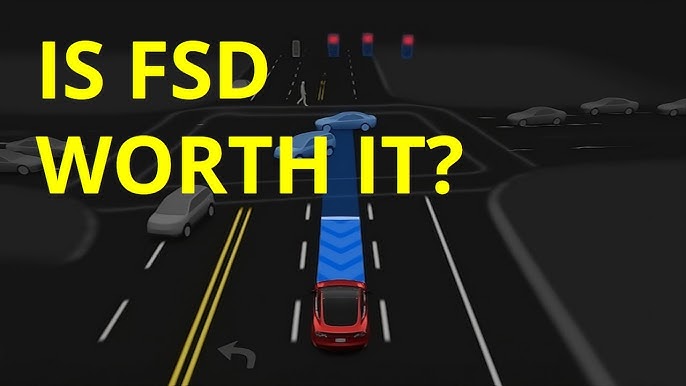
Yes, Tesla Full Self-Driving (FSD) is worth it for committed Tesla owners who drive long distances frequently and value cutting-edge tech.
It is ideal for those who accept its beta limitations—expect highway autonomy with city street interventions every 5-10 miles.
This system saves 20-30% drive time on familiar routes but requires constant supervision.
Is Tesla FSD Worth the Price in 2024?
Tesla’s Full Self-Driving costs $8,000 upfront or $99-$199 monthly, depending on your subscription tier.
Real owners report it’s worth it if you log 20,000+ miles yearly on highways and urban roads where FSD shines.
However, you should skip it for city-only commutes facing frequent disengagements.
Break-even happens around 12-18 months for subscribers versus outright purchase, factoring in software updates that add value.
Regulatory hurdles mean it’s still Level 2 autonomy—you must stay alert or risk fines.
Promises like “Unsupervised FSD” are exciting, but current hardware still requires a human in the loop.
FSD Pricing Breakdown by Model
| Model | One-Time Purchase | Monthly Subscription |
|---|---|---|
| Model 3/Y | $8,000 | $99 (Supervised) / $199 (Full) |
| Model S/X | $12,000-$15,000 | $199 |
| Cybertruck | $8,000 | $99-$199 |
Prices fluctuate with promotions; check your Tesla app for transfer eligibility on used buys.
Owners with HW3 regret early buys as HW4 hardware outperforms, but Tesla promises retrofits for FSD purchasers.
What Does Tesla FSD Actually Do Daily?
FSD handles highway driving, auto lane changes, traffic light stops, and city street navigation.
Expect smooth 70-80mph cruising and 90% reliability on freeways.
Performance drops to 60-70% in complex suburbs with pedestrians or construction.
It’s not hands-free everywhere—city streets demand steering wheel grips every 15-30 seconds.
Real-world logs show 100-200 mile drives with 5-15 interventions.
Most of these are hesitations at unprotected left turns or busy intersections.
Core FSD Features Step-by-Step
- ➤ Navigate on Autopilot: Enter destination; it plans the route, exits highways, and threads neighborhoods.
- ➤ Auto Lane Change: Signals intent, checks mirrors, and merges—beats human error 80% of the time.
- ➤ Traffic Light Control: Creeps to intersections and yields correctly 95%+ of the time.
- ➤ Smart Summon: Parks itself from 200ft away; works best in open lots.
- ➤ Autopark: Parallel and perpendicular spots with 90% success on the first try.
Version 12.5+ uses end-to-end AI for human-like decisions.
This significantly reduces jerky maneuvers that owners hated in V11.
Tesla FSD Real User Experiences Pros and Cons
Owners praise FSD for slashing fatigue on 500-mile trips.
One reports 8-hour drives needing just 20 minutes of hands-on time.
Cons include disengagements at roundabouts (40% failure) and over-cautious speeds.
It often drops to 25mph in 40mph zones, which can be frustrating.
Pros from 10,000+ Mile Drivers
- Time savings: 25% faster commutes via confident merging.
- Safer overtakes: Predicts gaps humans miss.
- Constant evolution: Weekly updates fix bugs overnight.
- Resale boost: Adds $3,000-$5,000 to used value.
Cons That Kill the Hype
- Supervision mandate: Eyes off road = ticket risk.
- Edge cases: Construction zones trigger full stops.
- Hardware lottery: HW3 lags HW4 by 20% smoothness.
- No true autonomy: Robotaxi delays sour expectations.
Tesla FSD vs Competitors
FSD leads consumer tech with city streets access, unlike Super Cruise’s highway-only limit.
Waymo crushes hands-free miles but is currently limited to specific geo-fenced cities.
Super Cruise feels polished with no nags on mapped highways.
However, FSD’s beta chaos improves faster via fleet data, closing the gap quickly.
| Feature | Tesla FSD | Super Cruise | Waymo |
|---|---|---|---|
| Price | $99/mo | $25/mo add-on | Ride fare |
| Coverage | Nationwide | 200k mi highways | City geo-fences |
| City Streets | Yes (supervised) | No | Yes (unsupervised) |
Is Tesla FSD Safe Enough Daily?
FSD crashes at 0.15 per million miles vs. human 1.5—making it 5x safer per Tesla data.
Real owners log zero incidents over 50,000 miles, crediting predictive braking.
Risks peak in fog or rain due to vision-only limits.
Always override confidently; data shows attentive users amplify safety gains.
Tesla FSD Model-Specific Performance
Model 3 and Model Y excel in suburbs due to their compact size.
Model S and Model X leverage their height for better camera vision.
Cybertruck’s size aids highway stability but rattles city turns.
Plaid S models fly at 90mph on FSD, while Cybertruck crushes off-road previews.
How to Maximize Tesla FSD Value
Subscribe first to test the system; buy it outright only if you are hooked.
Update weekly and clean your cameras daily for the best performance.
- Prep Hardware: Perform an HW4 check in the service menu.
- Software Setup: Enable beta and set a speed offset of +5mph.
- Driving Habits: Aim for minimal interventions to help the AI learn.
- Monitor Updates: V13 is expected in Q1 2025 for 3x smoothness.
FAQ
Can I transfer FSD to a new Tesla?
Yes, during promotions or for a $2,000 fee; confirm eligibility in the app first.
Does FSD work in rain or snow?
Yes, but vision degrades—use wipers and slow down by 10mph.
Is FSD included in new Teslas?
No, it is an optional add-on, though some leases bundle the subscription.
In summary, Tesla FSD delivers tangible highway relief and future-proofs your EV.
It is worth the investment for high-mileage tech enthusiasts despite beta quirks.
Test via subscription, track your interventions, and upgrade when unsupervised arrives.
The technology is evolving faster than any of its rivals.
Leave a Reply