
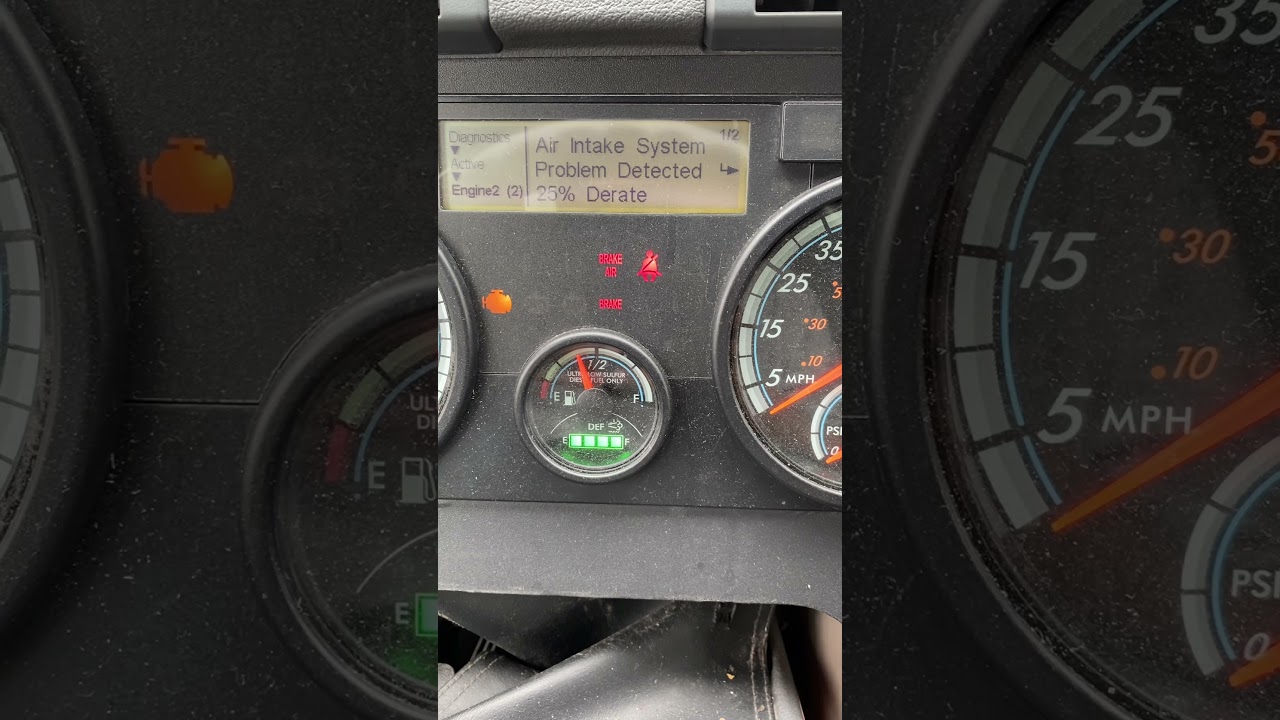
The “Air Intake System Problem Detected 25% Derate” fault code on Freightliner Cascadia and similar heavy-duty trucks typically indicates restricted airflow due to a clogged air filter, faulty intake manifold sensors, or leaks in the intake tract, triggering a 25% engine power reduction for safety.
What Does Air Intake System Problem Detected 25% Derate Mean?
This warning appears on the dashboard of Detroit DD13, DD15, or DD16 engines in Freightliner Cascadia trucks when the ECM detects insufficient airflow into the engine.
The 25% derate limits engine power to 75% to prevent damage from running lean, often accompanied by code SPN 102 FMI 3 or 4.
In real-world diagnostics, I’ve seen this hit drivers mid-haul on highways, forcing a limp mode that kills acceleration and torque.
Dealerships often quote $2,000+ for full intake overhauls, but independents fix 80% of cases under $200 by addressing the root cause first.
Common Symptoms Beyond the Warning Light
- Reduced power, especially uphill or when merging.
- Black smoke from exhaust due to incomplete combustion.
- High EGT readings over 1200°F under load.
- Active fault codes like SPN 102 (boost pressure), SPN 3510 (intake manifold pressure sensor).
- Regen frequency increases as the ECM struggles with efficiency.
Why It Triggers a 25% Derate Specifically
The ECM uses a derate table programmed by OEM to protect turbochargers and pistons from overheat or detonation.
At 25%, it’s the first threshold; ignore it, and it escalates to 50% or full shutdown.
Air Intake System Problem Detected 25% Derate Causes
The primary cause is airflow restriction below ECM thresholds, detected by MAP or boost sensors.
Most cases trace back to maintenance neglect, but sensor failures and physical damage play roles too.
1. Clogged or Dirty Air Filter (Most Common – 60% of Cases)
Dust from construction sites or off-road routes packs the filter, dropping intake pressure.
Even “high-capacity” filters clog faster in dirty environments, starving the turbo.
2. Faulty Intake Manifold Pressure (MAP) Sensor
This sensor measures post-turbo pressure; carbon buildup or wiring chafing sends false low readings.
Dealerships replace it unnecessarily without cleaning first.
3. Air Leaks in Intake Tract
Cracked hoses, loose clamps, or failed turbo inlet seals let unfiltered air bypass or cause turbulence.
High-boost engines amplify small leaks into big derates.
4. Turbocharger Inlet Restrictions or Damage
Bent fins from debris or oil sludge in the compressor wheel restricts flow.
Often misdiagnosed as a full turbo failure.
5. EGR System Cross-Contamination
EGR cooler leaks dump soot into the intake, mimicking filter clogs on DD15s.
How to Diagnose Air Intake System Problem 25% Derate Step by Step
Start with free visual checks before scanning—I’ve cleared this code countless times without a dealer tool.
Use a JPRO or DiagnosticLink scanner for codes, but basics work first.
- Park Safely and Inspect Air Filter: Pop the hood, remove the air filter housing. If it’s black with dust or oil-soaked, replace it immediately—don’t run the engine.
- Scan for Codes: Plug in your scanner. Note SPN 102 FMI 3 (low boost), FMI 4 (low signal), or SPN 2631 (MAP voltage).
- Check Boost Pressure Live Data: Idle the engine; boost should read 0-5 psi. Rev to 1500 RPM—should hit 20-30 psi. Below 15 psi points to restriction.
- Pressure Test Intake Tract: Use a manometer or shop vac on the intake post-filter. Look for 1+ inHg drop across components.
- Visual Leak Check: Spray soapy water on hoses/clamps while running. Bubbles mean leaks.
Tools You’ll Need for DIY Diagnosis
| Tool | Purpose | Cost |
|---|---|---|
| OBD-II Scanner (BlueDriver or JPRO Lite) | Read/clear codes, live data | $100-300 |
| Air Filter Wrench | Remove housing | $20 |
| Manometer Kit | Test restrictions | $50 |
| Soapy Water Spray Bottle | Leak detection | $5 |
Pro tip: Compare restricted side pressure to unrestricted. A 5+ inHg delta screams clog or leak.
Fix Air Intake System Problem Detected 25% Derate on Freightliner Cascadia DD15
For DD15-equipped Cascadias, focus on filter and sensors first.
These steps fixed it for dozens of OTR drivers I’ve guided.
Step 1: Replace Air Filter and Clean Housing
- Shut off engine, release hood struts.
- Loosen clamps on air intake tube, remove filter (note orientation).
- Blow out housing with compressed air (under 30 PSI to avoid damage).
- Install new OEM or Donaldson filter (PN A0000909251 for DD15).
- Reassemble, clear codes, test drive.
Step 2: Clean or Replace MAP Sensor (DD15 Specific)
Location: On intake manifold, post-EGR. Unplug, spray with MAF cleaner, dry fully.
If readings don’t normalize, replace (PN A0000908200, ~$150).
Step 3: Repair Intake Leaks
- Tighten all clamps to 60 in-lbs.
- Replace cracked silicone hoses (common at turbo inlet).
- Inspect charge air cooler for pinholes—pressure test at 30 PSI.
DD13 vs DD16 Air Intake Derate Fixes
DD13 has simpler intake but sensitive to EGR soot; DD16’s larger turbo amplifies restrictions.
DD13-Specific Fixes
- EGR differential pressure sensor often fails—clean first (location: EGR valve).
- Check plastic intake manifold for cracks (pre-2018 models).
- Turbo actuator calibration after fixes (use DiagnosticLink).
DD16-Specific Fixes
- Inspect larger air filter (PN A0000909951)—clogs faster in sand.
- Variable geometry turbo (VGT) vanes stick; command test via scanner.
- High-pressure EGR loop leaks common; replace gaskets.
How to Reset Air Intake System Problem 25% Derate After Fix
Clearing codes isn’t enough—run a key cycle and drive test to exit derate.
- Fix root cause.
- Turn key off 1 minute, restart.
- Idle 5 minutes, then highway run to 65 MPH for 10 minutes.
- Rescan—no codes, derate gone. If persistent, check for intermittent leaks.
Dealerships charge $150 for this; do it free.
Prevent Air Intake System Problem 25% Derate Recurrence
Service every 25,000 miles or sooner in dusty areas.
OEM filters last 40k, but aftermarket like Fleetguard fail early.
- Install pre-cleaners on air intakes for construction hauls.
- Monthly visual checks on hoses/clamps.
- Monitor boost/EGT via dash display—alerts before derate.
- Use fuel additives to reduce EGR soot.
Cost Comparison: DIY vs Shop
| Fix | DIY Cost | Shop Cost | Time |
|---|---|---|---|
| Air Filter | $50-80 | $250-400 | 15 min |
| MAP Sensor | $150 | $500-700 | 30 min |
| Full Intake Inspection | $0-200 | $800-1500 | 1-2 hrs |
FAQ
Will the truck derate further if I keep driving with 25%?
Yes, it can progress to 40% or shutdown within hours under load.
Pull over and diagnose immediately to avoid stranding.
Can a bad turbo cause this code?
Indirectly yes, if inlet restricted or VGT stuck.
Test boost first—low output confirms turbo issues.
Is this related to DPF/regen problems?
Often linked; low intake air forces frequent regens.
Fix intake to normalize.
Does aftermarket air filter fix prevent derates?
High-quality ones like Donaldson yes, cheap universals clog faster and void warranties.
How long to clear derate after filter change?
Usually 10-20 minutes of driving post-clear, but monitor for code return.
In summary, the air intake derate is a preventable issue rooted in airflow basics.
Diagnose methodically, fix DIY where possible, and maintain proactively to keep your Cascadia hauling without interruption.
Skip the dealer upsell—most fixes are straightforward with the right steps.
Leave a Reply