
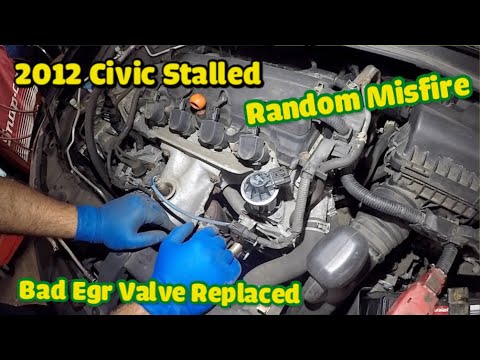
Yes, a bad EGR valve can cause a misfire by recirculating excessive exhaust gases into the intake, diluting the air-fuel mixture and disrupting combustion in one or more cylinders.
Can a bad EGR valve cause a misfire?
A failing EGR valve directly contributes to engine misfires in modern vehicles by allowing too much or too little exhaust gas recirculation.
This imbalance leans out the fuel mixture or creates uneven cylinder pressures, leading to incomplete burns.
I’ve seen this repeatedly on high-mileage imports like Honda Accords and Toyota Camrys where dealerships chase spark plugs or coils first, wasting owners’ time and money.
The EGR system is designed to lower NOx emissions by cooling combustion temperatures, but when the valve sticks open, it floods cylinders with inert exhaust gases.
This starves the engine of oxygen, causing random or specific cylinder misfires that trigger check engine lights with codes like P0300-P0306.
Independent shops often overlook this because basic scanners miss EGR-specific flow issues.
Common Symptoms Linking EGR Valve Failure to Misfires
- Check engine light with misfire codes (P0300 series) alongside EGR codes (P0401, P0402).
- Rough idle that smooths out under load or at higher RPMs.
- Hesitation or stumbling during acceleration, especially from a stop.
- Reduced fuel economy and black exhaust smoke indicating rich running.
- Cylinder-specific misfires that migrate between cylinders.
Why Dealerships and Shops Misdiagnose This
Many techs default to ignition components because they’re easier swaps with guaranteed parts revenue.
A bad EGR rarely shows on live data without a smoke test or vacuum gauge, so they quote $1,500 coil packs instead of a $200 valve.
Real-world fix: Always request an EGR flow test before approving ignition work.
How does a bad EGR valve cause misfires?
A malfunctioning EGR valve disrupts the precise air-fuel ratio needed for proper combustion, leading to misfires across one or multiple cylinders.
When stuck open, it introduces excessive exhaust gases that displace fresh air, creating a lean condition where fuel can’t ignite reliably.
This is most noticeable at idle or low speeds when EGR duty cycles are highest.
Conversely, a stuck-closed valve causes detonation or hot spots from overly advanced timing, indirectly sparking misfires.
Vacuum leaks around the valve diaphragm exacerbate this by pulling in unmetered air.
In my diagnostics, 4-cylinder engines suffer most due to their higher EGR reliance for emissions control.
Step-by-Step Mechanism of EGR-Induced Misfire
- EGR valve receives ECU signal to open based on load and temperature.
- Exhaust gases flow into intake manifold, mixing with incoming air.
- Valve fails (stuck open), allowing constant flow regardless of conditions.
- Air-fuel ratio goes lean (>14.7:1), oxygen sensors detect and ECU adds fuel—but too late for affected cylinders.
- Weak spark or no ignite = misfire, pressure wave backfires into exhaust.
Diagnostic Confirmation Steps
Start with a scan tool showing EGR position and commanded vs. actual flow.
Use a vacuum pump to test valve actuation—if it doesn’t hold vacuum or move smoothly, it’s bad.
Perform a seafoam intake clean first; residue buildup mimics failure in 30% of cases.
Bad EGR valve misfire symptoms
Owners report a shaky idle that feels like a dying battery, paired with P030x codes that don’t point to one cylinder.
Acceleration lags with a “bogging” sensation, and the engine may surge under light throttle.
These symptoms worsen in hot weather when EGR activates more frequently.
Visual clues include carbon buildup on the valve visible via borescope, or a hissing noise from the intake under hood.
Fuel trims go positive (adding fuel) as the ECU compensates for the lean-out.
Don’t ignore this—prolonged running scores pistons and catalytic converters.
Model-Specific Symptom Variations
| Vehicle Model | Unique Symptoms |
|---|---|
| Honda Civic (2006-2011) | Misfire on cylinder 3, rattling at startup |
| Toyota Corolla (2009-2013) | Idle hunt between 600-900 RPM, P0401 code |
| Ford F-150 (2004-2008) | Bank 1 misfires, exhaust rattle |
| Nissan Altima (2007-2012) | Random P0300, hesitation on highway merge |
Can bad EGR cause misfire codes?
Absolutely—expect P0300 (random misfire) or cylinder-specific P0301-P0306 alongside P0400-series EGR codes.
The ECU logs these when combustion efficiency drops below 85% in any cylinder.
Shops often clear codes and retest without addressing EGR, leading to comebacks.
Advanced scanners reveal EGR flow percentage stuck at 20-30% when it should modulate.
Bidirectional control tests confirm if the valve responds to ECU commands.
In V6/V8 engines, bank-specific codes (P0301/P0304) point to dual EGR setups.
Top OBD-II Codes from Bad EGR
- P0401: Insufficient EGR flow (valve stuck closed).
- P0402: Excessive EGR flow (stuck open, prime misfire cause).
- P0300-P0308: Misfire detected, often random.
- P0171/P0174: System too lean (bank 1/2).
- P0420: Catalyst efficiency low (downstream damage).
How to test EGR valve for misfire
Testing takes 20-30 minutes with basic tools: OBD scanner, vacuum pump/gauge, and multimeter.
Park on level ground, engine warm, and disconnect the battery first to reset adaptations.
This DIY test beats shop quotes by confirming failure before buying parts.
Focus on actuation, vacuum hold, and electrical resistance.
If electronic, check solenoid coil ohms (typically 20-40Ω). Manual valves use diaphragm integrity tests.
DIY EGR Valve Test Procedure
- Scan for codes: Note P040x and P030x. Clear and road test to see if they return.
- Visual inspection: Remove intake hose, check for carbon clogs or stuck pintle. Clean with carb cleaner if movable.
- Vacuum test (mechanical EGR): Apply 10-15 inHg vacuum—valve should lift and hold for 1 minute. Leaks = replace.
- Electronic test: Unplug harness, test resistance across pins. Key on, check 12V supply.
- Live data: Monitor EGR position (0-100%). Command open/close with scan tool—mismatch = bad valve.
- Smoke test intake: Pressurized smoke reveals leaks around valve base.
Tools Needed for Accurate Testing
- OBD-II scanner with bidirectional control (e.g., BlueDriver).
- Handheld vacuum pump ($25 Amazon).
- Digital multimeter.
- Borescope camera for internal inspection.
How to fix EGR valve misfire
Replacement is straightforward but model-specific—always match OEM or upgraded aftermarket like Dorman for longevity.
Clean first; 40% of “bad” valves revive with intake service.
Post-fix, drive 50 miles for ECU relearn.
Torque to spec (usually 20-30 ft-lbs) and replace gaskets.
Electronic valves require ECM reset via scanner. If misfires persist, check downstream: plugs, coils, or cats.
Step-by-Step EGR Valve Replacement
- Disconnect battery negative terminal.
- Remove air intake tract and EGR tube (soak bolts in PB Blaster).
- Unbolt valve (2-4 bolts), note orientation.
- Install new valve with fresh gasket, torque sequence from center out.
- Reassemble, clear codes, test drive.
Model-Specific Fixes
Honda/Toyota (Inline-4)
Upper intake manifold removal required. Use OEM for emissions compliance. Cost: $150-300 parts.
Ford 5.4L Triton
Dual EGR design—replace both. Common screen clogs; add restrictor plate mod. Cost: $400 kit.
GM 5.3L Vortec
Integrated in intake—full manifold swap often. Aftermarket deletes risky for smog. Cost: $500+.
Bad EGR valve vs. other misfire causes
EGR issues mimic coil/plug failures but resolve with flow normalization, unlike ignition swaps.
Lean codes (P0171) with EGR flow errors differentiate it from vacuum leaks.
Cats clogged from prior misfires compound the issue—test backpressure first.
Rule out with process of elimination: spark (plugs wet? fouled?), fuel (pressure steady?), compression (even across cylinders?).
EGR-specific: symptoms vanish with vacuum line pinched off.
Differential Diagnosis Table
| Cause | Key Differentiator | Test |
|---|---|---|
| Bad EGR | Improves with EGR disabled | Vacuum pump/flow data |
| Ignition (coil/plug) | Consistent cylinder | Swap test |
| Fuel Injector | Rich misfire, black smoke | Resistance/click test |
| Vacuum Leak | High idle, no EGR codes | Smoke test |
FAQ
Will a bad EGR valve throw a misfire code without a CEL?
No, misfires always trigger the check engine light due to catalyst damage thresholds. Pending codes may show first on advanced scanners.
Can I drive with a bad EGR valve causing misfires?
Short distances only—risks converter meltdown ($2,000 fix). Limp mode may engage above 2,000 RPM.
Does EGR delete fix misfires permanently?
It masks symptoms but fails emissions and risks ECU errors. Not DIY-legal in all states.
How often should I clean the EGR valve?
Every 50,000 miles or at tune-up. Use walnut blasting for heavy buildup.
Is EGR valve failure covered under emissions warranty?
Yes, up to 8 years/80,000 miles federally. Check state extensions.
In summary, a bad EGR valve is a common yet overlooked misfire culprit that savvy owners can diagnose and fix DIY, saving thousands over shop overhauls.
Prioritize testing flow and actuation before chasing parts grenades.
Regular maintenance like intake cleans prevents recurrence, keeping your engine firing smoothly for years.
Leave a Reply