
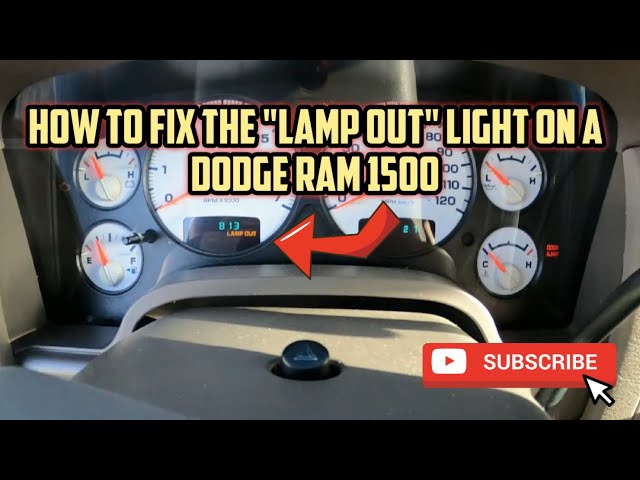
The “Lamp Out” warning on a Dodge Ram means the Body Control Module (BCM) has detected a bulb on your exterior lighting circuit that is either burned out, drawing too little current, or has a poor connection at the socket. In many cases, the bulb looks fine visually but has a failing filament or corroded socket causing abnormal resistance. Swapping to LED bulbs without a resistor or decoder will also trigger this warning because LEDs draw far less amperage than the BCM expects.
What Does “Lamp Out” Mean on a Dodge Ram?
The “Lamp Out” message on your Dodge Ram’s EVIC (Electronic Vehicle Information Center) display means the truck’s Body Control Module has detected an open or underperforming circuit on one of your exterior lamps. This system works by monitoring current draw—not by checking if a bulb is physically broken. That distinction matters because it explains why so many owners get frustrated chasing this warning.
On most Rams from 2002 through 2018, the BCM sends a small voltage pulse to each lighting circuit and measures the return current. A standard incandescent 3157 or 3057 bulb draws roughly 26 watts. If the current returning to the BCM falls below a calibrated threshold, it assumes the bulb is out and throws the warning on your dash.
The critical thing to understand is that a bulb can still light up and still trigger this warning. If the filament is partially broken, corroded, or the socket has high resistance, the bulb might glow dimly but not draw enough current to satisfy the BCM. This is the single most common reason owners get confused.
Exterior Bulbs Monitored by the BCM
- Tail lights (running lights)
- Brake lights
- Turn signals (front and rear)
- Reverse lights
- License plate lights
- Side marker lights
- Third brake light (CHMSL)
Not all model years monitor every single bulb. On the 2002–2005 third-generation Ram, the system monitors tail and brake lights primarily.
The 2006–2008 models expanded coverage. The 2009+ fourth-generation trucks with the TIPM monitor virtually every exterior lamp.
Why Does My Dodge Ram Say “Lamp Out” but All Lights Work?
This is the number one complaint on Ram forums, and it happens because the BCM is checking current draw, not whether a bulb physically glows. A bulb can light up with a failing filament, corroded socket, or partial ground and still fall below the BCM’s amperage threshold.
Walk around your truck at night with the parking lights on. Have someone press the brake pedal and hit the turn signals.
Look closely—sometimes a bulb that appears “on” is visibly dimmer than the one on the other side. That dimness is the telltale sign of high resistance somewhere in the circuit.
Common Hidden Causes When Bulbs Appear Fine
- Corroded bulb sockets — Water intrusion into the tail light housings causes green corrosion on the socket contacts. The bulb still touches the contacts enough to glow but not enough to draw full current.
- Heat-damaged socket terminals — The socket plastic melts slightly from years of heat cycling, warping the contacts away from the bulb base pins.
- Partial filament failure — A dual-filament bulb like the 3157 can have one filament intact and one broken. The running light works but the brake filament is gone, or vice versa.
- Bad ground point — The tail light ground wire bolts to the truck bed or frame. Corrosion at that ground bolt creates resistance across the entire circuit.
- Aftermarket LED bulbs without resistors — LEDs draw 2-3 watts versus 26 watts for incandescents. The BCM sees this as an open circuit.
How to Find Which Bulb Is Triggering the Lamp Out Warning
The EVIC does not tell you which specific bulb is causing the problem. You need to systematically check each one. Here is the method that works reliably in the real world.
Step-by-Step Bulb Inspection Method
- Turn on your parking lights (headlights in the “on” position). Walk around the truck and note which bulbs are on. Compare left to right for brightness. A dimmer bulb on one side is your culprit.
- Have someone press the brake pedal. Check all three brake lights—left, right, and center high-mount. Any that are dim or not working are suspects.
- Activate each turn signal individually. Watch both the front and rear. A fast-blinking turn signal often indicates an open circuit on that side.
- Check reverse lights with the truck in reverse (key on, parking brake set).
- Check license plate lights. These are frequently overlooked and are a common trigger.
- Inspect side markers and front turn signals.
If everything looks correct visually, pull each bulb and inspect the socket and bulb base for corrosion, blackening, or melting. Use a multimeter set to ohms and check continuity across each bulb. A good 3157 bulb reads roughly 2.5 ohms on one filament and around 6-8 ohms on the other.
How to Fix Dodge Ram Lamp Out Warning by Bulb Type
Standard Incandescent Bulb Replacement
If you find a burned-out or weak incandescent bulb, replace it with an OEM-spec bulb. For tail and brake applications on most Rams, that is a 3157 or 3057 depending on model year.
Do not use cheap dollar-store bulbs—use Sylvania, Philips, or Wagner. Cheap bulbs have thinner filaments that fail prematurely and cause this warning to return within weeks.
While you have the bulb out, spray the socket with electrical contact cleaner and use a small pick or wire brush to clean the contact tabs inside the socket. Apply a thin layer of dielectric grease before installing the new bulb. This prevents future corrosion and is the single most effective long-term fix.
LED Bulb Swap Problems and Solutions
If you have installed LED replacement bulbs, this is almost certainly your problem. The Dodge Ram BCM uses current-sensing to detect lamp status.
LEDs draw roughly one-tenth the current of incandescent bulbs. The BCM interprets this as a burned-out bulb.
Solution 1: Load Resistors
Wire a 6-ohm, 50-watt load resistor in parallel with each LED bulb. This creates an artificial load that mimics incandescent current draw.
Mount the resistor to metal using the included screws—these get extremely hot. This is the cheapest fix but adds wiring complexity.
Solution 2: CAN Bus Compatible LED Bulbs
Some LED bulbs are built with internal resistors or decoders specifically for CAN bus systems like the Ram uses. Look for bulbs marketed as “CAN bus error-free” or “decoder built in.” These work on many Rams but not all—some model years are more sensitive than others.
Solution 3: Flash the BCM with a Dealer Tool or AlphaOBD
On 2009+ Rams, the BCM can be reprogrammed using AlphaOBD software and an OBDLink MX+ adapter to change the bulb type configuration from incandescent to LED. This tells the BCM to expect lower current draw. This is the cleanest solution but requires technical confidence with the software.
Dodge Ram Lamp Out Fix by Model Year
2002–2005 Ram 1500/2500/3500
These trucks use the first-generation lamp monitoring system. The most common culprit is the tail light socket on the driver side.
The housing collects water through the lens gasket and corrodes the socket from the inside. Replace the entire socket pigtail assembly (Dorman 645-702 for the common 3157 socket) rather than just the bulb.
The ground wire on these trucks attaches to a bolt on the inner bed wall behind the tail light. Remove the bolt, sand the contact area to bare metal, apply dielectric grease, and reattach. This fixes a surprising number of false lamp out warnings.
2006–2008 Ram 1500/2500/3500
These trucks introduced the multiplex wiring system with a centralized BCM. The lamp out system is more sensitive and monitors more circuits.
A common failure point is the trailer harness connection. If you have an aftermarket or factory trailer plug, corrosion in that connector feeds back into the BCM monitoring circuit and triggers false warnings.
Unplug the trailer harness connector behind the rear bumper, clean it with contact cleaner, and apply dielectric grease.
2009–2018 Ram 1500/2500/3500
These trucks use the TIPM (Totally Integrated Power Module) which controls all exterior lighting. TIPM-related lamp out warnings are more complex.
If you have confirmed all bulbs and sockets are good, the TIPM itself may be the problem. This was common enough that Ram issued a TSB for certain year models.
How to Reset the Dodge Ram Lamp Out Warning
After fixing the underlying issue, the lamp out message should clear automatically after the BCM detects normal current draw for several ignition cycles—usually 3 to 5 cycles. If the message persists after you have verified the repair is correct:
- Disconnect the negative battery cable for 15 minutes. This resets the BCM.
- Reconnect and start the truck. Turn on the headlights and cycle through brake and turn signals.
- If the warning returns immediately, the issue is not fixed—go back and recheck your work.
For 2009+ trucks with a TIPM, you can also use an OBD-II scanner with BCM access to clear the stored DTC. Common codes for lamp out include B1503, B1504, B1505, B1506 and related codes for individual lamp circuits.
Preventing the Lamp Out Warning from Coming Back
Routine Socket Maintenance
Every time you rotate your tires or do an oil change, pop the tail light housings out and inspect the sockets. Clean any early signs of corrosion.
Apply dielectric grease to the bulb bases and socket contacts. This five-minute task prevents 90 percent of lamp out issues.
Seal the Tail Light Housings
On 2002–2012 Rams, the tail light housings are not perfectly sealed. Water enters through the lens seam and collects in the socket area.
After removing and cleaning the housings, run a thin bead of clear silicone sealant around the lens-to-housing seam. This keeps moisture out permanently.
Use Quality Bulbs
Incandescent bulbs from reputable manufacturers last longer and maintain proper current draw throughout their lifespan. Budget bulbs degrade faster, causing intermittent lamp out warnings before they fully fail.
Frequently Asked Questions
Can a blown fuse cause the Dodge Ram lamp out warning?
A blown fuse will cause an entire circuit to go dead, which will definitely trigger the lamp out warning. However, if the fuse is blown, the associated bulbs will not work at all. If your bulbs are lighting up but you still get the warning, the fuse is not your problem.
Will disconnecting the battery clear the lamp out warning permanently?
Disconnecting the battery resets the BCM and clears the warning temporarily. If the underlying issue—a bad bulb, corroded socket, or incorrect LED—is still present, the warning will return within a few driving cycles. You must fix the root cause first.
Why does my Ram lamp out warning come on only when it rains or is humid?
This is a classic sign of moisture intrusion into a tail light housing or trailer plug connector. Water creates a partial short or changes the resistance in the circuit just enough to drop below the BCM’s threshold. Inspect your tail light housing gaskets and 7-pin trailer connector for water damage.
Can a bad TIPM cause a false lamp out warning on a Dodge Ram?
Yes. On 2009 and newer Rams, the TIPM controls all exterior lighting.
Internal TIPM faults—including bad solder joints on the circuit board or degraded internal relays—can produce false lamp out warnings even when every bulb and socket checks out perfectly. This was documented in multiple TSBs from Ram for the 2009–2013 model years.
Do LED bulbs with built-in decoders actually work on Dodge Rams?
They work on some model years but not all. The 2006–2008 trucks are the most tolerant of CAN bus compatible LEDs.
The 2009+ trucks with TIPM are hit or miss—some owners report success while others still get warnings. The most reliable solution for 2009+ trucks is flashing the BCM with AlphaOBD to change the bulb type setting.
Fix It Right the First Time
The Dodge Ram lamp out warning is almost never a serious electrical problem. In the vast majority of cases, it comes down to a corroded socket, a cheap bulb, or an LED swap without proper resistors or BCM programming.
Systematically inspect every exterior bulb and socket, clean your grounds, and use quality parts. Most owners can diagnose and fix this problem in under an hour with basic hand tools and a can of electrical contact cleaner.
If you have verified every bulb, socket, and ground and the warning still persists on a 2009+ truck, that is when you start looking at the TIPM as the culprit—but always rule out the simple stuff first.
Leave a Reply