
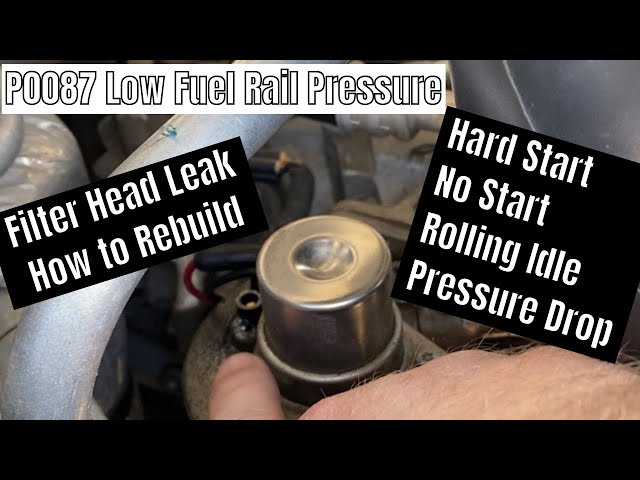
On a 6.6L Duramax diesel engine, the P0087 diagnostic trouble code (DTC) indicates that the Fuel Rail Pressure (FRP) has dropped below the commanded threshold set by the Engine Control Module (ECM). This low-pressure condition is most commonly caused by a collapsing soft rubber fuel line, a vacuum leak at the fuel filter primer housing, a weak fuel pressure relief valve (PRV) bypassing fuel back to the tank, or a failing high-pressure injection pump (CP3 or CP4).
What is the Duramax P0087 Code and What Triggers It?
The P0087 code triggers when the actual fuel rail pressure falls at least 1,450 PSI (10 MPa) below the target pressure commanded by the ECM for more than five consecutive seconds. This discrepancy typically occurs under heavy engine loads, such as towing uphill or during hard acceleration, when fuel demand is at its peak.
When the ECM detects this pressure drop, it immediately commands “Reduced Engine Power” mode (limp mode) to protect the high-pressure fuel system from catastrophic lubrication failure.
To understand why this happens, you must understand the unique architecture of the pre-2017 Duramax fuel system (LB7, LLY, LBZ, LMM, and LML engines). Unlike most modern diesel engines, these Duramax generations do not feature a factory low-pressure lift pump in the fuel tank.
Instead, the high-pressure injection pump mounted on the engine must pull fuel all the way from the fuel tank under a deep vacuum. This suction-based design makes the system incredibly sensitive to any restriction, air intrusion, or component wear along the entire fuel supply line.
When a restriction or leak occurs on the vacuum side of the system, the high-pressure pump cannot pull enough fuel to meet demand. As a result, the fuel rail pressure drops, the engine stumbles, and the ECM stores the P0087 code.
Dealerships often misdiagnose this issue as a failing high-pressure pump, resulting in unnecessary and highly expensive repair quotes when the actual culprit is often a simple low-pressure side fault.
What Are the Common Causes of P0087 on a Duramax?
The most common causes of a P0087 code on a Duramax include a clogged fuel filter, cracked seals in the fuel filter primer housing, collapsed soft rubber fuel supply lines, a fatigued fuel pressure relief valve (PRV), or a failing high-pressure injection pump.
Identifying the exact cause requires a systematic diagnostic approach rather than throwing expensive parts at the vehicle.
1. Clogged Fuel Filter or Cracked Primer Housing
Because the Duramax fuel system relies on vacuum to pull fuel, a partially clogged fuel filter will quickly starve the high-pressure pump under load. Additionally, the factory fuel filter housing features a hand-primer pump with internal rubber O-rings and a plastic air bleed screw.
Over time, these rubber seals dry out and crack, allowing air to be sucked into the fuel system. Because the system is under vacuum rather than pressure, fuel will not leak out to warn you; instead, air is drawn in silently, causing cavitation and pressure drops.
2. Collapsed Soft Rubber Fuel Supply Lines
GM utilized soft rubber hoses to transition the fuel lines from the metal frame rails to the engine intake valley. Over years of thermal cycling and exposure to modern diesel fuels, these rubber hoses soften and lose their structural integrity.
Under high fuel demand, the suction generated by the injection pump becomes so strong that it literally collapses these soft hoses shut. This restriction cuts off fuel supply completely, instantly triggering the P0087 code and sending the truck into limp mode.
3. Fatigued Fuel Pressure Relief Valve (PRV)
The fuel pressure relief valve is a mechanical safety valve located at the back of the driver’s side fuel rail. It is designed to pop open and dump fuel back into the return line if system pressure exceeds safe limits (typically around 26,000 to 29,000 PSI depending on the model).
Over time, the internal spring inside this valve weakens and fatigues. Consequently, the valve begins to pop open at much lower pressures, constantly bleeding off essential fuel pressure back to the tank during heavy acceleration.
4. Failing CP3 or CP4 High-Pressure Fuel Pump
If the low-pressure supply side is functioning perfectly, the issue may lie within the high-pressure pump itself. On LB7, LLY, LBZ, and LMM engines, the Bosch CP3 pump is highly durable but can eventually wear out after high mileage, losing its ability to pump high volumes.
On 2011–2016 LML engines, the Bosch CP4 pump is notorious for catastrophic internal failure.
Due to a lack of lubrication from dry US ultra-low sulfur diesel (ULSD), the CP4 lifter bucket can rotate, causing metal-on-metal shaving that destroys the pump and sends metal debris throughout the entire fuel system.
How to Diagnose Duramax P0087 Step-by-Step
Diagnosing a P0087 code systematically will save you thousands of dollars in unnecessary parts. Follow this professional diagnostic sequence to isolate the exact component failure on your Duramax.
Step 1: Perform a Visual Inspection and Vacuum Test
Begin by inspecting the soft rubber fuel lines located near the driver’s side valve cover and behind the fuel filter housing near the transmission bell housing. Look for hoses that appear kinked, soft, or pinched.
Next, inspect the fuel filter housing for any signs of wetness around the primer bulb, water-in-fuel sensor, or plastic bleed screw.
To verify a low-pressure restriction, install a vacuum gauge in the fuel supply line using a test port adapter; a healthy system should pull no more than 5 inches of mercury (Hg) under load, while a restriction will pull over 10 inches of Hg.
Step 2: Perform the Fuel Pressure Relief Valve “Bottle Test”
The “bottle test” is the definitive diagnostic method to determine if your fuel pressure relief valve is leaking fuel back to the tank prematurely. This test isolates the PRV return circuit to see if fuel is bypassing the valve when it should be closed.
- Locate the valve: Locate the fuel pressure relief valve at the back of the driver’s side fuel rail.
- Disconnect the line: Disconnect the rubber fuel return line from the metal pipe connected to the PRV.
- Plug the return: Plug the disconnected return line to prevent fuel from spilling from the return circuit.
- Attach tubing: Attach a length of clear, fuel-rated vinyl tubing to the nipple of the PRV.
- Route to bottle: Route the other end of the vinyl tubing into a clean, dry plastic bottle and secure it safely in the engine bay.
- Test drive: Drive the truck and attempt to duplicate the conditions that trigger the P0087 code (e.g., hard acceleration or hill climbing).
- Inspect results: Inspect the bottle: if there is any fuel in the bottle, your PRV is weak and must be shimmed or replaced. A healthy valve will leave the bottle completely dry.
Step 3: Monitor Commanded vs. Actual Fuel Rail Pressure
Connect a high-quality OBD-II scan tool capable of reading live data stream parameters. Set up a data log to monitor “Commanded Fuel Rail Pressure” alongside “Actual Fuel Rail Pressure” and “Fuel Pressure Regulator Current (mA).”
Take the vehicle for a test drive and perform a wide-open throttle run. If the commanded pressure rises to 26,000 PSI but the actual pressure struggles to exceed 18,000 PSI while the regulator current is maxed out, you have confirmed a physical pressure delivery issue rather than a sensor calibration error.
Duramax Generation-Specific Solutions for P0087
Because GM updated the Duramax fuel system architecture across different model years, the most effective solution for a P0087 code depends heavily on your specific engine generation.
| Engine Code | Model Years | High-Pressure Pump | Primary P0087 Culprit | Recommended Solution |
|---|---|---|---|---|
| LLY / LBZ | 2004.5–2007 | Bosch CP3 | Weak PRV / Collapsing soft fuel lines | Install PRV Shim Kit & replace soft lines |
| LMM | 2007.5–2010 | Bosch CP3 | Cracked fuel filter housing / Weak PRV | Rebuild filter housing & add aftermarket lift pump |
| LML | 2011–2016 | Bosch CP4.2 | CP4 Pump failure / Internal system contamination | CP3 Conversion Kit & complete fuel system flush |
| L5P | 2017–Present | Denso HP4 | Clogged fuel filter / Sensor wiring fault | Replace fuel filter & check harness routing |
LLY & LBZ Engines (2004.5–2007)
On LLY and LBZ engines, focus your efforts on the soft rubber fuel lines and the mechanical pressure relief valve. The factory rubber lines behind the fuel filter housing are highly prone to softening and collapsing under vacuum.
Replacing these sections with heavy-duty, reinforced fuel hose (such as Gates Barricade) is a highly effective, low-cost fix. Additionally, the PRV on these models is notorious for weakening early; installing a shim kit or a high-quality replacement valve resolves this issue permanently.
LMM Engines (2007.5–2010)
The LMM generation frequently suffers from air intrusion at the fuel filter housing. The plastic bleed screw often cracks due to over-tightening during routine maintenance, and the hand-primer pump seals degrade.
Rebuilding the housing with high-temperature Viton O-rings and replacing the plastic bleed screw with an anodized aluminum version is the recommended course of action. Installing an aftermarket lift pump on this generation completely eliminates the vacuum side of the system, preventing air leaks from ever occurring.
LML Engines (2011–2016)
The LML engine requires extreme caution when diagnosing a P0087 code. Because this generation uses the fragile Bosch CP4.2 pump, a P0087 code can be the first warning sign of an impending catastrophic pump failure.
Remove the Fuel Pressure Regulator (FPR) from the top of the CP4 pump and inspect the screen underneath. If you find shiny metal shavings or “glitter” on the screen, the pump has failed internally.
In this scenario, you must replace the entire fuel system, including the pump, injectors, lines, and rails. To prevent this, many owners install a CP3 conversion kit to replace the CP4 with the older, ultra-reliable CP3 pump.
L5P Engines (2017–Present)
The L5P generation represents a massive shift because GM finally added a factory electric lift pump mounted in the fuel tank. Consequently, vacuum-side collapsing lines and primer pump air leaks are virtually non-existent on these trucks.
If you trigger a P0087 on an L5P, the issue is almost always a severely clogged fuel filter, a faulty Fuel Rail Pressure Sensor, or a wiring harness chaffing issue. Check the wiring harness running near the alternator and AC compressor, as it is known to rub against metal brackets and short out the sensor signals.
How to Fix P0087 Permanently (Upgrades & Preventive Maintenance)
If you want to ensure your Duramax never suffers from a P0087 code or limp mode again, you should implement these proven aftermarket upgrades and preventative maintenance steps.
1. Install an Aftermarket Positive-Pressure Lift Pump
“The single best upgrade you can perform on a pre-2017 Duramax is the installation of an aftermarket electric lift pump, such as a FASS or AirDog system.”
An aftermarket lift pump mounts near the fuel tank and pushes fuel forward to the engine under positive pressure (usually 8 to 10 PSI). This completely eliminates the suction-vacuum dynamic that causes fuel lines to collapse and air to enter the system.
Furthermore, these lift pumps feature advanced water separation and air-separation filtration systems, ensuring that only pure, pressurized fuel reaches your expensive high-pressure injection pump. This dramatically extends the life of your CP3 or CP4 pump while permanently resolving P0087 issues.
2. Perform the PRV Shim Kit Modification
If your bottle test confirmed that the fuel pressure relief valve is releasing pressure prematurely, you can fix it permanently using a PRV shim kit. This DIY-friendly kit contains small, highly precise stainless steel washers that are inserted inside the valve body behind the internal spring.
By adding these shims, you increase the spring tension, raising the pressure threshold required for the valve to open. This prevents the valve from popping under heavy acceleration while maintaining it as an active safety device.
Avoid using “race plugs” (which block the passage completely) on street-driven vehicles, as they eliminate the safety relief mechanism entirely, risking damage to other fuel system components during an over-pressure event.
3. Rebuild or Replace the Fuel Filter Housing
If you choose not to install an aftermarket lift pump, you must ensure your factory fuel filter housing is in pristine condition. Purchase a high-quality rebuild kit that includes new Viton O-rings for the hand-primer plunger, the fuel heater connector, and the filter mounting interface.
When reassembling, replace the fragile plastic air bleed screw with a high-quality brass or aluminum screw. Ensure you lubricate the new O-rings with clean diesel fuel during installation to prevent them from tearing or binding, which would create a new path for air intrusion.
Frequently Asked Questions (FAQs)
Can I drive my Duramax with a P0087 code active?
You should avoid driving your Duramax with an active P0087 code, especially when towing or hauling. The low fuel pressure causes the engine to run lean, which increases exhaust gas temperatures (EGTs) and can lead to piston damage.
Additionally, if the high-pressure pump is starved of fuel, it lacks the necessary lubrication provided by the diesel fuel itself, which can cause internal pump failure and ruin your entire fuel system.
Will a bad fuel pressure sensor cause a P0087 code?
Yes, a failing or biased Fuel Rail Pressure (FRP) sensor can send inaccurate voltage readings to the ECM, indicating that fuel pressure is low when it is actually within normal operating specs. However, this is far less common than physical fuel starvation.
You can verify sensor health by comparing the sensor reading with a physical mechanical pressure gauge connected to the fuel rail diagnostic port while the engine is idling.
How much does it cost to fix a P0087 code on a Duramax?
The repair cost varies wildly depending on the root cause. If the issue is a collapsed rubber hose or a cracked primer housing seal, the DIY repair cost is under $50.
If you need to install an aftermarket lift pump to resolve vacuum issues permanently, expect to spend $700 to $900 in parts.
However, if the code is caused by a catastrophic CP4 pump failure on an LML engine, the complete system replacement can cost between $8,000 and $10,000 at a professional shop.
Does adding a fuel additive prevent the P0087 code?
Using a high-quality fuel additive that improves lubricity and cetane can help prevent P0087 codes caused by internal pump wear, especially on CP4-equipped LML engines. US diesel fuel has lower lubricity standards than European diesel, which accelerates wear on precision injection components.
A lubricity additive protects the internal components of the high-pressure pump, ensuring it can maintain target pressures over high mileages.
Conclusion
The Duramax P0087 code is a frustrating but highly solvable issue when approached with a methodical diagnostic mindset. By understanding that pre-2017 Duramax engines operate on a vacuum-side fuel supply system, you can easily trace the fault to common weaknesses like collapsing rubber hoses, leaking filter housings, or a fatigued pressure relief valve.
Implementing permanent upgrades like an aftermarket lift pump or a PRV shim kit not only clears the P0087 code permanently but also protects your high-pressure fuel system from future wear, ensuring your Duramax remains reliable for hundreds of thousands of miles to come.
Leave a Reply