
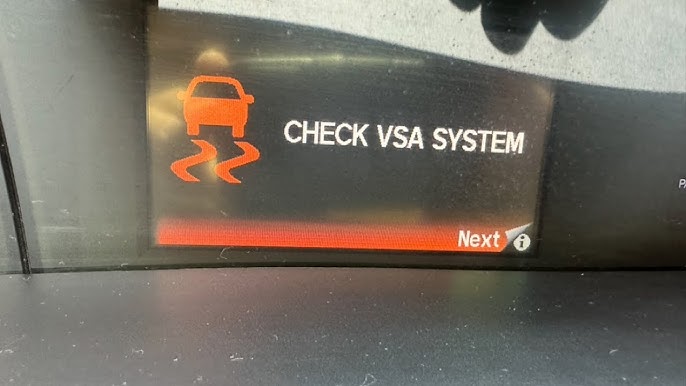
The “Check VSA System” warning on a Honda Civic means the Vehicle Stability Assist system has detected a fault and disabled itself. Common causes include a faulty ABS wheel speed sensor, low brake fluid, a bad steering angle sensor, or a failing VSA modulator. The vehicle is still drivable but lacks stability control and traction assistance until the fault is fixed.
What Does “Check VSA System” Mean on a Honda Civic?
The VSA (Vehicle Stability Assist) warning means your Civic’s stability control and traction control systems are disabled due to a detected fault. The system relies on input from multiple sensors and modules to function, and when any single component sends an out-of-range signal, the VSA light triggers and the system shuts down as a safety precaution.
You will typically see the amber triangle warning light, the VSA indicator, and sometimes the ABS light illuminate together on the dashboard. The car will still drive normally under everyday conditions, but you lose the safety net that prevents wheel slip, oversteer, and understeer during emergency maneuvers or slippery conditions.
The VSA system on Honda Civics is not just traction control — it also integrates with the ABS, electronic brake distribution, and brake assist. A VSA fault almost always means other systems are affected too.
What Causes the Check VSA System Warning on a Honda Civic?
The most common cause is a failed ABS wheel speed sensor, followed by low brake fluid, a faulty steering angle sensor, or a bad VSA modulator. However, dozens of other faults can trigger this warning. Below is a full breakdown of every known cause, organized by frequency.
1. Faulty ABS Wheel Speed Sensor
This is the number one cause on Honda Civics from 2006 through 2021 model years. The wheel speed sensors read each wheel’s rotational speed and send that data to the VSA control unit. When one sensor fails or reads incorrectly, the VSA system cannot determine wheel slip and shuts down entirely.
Diagnosis is straightforward with an OBD-II scanner that reads ABS codes. You will see codes like 11-1, 11-2, 11-3, or 11-4, which correspond to the right front, left front, right rear, and left rear sensors respectively. On some newer models, codes will read as C0031 through C0038.
2. Low Brake Fluid Level
The VSA system shares the hydraulic brake circuit. If the fluid drops below the minimum mark in the reservoir, the pressure sensor reads a fault and triggers the VSA warning. This is the simplest and cheapest fix — top off with DOT 3 brake fluid to the max line.
However, do not just top it off and forget about it. Low brake fluid means either your brake pads are worn down significantly, or you have a leak somewhere in the system. Inspect the pads and all brake lines before moving on.
3. Faulty Steering Angle Sensor
The steering angle sensor tells the VSA system where the driver intends to steer. If it fails or loses calibration, the VSA control unit receives conflicting data and disables the system. This often happens after wheel alignments, steering column work, or battery replacements.
4. Bad VSA Modulator or Control Unit
The VSA modulator is the hydraulic unit that actually applies brake pressure to individual wheels. On 8th and 9th generation Civics (2006–2015), these modules are known to fail internally. Common symptoms include the VSA light staying on permanently, ABS codes pointing to the modulator, and sometimes a spongy or inconsistent brake pedal feel.
5. Brake Light Switch Failure
The brake light switch tells the VSA system when you are applying the brakes. A faulty switch sends erratic signals or no signal at all, confusing the VSA controller. This is a cheap part (usually under $20) and easy to replace behind the brake pedal.
6. Weak Battery or Charging System Faults
Low voltage confuses module communication across the CAN bus. If your battery is marginal or your alternator is underperforming, the VSA system may throw intermittent warnings that disappear once the engine is running and charging properly. Always test battery voltage before chasing sensor faults.
7. Damaged Wiring or Corroded Connectors
Wheel speed sensor wiring harnesses run through exposed areas near the suspension. Road debris, salt, moisture, and general aging can damage these wires or corrode the connector pins. A visual inspection of the harness at each wheel often reveals the problem.
How to Diagnose the VSA Warning on a Honda Civic at Home
You can narrow down the fault with a basic OBD-II scanner and a multimeter. Most sub-$50 Bluetooth scanners paired with apps like Torque Pro or Car Scanner will read ABS and VSA codes. Here is the step-by-step process professionals use.
- Read Codes: Connect the OBD-II scanner and read all stored ABS/VSA fault codes. Write down every code, including pending ones.
- Check Brake Fluid: Check brake fluid level in the reservoir. Top off if low, then recheck the warning after a short drive.
- Inspect Sensors: Inspect all four wheel speed sensors for physical damage, loose mounting, or debris buildup on the sensor tip.
- Test Resistance: Measure resistance of each wheel speed sensor with a multimeter. Most Honda wheel speed sensors should read between 800 and 1400 ohms. An open circuit or near-zero reading means the sensor is bad.
- Battery Voltage: Check battery voltage with the engine off. It should read at least 12.4V. Start the engine and verify the alternator is charging between 13.5V and 14.5V.
- Steering Sensor Calibration: If codes point to the steering angle sensor, check if a calibration procedure resolves the fault. On most Civics, turn the steering wheel fully left, then fully right, then center it and drive straight for 30 seconds.
How to Fix the Check VSA System on Different Honda Civic Generations
Different Civic generations have different known weak points. Here is what to focus on based on your model year.
2006–2011 Honda Civic (8th Generation)
These models are notorious for VSA modulator failures. The ABS/VSA modulator unit sits in the engine bay near the firewall and is prone to internal electronic failure.
If your scanner shows code 66-1 (VSA solenoid valve failure), the modulator needs replacement. Dealers quote $1,200 to $1,800 for the part and labor, but a remanufactured unit from a reputable supplier costs $300 to $500 and can be installed in under two hours with basic tools.
2012–2015 Honda Civic (9th Generation)
Wheel speed sensor failures dominate this generation. The rear sensors are especially vulnerable because the wiring harness runs close to the rear suspension components and gets snagged or damaged. Replacement sensors cost $30 to $60 each and take about 30 minutes per side with jack stands.
2016–2021 Honda Civic (10th Generation)
The 10th generation introduced a more integrated VSA system that ties into the electric power steering module. Steering angle sensor recalibration is more common here, especially after alignments or tire replacements. Battery-related VSA warnings are also more frequent due to the increased electrical demands of the newer electronics.
2022+ Honda Civic (11th Generation)
These models use a fully integrated vehicle dynamics control system. The VSA warning can trigger from the newer camera-based sensor fusion system used for Honda Sensing.
If the forward-facing camera is misaligned or the windshield is replaced without recalibration, the VSA system can fault. Dealer-level calibration or a quality independent shop with a Honda diagnostic tool is required.
How Much Does It Cost to Fix the Check VSA System on a Honda Civic?
Can You Drive a Honda Civic with the VSA Light On?
Yes, the vehicle is safe to drive under normal conditions. However, you lose stability control, traction control, and in some cases ABS function depending on what triggered the fault. In wet, icy, or emergency driving situations, these disabled systems significantly increase the risk of losing control.
Drive cautiously and avoid aggressive maneuvers until the fault is diagnosed and repaired. The longer the system stays disabled, the more likely you are to forget it is off and get caught off guard in a situation where VSA would have intervened.
Frequently Asked Questions
Does the Honda Civic VSA light mean the car needs new brakes?
Not directly. Low brake fluid, which is sometimes caused by worn brake pads, can trigger the VSA warning. Check your brake pad thickness if the fluid is low, but the VSA light itself is not a brake wear indicator.
Will disconnecting the battery reset the VSA warning on a Honda Civic?
Temporarily, yes. Disconnecting the battery for 10 to 15 minutes will clear the warning.
However, if the underlying fault is still present, the light will return within a few miles of driving. This method only helps if the warning was triggered by a one-time event like a voltage spike.
Is the VSA system the same as traction control on a Honda Civic?
VSA includes traction control but goes beyond it. Traction control only prevents wheel spin during acceleration. VSA also applies individual brake pressure and reduces engine torque to correct oversteer and understeer during cornering and emergency lane changes.
Why does my VSA light come on only when it is cold outside?
Cold temperatures cause wiring resistance to change and can expose weak sensor connections that work fine in warm weather. Wheel speed sensor harnesses are the most common culprit. Inspect the connectors at each wheel for corrosion or loose pins.
Do I need a Honda-specific scanner to read VSA codes?
For basic fault codes, any OBD-II scanner that supports ABS systems will work. For advanced diagnostics like sensor calibration, live data streaming, and VSA modulator testing, a Honda-compatible tool like the iCarsoft Honda or Autel MaxiCOM provides deeper access.
Stop Ignoring the VSA Warning — Fix It Before It Costs More
The Check VSA System warning on a Honda Civic is rarely catastrophic, but it is never something to ignore indefinitely. What starts as a $40 wheel speed sensor today can snowball into misdiagnosed module replacements costing thousands if left unchecked. Get the codes read, inspect the common failure points listed above, and address the root cause before your next emergency stop or winter drive reminds you what the system was protecting you from.
Leave a Reply