
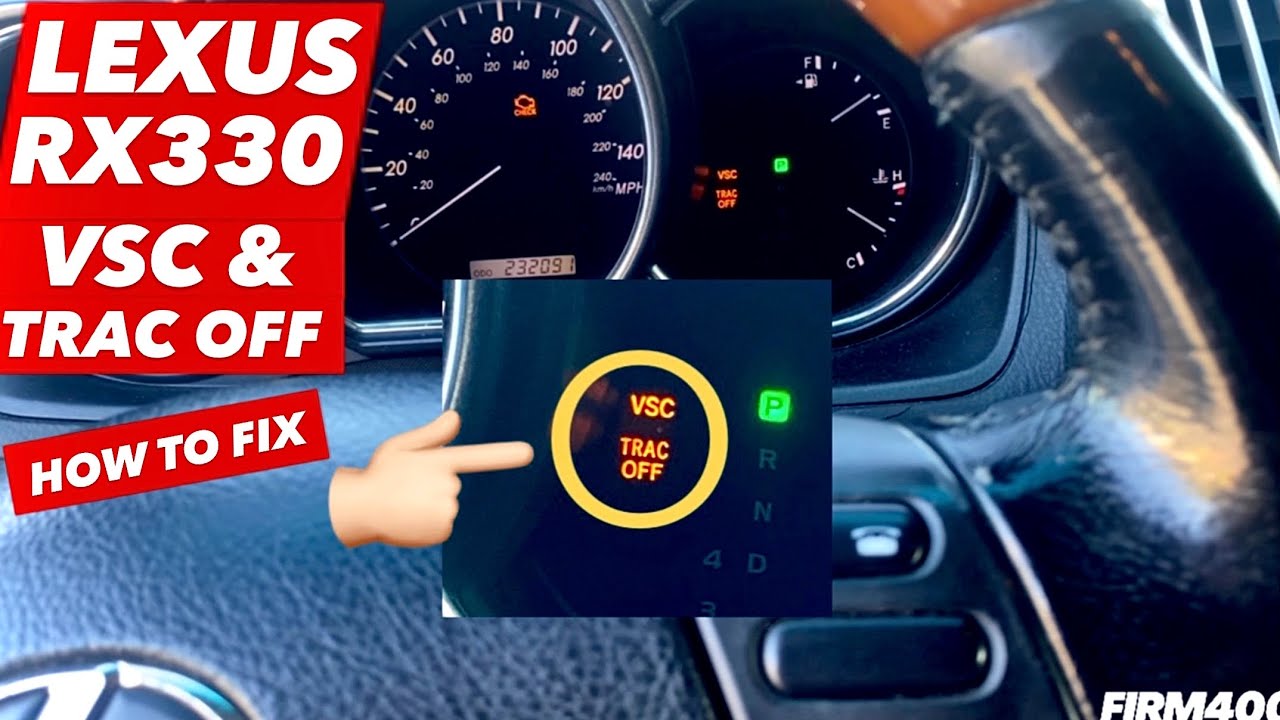
To reset the VSC light on a Lexus, first fix the underlying issue (often a loose gas cap or faulty O2 sensor), then disconnect the negative battery terminal for 15 seconds, or use an OBD-II scanner to clear the codes. The VSC (Vehicle Stability Control) light almost never turns on by itself—it is triggered by a check engine light or an ABS fault, so resetting it without addressing the root cause will bring it right back.
What Does the VSC Light Mean on a Lexus?
The VSC light indicates that your Lexus Vehicle Stability Control system has been disabled. This is not a standalone failure—it is a secondary warning that activates whenever another system fault is detected.
In nearly every case I have seen across Lexus models, the VSC light comes on alongside the check engine light or the ABS/traction control light. The stability system shuts itself down as a safety precaution because it cannot guarantee accurate traction control when it is receiving bad data from another sensor.
Here is what the different VSC-related dashboard indicators tell you:
- VSC OFF light solid: You or the system manually turned off traction control. Press the VSC button to re-enable it.
- Check Engine + VSC lights together: An engine-related fault triggered the VSC shutdown. This is the most common scenario.
- Slip indicator + VSC light: An ABS wheel speed sensor or yaw rate sensor is sending erratic data.
- VSC light flashing: The system is actively working to stabilize the vehicle during a loss of traction. This is normal operation.
How to Reset the VSC Light on a Lexus Step by Step
Disconnect the negative battery terminal for 15 to 30 seconds, then reconnect it. This clears stored codes and resets all electronic systems including VSC. However, this only works if the underlying fault has been resolved first.
Method 1: Battery Disconnect Reset
- Turn the ignition completely off and remove the key.
- Open the hood and locate the battery.
- Using a 10mm wrench, loosen the negative (black) battery terminal clamp.
- Remove the negative cable and set it aside where it cannot touch the battery post.
- Wait 15 to 30 seconds. Some technicians recommend waiting up to 60 seconds for capacitors to fully discharge.
- Press and hold the brake pedal for 10 seconds while the cable is disconnected to drain residual power.
- Reconnect the negative terminal and tighten it securely.
- Start the engine and drive for 2 to 3 minutes. The VSC light should be off if the fault is resolved.
Method 2: OBD-II Scanner Reset
- Plug an OBD-II scanner into the diagnostic port under the dashboard on the driver side.
- Turn the ignition to the ON position without starting the engine.
- Read the diagnostic trouble codes (DTCs) and write them down.
- Select “Clear Codes” or “Erase DTCs” from the scanner menu.
- Confirm the action and wait for the scanner to complete the process.
- Start the vehicle and verify that the VSC and check engine lights are off.
- Drive the vehicle through at least two complete warm-up cycles to confirm the lights stay off.
Method 3: Gas Cap Reset (If Applicable)
If the VSC light appeared right after you got gas, a loose or faulty gas cap is the most likely culprit. Remove the gas cap, inspect the rubber O-ring seal for cracks, reinstall it tightly until you hear three clicks, and drive for 50 to 100 miles. The system will self-check and turn off the lights if the cap was the issue.
Why Does the VSC Light Come On With the Check Engine Light on a Lexus?
The VSC system shares sensor data with the engine control module. When the check engine light triggers, the VSC system automatically disables itself because it cannot trust the data it is receiving from a compromised sensor circuit.
This is a design decision by Toyota and Lexus engineers. Rather than risk the stability system making incorrect traction adjustments based on faulty engine data, the system shuts down and alerts the driver. Here are the most common check engine codes that trigger the VSC light:
| Trouble Code | Description | Common Cause |
|---|---|---|
| P0420/P0430 | Catalyst system efficiency below threshold | Failing catalytic converter or O2 sensor |
| P0441/P0446 | Evaporative emission system malfunction | Loose gas cap, cracked EVAP hose, purge valve |
| P0171/P0174 | System too lean (Bank 1 or 2) | Vacuum leak, dirty MAF sensor, failing fuel pump |
| P0300-P0306 | Engine misfire detected | Worn spark plugs, ignition coils, or injectors |
| C1201 | Engine control system malfunction | Communication error between ECM and VSC module |
Common Causes of the VSC Light on Lexus Vehicles
The VSC light on a Lexus is most commonly triggered by a loose gas cap, a failing oxygen sensor, or a faulty wheel speed sensor. These three issues account for the majority of VSC warnings I have encountered across ES, RX, IS, and GX models.
Cause 1: Loose or Faulty Gas Cap
This is the number one cause and the easiest to fix. A loose gas cap triggers an EVAP code, which triggers the check engine light, which triggers the VSC light.
Tighten the cap until it clicks three times or replace it if the seal is cracked. The part costs under $15 at any auto parts store.
Cause 2: Failing Oxygen Sensor
Lexus vehicles, particularly the RX 350 and ES 350 with the 2GR-FE engine, are known for O2 sensor failures between 80,000 and 120,000 miles. The upstream sensor (Bank 1 Sensor 1) fails most often. A failing O2 sensor triggers P0420 or P0133 codes and immediately disables VSC.
Cause 3: Faulty Wheel Speed Sensor
Each wheel has a speed sensor that feeds data to the ABS and VSC modules. Corrosion, road debris, or a damaged tone ring can cause erratic readings. This typically triggers C1223, C1241, or C1251 codes and causes the ABS and VSC lights to illuminate together.
Cause 4: Dirty or Failing MAF Sensor
A contaminated mass airflow sensor causes lean running conditions (P0171), which cascades into a VSC shutdown. Cleaning the MAF sensor with dedicated MAF cleaner spray takes five minutes and costs about $8. This is a common fix on the Lexus IS 250 and GS 350.
Cause 5: Failing Yaw Rate Sensor or Steering Angle Sensor
The yaw rate sensor measures how fast the vehicle is rotating around its vertical axis. If it fails or drifts out of calibration, the VSC system cannot determine the vehicle’s actual direction of travel. This requires professional recalibration with a Toyota Techstream or equivalent scan tool.
Lexus Model-Specific VSC Light Solutions
Different Lexus models have known VSC-related weak points based on their platform, engine, and model year. Here are the most common model-specific issues and fixes.
Lexus RX 350 (2007–2015)
- Most common trigger: O2 sensor failure and EVAP system leaks
- Known issue: Cracked EVAP canister hoses behind the rear wheel well
- Fix: Replace the cracked hose section and clear codes. The part is approximately $30 to $50.
- Secondary issue: ABS actuator internal failure causing C1256 code
Lexus ES 350 (2007–2018)
- Most common trigger: Loose gas cap and catalytic converter degradation
- Known issue: The 2GR-FE engine develops P0420 codes around 100,000 miles
- Fix: Replace the downstream O2 sensor first before condemning the catalytic converter. Many cases resolve with just the sensor.
Lexus IS 250/350 (2006–2013)
- Most common trigger: Carbon buildup causing misfires (P0300-P0306)
- Known issue: Direct injection carbon fouling on the IS 250 intake valves
- Fix: Walnut blasting the intake valves or using a top-end cleaner. This is a labor-intensive job costing $400 to $800 at an independent shop.
Lexus GX 460/470 (2003–Present)
- Most common trigger: Wheel speed sensor failure from off-road debris
- Known issue: The front wheel speed sensors accumulate magnetic debris on the sensor tip
- Fix: Remove the sensor, clean the magnetic tip with brake cleaner, and reinstall. If the code persists, replace the sensor ($40 to $80 per unit).
How to Fix a VSC Light That Will Not Turn Off
If you have cleared the codes and the VSC light keeps coming back, the underlying fault has not been resolved. A simple code clear is a temporary fix, not a repair. Here is how to track down a persistent VSC warning.
Step 1: Read the Codes Again
Do not guess. Use an OBD-II scanner that can read ABS and chassis codes, not just engine codes.
A basic $20 scanner may only read engine codes, which means you are missing the full picture. Invest in a scanner that reads Toyota/Lexus-specific codes or visit a shop that uses Techstream.
Step 2: Check for Pending Codes
Some faults only show as “pending” codes on the first occurrence and do not trigger the light until the fault repeats. Your scanner should have a “Pending Codes” section. Check it even if no current codes are stored.
Step 3: Inspect the Wiring Harness
Rodent damage, chafing against metal brackets, and corroded connectors are more common than people think. Inspect the wiring to the wheel speed sensors, O2 sensors, and the ABS module. Look for exposed copper, green corrosion on pins, or melted insulation near the exhaust.
Step 4: Check the Brake Fluid Level
Low brake fluid triggers the VSC and ABS warning lights on many Lexus models. Check the reservoir under the hood. If it is below the MIN line, top it off with DOT 3 or DOT 4 fluid and inspect the brake pads for wear, as low fluid usually means the pads are worn down.
Step 5: Seek Professional Calibration
If you have replaced a steering angle sensor, yaw rate sensor, or had a wheel alignment done, the VSC system may need recalibration. This requires a Toyota Techstream diagnostic tool or equivalent and cannot be done with a basic OBD-II scanner. Expect to pay $100 to $200 for this service at an independent shop.
Frequently Asked Questions
Is it safe to drive with the VSC light on?
Yes, you can drive with the VSC light on, but your vehicle will not have active stability or traction control. In dry, normal driving conditions this is not dangerous.
However, in rain, snow, or icy conditions, the lack of stability control significantly increases the risk of losing control. Get the issue diagnosed as soon as possible.
Does disconnecting the battery reset the VSC light permanently?
No. Disconnecting the battery only clears the stored codes and turns off the warning lights temporarily. If the underlying fault still exists, the VSC light will return within 50 to 100 miles of driving after the system completes its self-diagnostic cycles.
How much does it cost to fix the VSC system on a Lexus?
The cost depends entirely on the root cause. A gas cap replacement costs $10 to $15. An O2 sensor replacement runs $150 to $300 parts and labor.
An ABS wheel speed sensor costs $150 to $250 installed. A full ABS actuator replacement can cost $1,000 to $2,000 at a dealership. Always diagnose the specific code before authorizing any repair.
Can a wheel alignment cause the VSC light to come on?
Yes. If the steering angle sensor is not recalibrated after an alignment, the VSC system detects a mismatch between the steering wheel position and the actual wheel angle.
This triggers a VSC warning. Any competent alignment shop should recalibrate the steering angle sensor as part of the alignment procedure on Lexus vehicles.
Why does my VSC light come on in cold weather?
Cold weather can cause battery voltage to drop, which triggers low-voltage communication errors between modules. It can also cause O2 sensors to respond more slowly, triggering lean or catalyst codes. If the VSC light only appears on cold mornings and disappears after the engine warms up, have the battery tested and check for pending codes.
Final Thoughts on Resetting the Lexus VSC Light
The VSC light on your Lexus is a messenger, not the problem itself. It is telling you that another system has a fault and stability control has been disabled as a result. Resetting the light without diagnosing and fixing the root cause is like unplugging a smoke detector because you do not want to hear the alarm.
Read the codes, fix the actual fault, and then clear the system. Your Lexus will reward you with years of reliable, safe driving when you address problems at their source rather than silencing the warnings.
Leave a Reply