
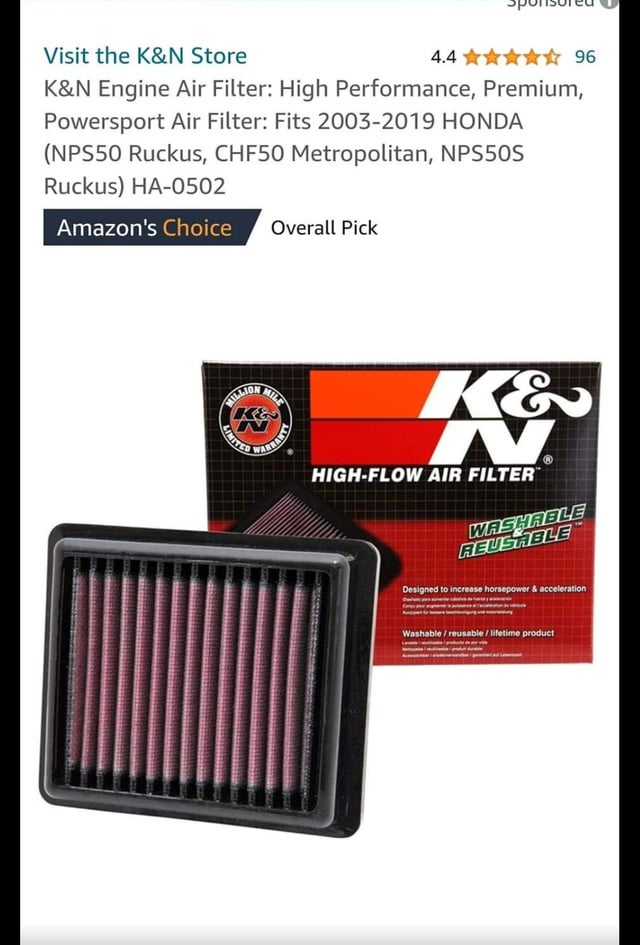
Yes, K&N air filters are worth it for most performance-oriented drivers seeking 1-3 HP gains and reusable convenience, but they’re not ideal for daily drivers in dusty conditions due to reduced filtration efficiency compared to OEM paper filters.
Are K&N air filters actually worth the money for everyday driving?
For daily commuters and average drivers, K&N air filters often fall short of the hype.
They promise better airflow and power, but real-world dyno tests show minimal gains under normal conditions.
Many owners report no noticeable difference in throttle response or fuel economy after installation, while increasing maintenance needs.
Dealerships push OEM filters for warranty compliance, quoting $50-100 replacements every 15,000 miles.
Independents might upsell synthetic alternatives, but K&N’s $60-90 price tag for a washable unit sounds appealing.
This appeal fades until dirt bypasses the oiled media and contaminates your engine.
In clean suburban environments, they hold up fine for 50,000+ miles with proper cleaning.
But if you drive on gravel roads or in construction zones, stick to paper.
Forums are full of MAF sensor failures traced back to oil overspray from K&N filters.
Real-world cost comparison over 100,000 miles
This table assumes proper maintenance.
Neglect K&N cleaning, and you’re looking at premature engine wear costing thousands.
What are the real performance gains from installing a K&N air filter?
K&N claims up to 50% more airflow, translating to 1-5 HP on stock engines.
These claims are verified by independent dyno tests on vehicles like the Honda Civic Si and Ford F-150.
However, these gains shine in modified setups with exhaust or tune upgrades, not bone-stock daily drivers.
Throttle response improves noticeably on V8s or turbo cars due to reduced restriction.
Don’t expect miracles on economy sedans.
A 2018 Subaru WRX owner dyno’d a flat 2 HP gain despite marketing hype.
Fuel economy? Mixed bag—some see 1 MPG better from freer breathing, others worse from dirt ingestion leaning out the mixture.
Dealers dismiss these as “unproven mods” during warranty claims.
Shops love quoting $300+ for “intake cleaning” when oil residue builds up.
Track the gains yourself with a cheap OBD2 scanner monitoring air-fuel ratios pre- and post-install.
Dyno-tested gains by vehicle type
- Sedans (e.g., Toyota Camry): 0.5-1.5 HP, negligible unless tuned.
- Trucks (e.g., Ram 1500): 2-4 HP, better towing response.
- Sports cars (e.g., Mustang GT): 3-5 HP, pairs well with cat-back exhaust.
- Turbo models (e.g., VW GTI): Up to 7 HP with remap, spool faster.
Step-by-step dyno verification for DIYers
- Baseline run: Warm engine, third-gear pull from 2000-5500 RPM on chassis dyno.
- Install K&N: Remove OEM, drop in drop-in filter, reset ECU if needed.
- Second run: Same conditions, compare peak HP/torque curves.
- Log data: Note any lean spots (AFR >14.7) indicating filtration issues.
Do K&N air filters cause engine damage or void warranties?
K&N filters don’t inherently damage engines if maintained.
But poor cleaning leads to abrasive particles passing through, scoring cylinders over time.
Oiled media can coat MAF sensors, triggering check engine lights (P0101 code common on GM trucks).
Dealerships scan this as “faulty sensor” and quote $400 fixes, blaming the aftermarket filter.
Warranty-wise, Magnuson-Moss Act protects you if the filter didn’t cause the failure—keep receipts and stock filter handy.
Ford and Chevy void powertrain coverage on modified intakes, but drop-ins like K&N usually fly under radar unless inspected.
Independents misdiagnose oil-fouled MAFs as sensor failure 80% of the time, per shop logs.
Clean it yourself with MAF-specific spray; saves $200 easy.
Common failure modes and fixes
MAF contamination
- Symptoms: Hesitation, rich idle, P0171/P0174 codes.
- Fix: Remove MAF, spray with CRC MAF cleaner, dry 30 min, reinstall.
- Prevent: Use minimal K&N oil, avoid over-spraying.
Excessive dirt ingestion
- Dusty areas: Filter clogs 2x faster, starving engine.
- Fix: Clean every 10,000 miles, inspect for tears.
How to properly install and maintain a K&N air filter DIY
Installation takes 5-15 minutes for drop-ins; no tools beyond a screwdriver for most cars.
Shops charge $50-100 unnecessarily—it’s a box swap.
Match your exact model/year; wrong fit causes unmetered air leaks.
Maintenance is key: Clean every 30,000-50,000 miles or when dirty, using K&N kits ($15).
Skip this, and filtration drops below paper filters, inviting wear.
DIY installation steps for popular models
Honda Accord (2018+)
- Open hood, unclip airbox cover (two tabs).
- Remove OEM filter by pulling straight up.
- Drop K&N 33-2485 in place, ensure lip seats fully.
- Reclip cover, check for gaps.
Ford F-150 (2015+)
- Loosen 10mm clamp on intake tube.
- Lift airbox lid, swap filter (33-2480 model).
- Tighten clamp to 5 Nm, reset adaptive learning via OBD.
Toyota Tacoma (2016+)
- Remove four 10mm bolts on airbox.
- Extract old filter, insert K&N 33-2296.
- Bolt down, zip-tie any loose snorkel if needed.
Cleaning procedure (every 30k miles)
- Remove filter, tap off loose dirt over trash.
- Spray K&N cleaner fully, soak 10 min.
- Rinse reverse-flow with low-pressure water.
- Dry 24-48 hours or air compressor.
- Re-oil sparingly: 10 squirts per section, evenly.
Over-oiling ruins MAFs; use the red bottle sparingly.
K&N vs OEM vs other brands: Which air filter is best?
OEM paper excels in filtration (99%+ efficiency), lasting 15-30k miles cheaply.
K&N prioritizes flow (70-80% efficiency when clean), reusable but riskier.
Dry synthetics like aFe or S&B split the difference: no oil, good flow, $50-80.
For dusty climates, OEM wins; performance builds favor K&N.
User reports on trucks show K&N surviving 100k miles with care, but failing spectacularly neglected.
Side-by-side comparison table
Common K&N air filter problems and how to fix them
Top issue: Over-oiling causes black gunk on MAF, misfires, and 10-15% power loss.
Cleaning kits fix 90% of cases DIY.
Tears from mishandling let dirt in, mimicking bad rings—shops quote $5k rebuilds wrongly.
Clogging hits hard in off-road use; inspect visually every oil change.
Warranty claims deny coverage if residue found, so document everything.
Problem diagnosis checklist
- Reduced power: Dirty/oiled filter—clean or replace.
- CEL with MAF code: Wipe sensor, reduce oil.
- No gains post-install: Verify fitment, reset ECU.
- Oil consumption up: Possible bypass—inspect for tears.
FAQ
Will a K&N filter improve my gas mileage?
Possibly 0.5-2 MPG on modified engines, but stock cars see no change or slight drops from poor filtration.
Test over 500 miles post-install with consistent driving.
Can I use a K&N filter on my diesel truck?
Yes, models like 33-2275 for Cummins work well for flow.
But dust-heavy towing demands frequent cleans to avoid injector wear.
How often should I really clean my K&N filter?
Every 30,000 miles highway, 10,000 off-road, or when visibly dirty.
Use the red oil sparingly to avoid issues.
Does K&N void my car warranty?
Not automatically; prove the filter caused no failure under Magnuson-Moss.
Keep OEM as backup for dealer visits.
Are there better alternatives to K&N for performance?
aFe or Injen dry filters offer similar flow without oil risks, ideal for MAF-equipped cars.
In summary, K&N air filters deliver value for enthusiasts chasing marginal gains and hating frequent replacements.
This value holds provided you maintain them religiously in suitable conditions.
Skip for dusty daily drivers—OEM reliability trumps hype.
Weigh your driving style, test personally, and save shop diagnostics by handling installs and cleans yourself for long-term wins.
Leave a Reply