
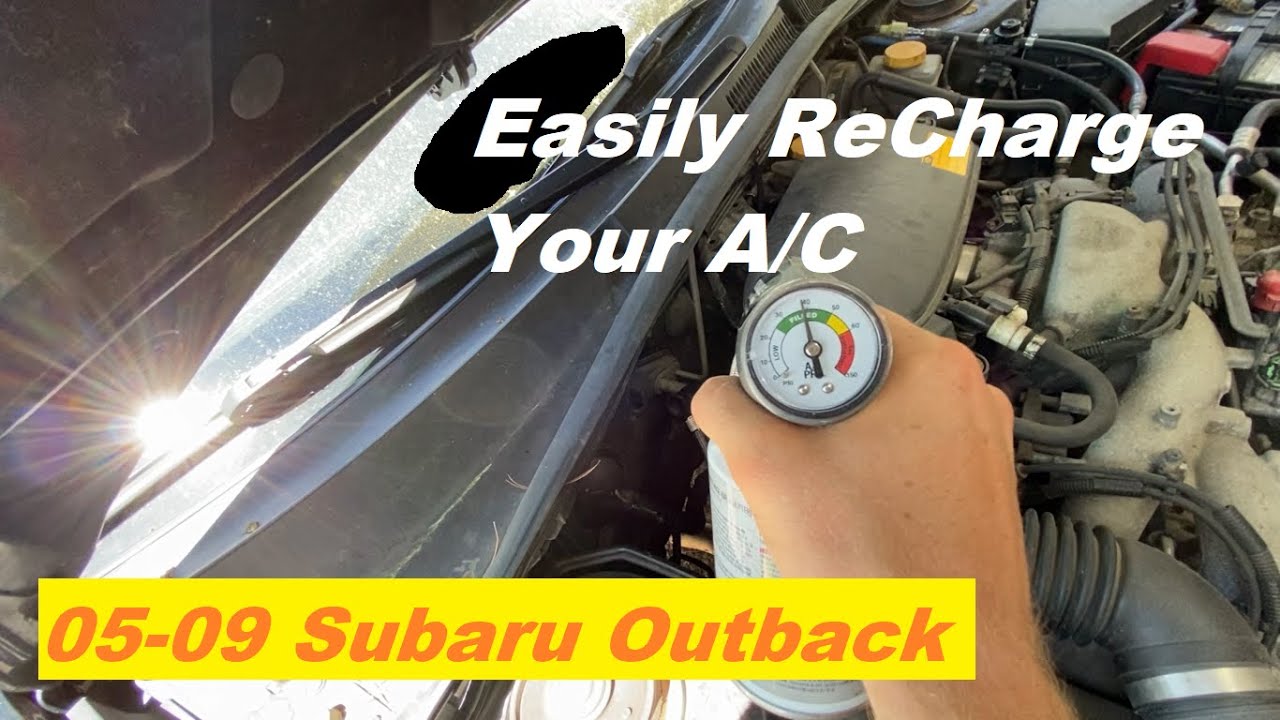
A Subaru Outback AC recharge involves adding R-134a refrigerant (or R-1234yf on 2020+ models) to the low-pressure service port located on the passenger side of the engine bay near the firewall. A full system holds approximately 17.6–19.4 oz of refrigerant depending on the model year. You can DIY with a recharge kit for $30–$60 or pay $150–$300 at a shop.
However, if the system is completely empty, you likely have a leak that must be repaired first—simply recharging will waste money.
How Do You Recharge the AC on a Subaru Outback?
To recharge the AC on a Subaru Outback, connect a recharge kit to the low-pressure port while the engine is running and the AC is set to max cold. The process takes about 15–20 minutes and requires no special tools beyond the recharge kit itself.
Here is the step-by-step process that works across most model years:
- Start the engine and turn the AC to the coldest setting with the fan on high.
- Open all windows to prevent the system from cycling off due to low cabin temperature.
- Locate the low-pressure service port on the passenger side of the engine bay, near the firewall. It has a black or blue plastic cap marked “L.”
- Remove the cap and connect the recharge hose from the kit to the port. It only fits one way—do not force it.
- Read the pressure gauge. With the compressor running, a properly charged system should read between 25–45 psi on the low side, depending on ambient temperature.
- If the pressure is low, hold the can upright and squeeze the trigger to add refrigerant in short bursts. Shake the can periodically.
- Monitor the gauge and stop adding when the pressure reaches the correct range for your current ambient temperature (the kit usually has a chart on the label).
- Disconnect the hose, replace the cap, and check vent temperature inside the cabin. It should blow 38–48°F within a few minutes.
What You Need Before Starting
- 🔧A recharge kit with a built-in gauge (R-134a for 2009–2019 models, R-1234yf for 2020 and newer)
- 🛡️Safety glasses and gloves—refrigerant can cause frostbite on contact with skin
- 🌡️A thermometer to verify vent temperature after recharging
- 💡UV dye kit (optional but recommended) to detect future leaks early
What Are the Signs Your Subaru Outback Needs an AC Recharge?
The most common signs include warm air blowing from the vents, the AC compressor cycling on and off rapidly, and a visible drop in cooling performance during hot weather. These symptoms usually appear gradually over weeks or months.
Primary Symptoms to Watch For
- Warm or lukewarm air from vents — The most obvious sign. If the AC runs but the air never gets truly cold, low refrigerant is the first suspect.
- Compressor clutch cycling rapidly — When refrigerant is low, the low-pressure switch kicks the compressor off and on every few seconds. Pop the hood and watch the compressor clutch while the AC is running.
- Hissing or bubbling sounds — A faint hissing near the firewall or dashboard when the AC is on can indicate refrigerant escaping through a small leak.
- Ice on AC lines — Paradoxically, low refrigerant can cause the evaporator to freeze up, leading to ice buildup on the low-pressure line under the hood.
- AC works fine in the morning but fades in the afternoon heat — This pattern suggests the system is borderline on charge and struggles when ambient temperatures rise.
What Refrigerant Does a Subaru Outback Use?
Subaru Outbacks from 2009 to 2019 use R-134a refrigerant. Starting with the 2020 model year, Subaru switched to R-1234yf, which is a newer, more environmentally friendly refrigerant. These two refrigerants are not interchangeable.
Refrigerant Capacity by Model Year
Important: Never mix R-134a and R-1234yf. Using the wrong refrigerant can damage the compressor, contaminate the system, and cost hundreds of dollars to flush and repair. Always check your underhood sticker or owner’s manual to confirm which refrigerant your specific vehicle uses.
How Much Does a Subaru Outback AC Recharge Cost?
A DIY recharge costs $30–$60 for the refrigerant kit. A professional recharge at an independent shop runs $150–$250, while a dealership typically charges $200–$350.
The price difference comes down to labor rates and whether the shop performs a full evacuation and recharge versus a simple top-off.
Cost Breakdown: DIY vs. Professional
A full evacuate-and-recharge is always better than a simple top-off. When a shop evacuates the system, they pull a vacuum that removes moisture and air—both of which reduce cooling efficiency and can damage internal components over time.
Why Is My Subaru Outback AC Not Cold After a Recharge?
If the AC is still not cold after recharging, the system likely has a leak, a failing compressor, a clogged expansion valve, or an electrical issue preventing the compressor clutch from engaging. A recharge alone will not fix any of these problems.
Cause 1: Refrigerant Leak
This is the number one reason a freshly recharged system fails. Subaru Outbacks are known to develop leaks at the condenser (road debris damage), the compressor shaft seal, and the evaporator core.
If the system was completely empty before you recharged, the refrigerant you added will escape within days to weeks.
Fix: Add UV dye to the system, run the AC for a few days, then inspect all fittings, hoses, and the condenser with a UV light. Replace the leaking component before recharging again.
Cause 2: AC Compressor Failure
The compressor on 2010–2015 Outbacks is a known weak point. If the compressor clutch engages but the system does not cool, the internal scroll mechanism may be worn out.
You will hear the clutch click on, but the compressor does not actually compress refrigerant effectively.
Fix: Check high-side and low-side pressures simultaneously. If both sides equalize while the compressor is running, the compressor is bad and needs replacement. Expect $400–$800 for parts and labor at an independent shop.
Cause 3: Clogged Expansion Valve or Orifice Tube
Debris from a failing compressor or moisture contamination can clog the expansion valve. Symptoms include one cold line and one warm line at the firewall, or frost forming on only one of the two AC lines.
Fix: Replace the expansion valve (located at the firewall where the lines enter the cabin). This is a $20–$50 part but requires evacuating the system first. A shop will charge $150–$300 for the full job.
Cause 4: Electrical or Clutch Issues
If the compressor clutch does not engage at all, check the AC fuse and relay first—both are in the underhood fuse box. On some Outback model years, a faulty ambient temperature sensor or low-pressure switch can also prevent the clutch from engaging even when the system has adequate charge.
Fix: Test the clutch connector with a multimeter. If you have power at the connector but the clutch does not engage, the clutch coil is bad. If you have no power, trace the circuit back through the fuse, relay, and pressure switches.
Where Is the AC Recharge Port on a Subaru Outback?
The low-pressure AC recharge port on a Subaru Outback is located on the passenger side of the engine bay, near the firewall, on the larger-diameter aluminum line. It has a black or blue plastic cap with an “L” stamped on it.
The high-pressure port is on the driver’s side—do not connect a recharge kit to the high-pressure port.
How to Tell the Low-Port from the High-Port
- Low-pressure port: Larger diameter fitting, passenger side, marked “L.” This is where you connect the recharge hose.
- High-pressure port: Smaller diameter fitting, driver’s side, marked “H.” Never connect a DIY recharge kit here—high-side pressures can exceed 250 psi and are dangerous.
- The port sizes are different by design, so a recharge kit connector should only physically fit the low-pressure port. If you have to force it, you are on the wrong port.
Should You DIY or Take Your Subaru Outback to a Shop?
A DIY recharge works well if the system is simply low on refrigerant and you want a quick, affordable fix. However, if the system is completely empty, making unusual noises, or has been recharged multiple times without lasting results, a professional diagnosis is the smarter investment.
When DIY Makes Sense
- ✅The AC still blows somewhat cool but not as cold as it used to
- ✅The compressor clutch is still engaging
- ✅You have never recharged the system before
- ✅You want to add UV dye to monitor for future leaks
When to Go to a Professional
- ⚠️The system is completely empty or nearly so
- ⚠️The compressor makes grinding or clicking noises
- ⚠️You recharged recently and it already lost cooling again
- ⚠️You own a 2020+ model with R-1234yf—this refrigerant requires specialized equipment and costs significantly more per can
- ⚠️You want a proper evacuate-and-recharge with vacuum testing
Frequently Asked Questions
How often should I recharge the AC on my Subaru Outback?
A properly sealed AC system should not need recharging at all during the life of the vehicle. If you are losing refrigerant, there is a leak that needs to be found and repaired. Frequent recharges are a band-aid, not a fix.
Can I use any R-134a recharge kit for my Subaru Outback?
Yes, any standard R-134a recharge kit with a gauge will work on 2009–2019 Outbacks. Avoid kits with added “sealant” or “stop leak”—these can clog the expansion valve and damage the compressor, turning a $50 fix into a $1,000 repair.
Why does my Subaru Outback AC smell musty after recharging?
A musty smell usually comes from mold or bacteria growing on the evaporator core, not from the recharge itself. Replace the cabin air filter and spray an evaporator cleaner into the drain tube or blower motor housing to eliminate the odor.
Is it safe to drive a Subaru Outback with low refrigerant?
Yes, it is safe to drive. The AC compressor has a low-pressure cutoff switch that disengages the clutch when refrigerant drops too low, preventing damage. However, running the system with low refrigerant for extended periods can allow moisture to enter and cause internal corrosion.
Will a Subaru Outback AC recharge fix a bad compressor?
No. If the compressor is mechanically failed, adding refrigerant will not restore cooling.
The compressor must be replaced. Common signs of a bad compressor include clutch engagement without cooling, unusual noises, and equalized high/low pressures.
Final Thoughts on Subaru Outback AC Recharge
Recharging the AC on a Subaru Outback is one of the most straightforward DIY maintenance tasks you can tackle, provided the system is not completely empty and the compressor is functioning. A $30–$60 recharge kit can restore cold air in under 20 minutes.
But if you find yourself recharging every few weeks, stop adding refrigerant and start looking for the leak. The money you spend on a proper diagnosis will save you from throwing refrigerant into a system that cannot hold it.
For 2020 and newer Outbacks running R-1234yf, leave it to a professional—the refrigerant alone costs $40–$60 per can, and the system requires specialized recovery equipment.
Leave a Reply