
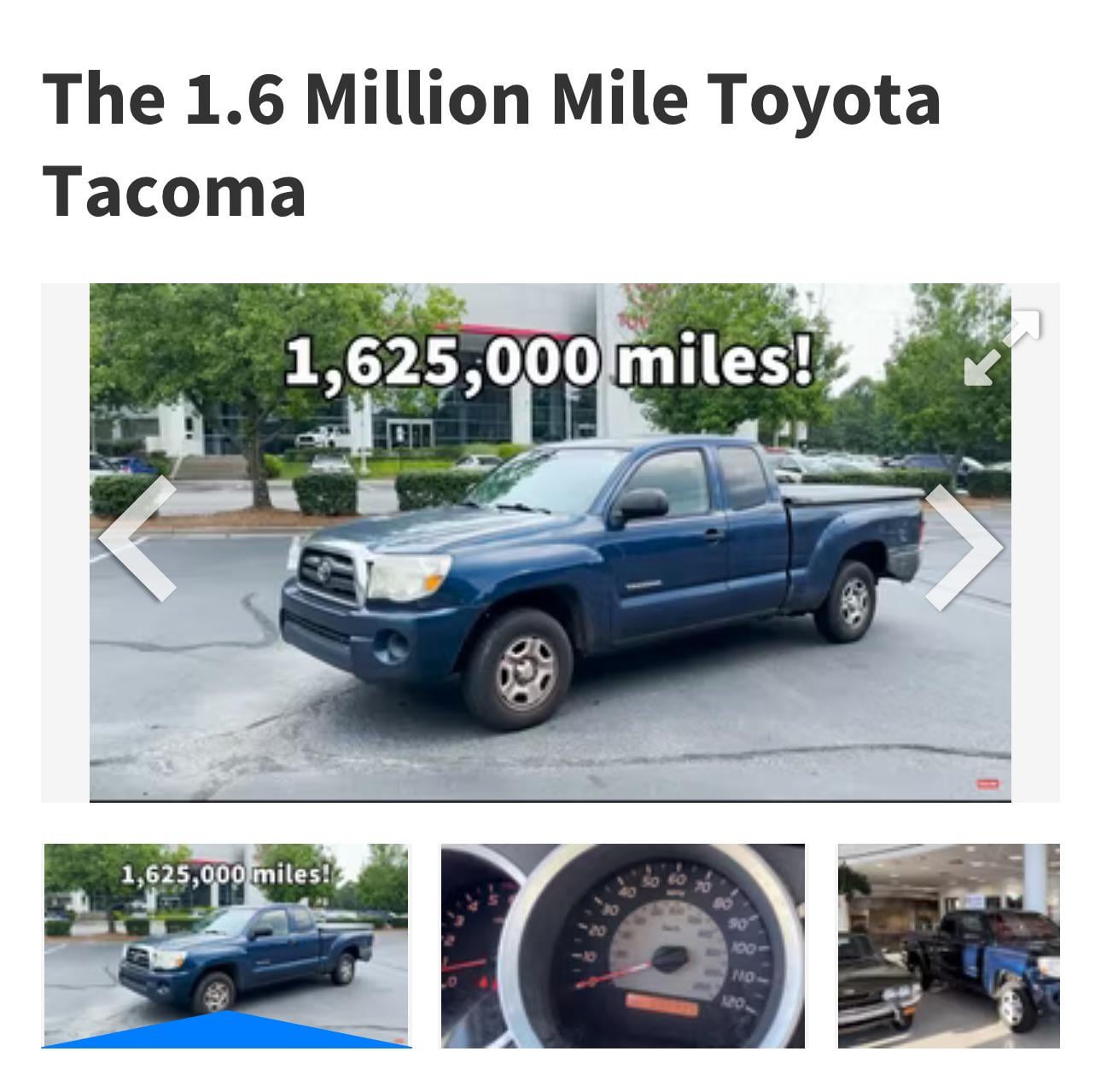
Yes, Toyota Tacomas rank among the most reliable midsize trucks, routinely surpassing 250,000 miles when owners address known weak points early.
How many miles do Toyota Tacomas typically last?
Toyota Tacomas commonly reach 250,000 to 300,000 miles before major drivetrain work becomes necessary. Owners who follow the factory service schedule and replace the timing chain, water pump, and radiator at 120,000-mile intervals report the highest longevity numbers.
Independent shops see fewer engine failures on Tacomas than on comparable domestic trucks. This is largely because the 2.7-liter and 4.0-liter engines use robust iron blocks and conservative tuning.
Real-world mileage examples from high-volume shops
- 2008-2015 models: Those with the 4.0-liter V6 often hit 280,000 miles before the first transmission rebuild when fluid is changed every 30,000 miles.
- 2016-2023 models: Units equipped with the 3.5-liter V6 show early signs of camshaft wear around 180,000 miles if oil changes are stretched beyond 5,000 miles.
- Second-generation trucks: Models (2005-2015) with frame rust repairs documented at 150,000 miles continue to 350,000 miles after undercoating is reapplied every three years.
What are the most common Toyota Tacoma problems by generation?
Each Tacoma generation carries a short list of repeatable failures that shops diagnose daily. Addressing these issues at the first sign prevents expensive follow-on repairs.
2005-2015 second-generation issues
Frame corrosion remains the dominant complaint on trucks operated in salt-belt states. Toyota issued a buyback and replacement program, yet many repaired frames later show new rust at the rear leaf-spring mounts.
The automatic transmission can develop a whining noise from the torque converter clutch after 140,000 miles if fluid is neglected. The 4.0-liter V6 occasionally leaks oil from the valve-cover gaskets, soaking the passenger-side exhaust manifold and creating a persistent smell.
2016-2023 third-generation issues
The 3.5-liter V6 suffers from premature camshaft lobe wear when oil viscosity drops below specification. The electric power steering rack develops a clunk on full-lock turns after 90,000 miles.
Rear differential seals leak fluid onto the brake rotors, causing pulsation that owners often mistake for warped rotors. The infotainment system frequently loses Bluetooth connectivity, requiring a software reflash rather than hardware replacement.
Are certain Tacoma model years more reliable than others?
Reliability varies sharply by model year due to engine changes and frame updates. The 2012-2015 trucks with the updated frame coating and revised 4.0-liter calibration post the fewest complaints in shop records.
The 2016 introduction of the 3.5-liter engine brought new camshaft and direct-injection carbon issues that took Toyota until the 2020 refresh to mitigate. Avoid 2005-2008 trucks unless a documented frame replacement and undercoating exist.
Year-by-year quick reference
- 2005-2008: Highest rust claims; verify frame replacement paperwork before purchase.
- 2009-2011: Improved frame coating but still vulnerable at spring perches; check for Toyota buyback sticker.
- 2012-2015: Best second-generation years; timing chain stretch rare before 200,000 miles.
- 2016-2019: Camshaft wear common; oil analysis every 5,000 miles recommended.
- 2020-2023: Revised cam profiles and piston rings reduce wear; still monitor for rear differential leaks.
How does Tacoma reliability compare to Ford Ranger and Chevy Colorado?
Tacomas retain higher resale value and lower long-term repair frequency than the Ranger or Colorado. The Ranger’s 2.3-liter EcoBoost engine requires turbo and high-pressure fuel pump replacements near 120,000 miles more often than the Tacoma’s naturally aspirated V6.
Colorado 3.6-liter V6 trucks show higher rates of AFM lifter failure. Tacoma parts remain available from multiple suppliers, keeping labor rates lower at independent shops.
What routine maintenance prevents expensive Tacoma repairs?
Follow a strict schedule rather than the factory “normal” interval. Change the automatic transmission fluid every 30,000 miles using Toyota WS fluid.
Inspect the frame and spray corrosion inhibitor annually in winter states. Replace the serpentine belt and tensioner at 90,000 miles to avoid stranding.
Perform a throttle-body cleaning every 60,000 miles to maintain smooth idle on the 3.5-liter engine.
Step-by-step frame protection procedure
- Pressure-wash the undercarriage after winter driving to remove salt.
- Apply a rubberized undercoating to the frame rails and crossmembers while the truck is on a lift.
- Reapply fluid film to the inside of the frame through existing drain holes every 24 months.
- Check leaf-spring mounts and cab mounts for bubbling paint during every oil change.
FAQ
Does the Tacoma hold value better than other midsize trucks?
Tacomas depreciate slower than Rangers and Colorados, retaining roughly 65 percent of original value at five years when rust-free examples are compared.
Is the manual transmission more reliable than the automatic?
The six-speed manual avoids torque-converter and valve-body failures but requires clutch replacement around 150,000 miles on well-driven examples.
Can I perform the timing chain service myself?
The job requires removal of the radiator, fan, and front cover; most owners send the truck to a shop with the correct Toyota timing tools to avoid cam and crank timing errors.
Are aftermarket lift kits harmful to long-term reliability?
Moderate lifts with proper geometry correction do not shorten driveline life, but excessive lift angles accelerate CV joint and ball-joint wear on 4×4 models.
What oil should I use after 150,000 miles?
Switch to 5W-30 full synthetic meeting Toyota specification if the engine begins to consume 5W-20, which often occurs past 180,000 miles.
Consistent maintenance and early attention to frame rust, camshaft wear, and fluid changes allow Tacoma owners to reach extremely high mileage with predictable costs.
Leave a Reply