
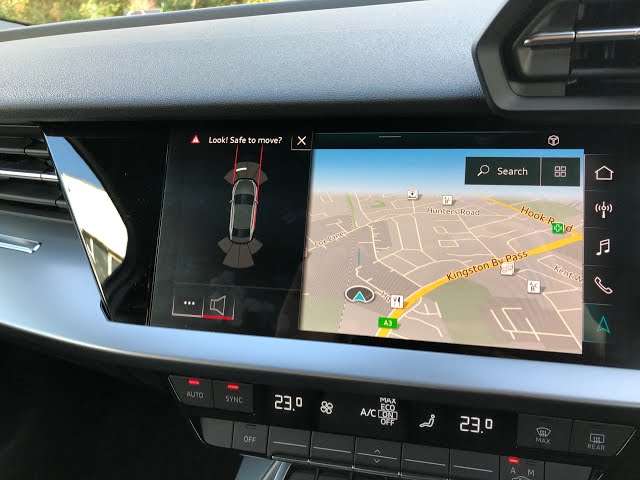
Audi Parking System Plus is a rear and front parking sensor system with visual display and acoustic alerts that commonly fails due to faulty sensors, wiring corrosion, or control module issues; diagnose by scanning for fault codes with VCDS or OBD-II tool and test sensors with a multimeter.
What is Audi Parking System Plus and How Does It Work?
Audi Parking System Plus (often called Park Assist Plus) uses ultrasonic sensors around the vehicle’s bumpers to detect obstacles during parking.
It provides audible beeps that increase in frequency as you get closer, plus a graphical display on the MMI screen showing the vehicle’s position relative to detected objects.
This system is standard on many A4, A6, Q5, and Q7 models from 2008 onward.
In real-world use, it activates automatically below 10 mph with reverse gear or low-speed forward motion.
The control module processes sensor signals, filters out noise like rain or mud, and outputs to speakers and the dashboard.
Dealerships often overlook how accumulated road salt or debris degrades performance over time.
Key Components of the System
- Sensors: 4-12 ultrasonic transducers (2-4 per bumper corner) mounted flush in bumpers.
- Control Module: Located behind the glovebox or under the dash, interprets data.
- Wiring Harness: Runs from sensors to module, prone to chafing in wheel wells.
- Display and Speakers: Integrated into MMI and door speakers for alerts.
Common Model Variations
A4 B8 (2008-2016) uses 8 sensors with basic display; Q5 (2009+) adds front sensors and 360-view in higher trims.
Newer models like A6 C8 integrate it with adaptive cruise, sharing modules that complicate diagnostics.
Audi Parking System Plus Not Working: Quick Diagnostic Steps
Start diagnosis by checking for a steady tone or no display—most failures show no warning lights, frustrating owners.
Use a scan tool like VCDS to pull fault codes from module 10 (Park Assist Gateway); common codes are 00378 (sensor fault) or 00437 (wiring open).
Visually inspect sensors for damage from curbs or snow plows, a frequent issue in northern climates.
Independent shops often misdiagnose as “module failure” and quote $1,500+ replacements, but 70% of cases are sensor or wiring fixes under $300.
Test each sensor’s resistance (should be 2-5 kOhms) and voltage supply (12V key-on).
Step-by-Step DIY Diagnostics
- Park on level ground, turn key to ON position without starting engine.
- Scan for codes: Connect VCDS/OBD-II to port under dash, select module 10, read/log faults.
- Inspect sensors: Remove bumper if needed (10-20 clips/bolts), check for cracks, paint overspray, or corrosion.
- Test wiring: Use multimeter to check continuity from sensor connector to module pinout (refer to ElsaWin diagrams).
- Activate test mode: In VCDS, go to Output Tests > Parking Aid > cycle sensors for audible confirmation.
Why Do Audi Parking Sensors Fail Most Often?
The top cause is physical sensor damage from parking mishaps or road debris, seen repeatedly on Q5 and A4 models hitting potholes.
Wiring corrosion in wheel arches from winter salt is next, especially pre-2015 builds with non-sealed harnesses.
Control module glitches occur from water ingress or software bugs, often after battery disconnects.
Physical Sensor Damage
Sensors crack from curb impacts; look for white paint chips or dents.
In snowy areas, ice buildup mutes signals—clean with isopropyl alcohol, not pressure washers that force water behind bumpers.
Wiring and Connector Issues
Harnesses rub on suspension components, fraying over 50k miles.
Connectors oxidize; apply dielectric grease during reassembly to prevent recurrence.
Control Module and Software Faults
Modules fail from heat cycling or poor grounds.
Reflash via ODIS at dealer ($150) often resolves without replacement.
How to Fix Faulty Audi Parking System Sensors DIY
Replace individual sensors first—OEM part ~$100 each vs. dealer $250.
Match part numbers exactly (e.g., 8T0919285A for A4); aftermarket like Hella work but may trigger codes.
Full bumper removal takes 1-2 hours with basic tools.
Tools and Parts Needed
| Tool/Part | Purpose |
|---|---|
| Torx T25/T30 bits | Bumper bolts |
| Trim removal tools | Clips without damage |
| Multimeter | Verify wiring |
| Dielectric grease | Prevent corrosion |
Model-Specific Sensor Replacement: A4/A5 (B8)
- Jack up front/rear, support on stands; remove wheels for access.
- Unclip underbody panels (8-12 clips), disconnect fog light harnesses.
- Remove 4 Torx bolts per wheel well liner, peel back liner.
- Unplug sensor (twist counterclockwise), note orientation, install new with thread sealant.
- Clear codes, test in reverse with box nearby.
Model-Specific for Q5/Q7
Q5 requires underguard removal first (12 bolts); Q7 has additional side sensors under doors.
Torque bumper bolts to 10 Nm to avoid rattles.
Audi Parking System No Display or Sound: Troubleshooting
No MMI display often points to fuse 36 (5A in E-box) blown from shorted wiring or fusebox water damage.
No sound means speaker integration fault—check door amp fuses.
Both absent? Module power/ground issue at J446 behind glovebox.
Fuse and Relay Checks
- Locate fuse panel under hood (E-box): Pull #36, inspect/replace.
- Rear fusebox (trunk side): Check #12 for rear sensors.
- Swap relays if clicking noises present.
MMI Display Fixes
Restart MMI by holding radio power + NAV + CAR buttons 10 seconds.
If persistent, recode module adaptation channels in VCDS for display enable.
Wiring Repair for Audi Parking System Plus Faults
Solder frayed wires instead of splicing—use heat-shrink with adhesive for waterproofing.
Pinout: Sensors have 4 pins (power, ground, signal A/B); trace with wiring diagram app like ETKA.
Step-by-Step Wiring Repair
- Expose harness in wheel well, tape off good sections.
- Cut damaged wire 2″ back, strip 1/2″, tin with solder.
- Join with 22-gauge wire, solder, shrink-wrap.
- Apply conformal coating, zip-tie securely.
- Adapt module channels 01-04 for calibration post-repair.
Control Module Replacement and Coding
Only replace if diagnostics confirm—no bypass possible.
Used modules from eBay (~$200) work if coded to VIN.
Dealers charge $800+ labor for coding; DIY with VCDS Login 20103.
Coding Procedure
- Install new/used module, connect VCDS.
- Login 20103, code to match original long code.
- Basic settings > 10-park assist > run calibration.
- Adapt channels for sensor count (e.g., 08 for 8-sensor).
Preventing Audi Parking System Failures Long-Term
Park away from curbs, wash underbody quarterly.
Apply paint protection film over sensors ($50 DIY kit).
Update software via dealer recall checks—some 2010-2014 models have TSBs for sensor sensitivity.
Cost Comparison: DIY vs Dealer Fixes
| Issue | DIY Cost | Dealer Cost |
|---|---|---|
| Single Sensor | $100 + 1hr | $400-600 |
| Wiring Repair | $20 + 2hr | $800+ |
| Module + Code | $250 + 1hr | $1,200-1,800 |
FAQ
Can I drive with a faulty Audi Parking System Plus?
Yes, it’s not a safety-critical system, but use mirrors and cameras.
Faulty sensors won’t affect other functions.
Will aftermarket sensors work reliably?
Hella or OEM-equivalent yes, but cheap Amazon ones fail calibration.
Always clear codes after install.
Why does my system beep randomly with no obstacles?
False positives from mud, snow, or license plate stickers.
Clean sensors and run VCDS auto-distance test.
Is there a software update for Parking System Plus?
Check for TSB 2034013/3 on 2013-2017 models; improves sensitivity in rain.
How to calibrate after sensor replacement?
Use VCDS Basic Settings channel 01; drive slowly in open lot for 30 seconds.
In summary, Audi Parking System Plus failures are predictable and fixable with targeted diagnostics—save thousands by skipping dealer overquotes.
Invest in VCDS ($200 used) for lifetime self-sufficiency on these common gremlins.
Regular maintenance keeps it reliable for 100k+ miles.
Leave a Reply