
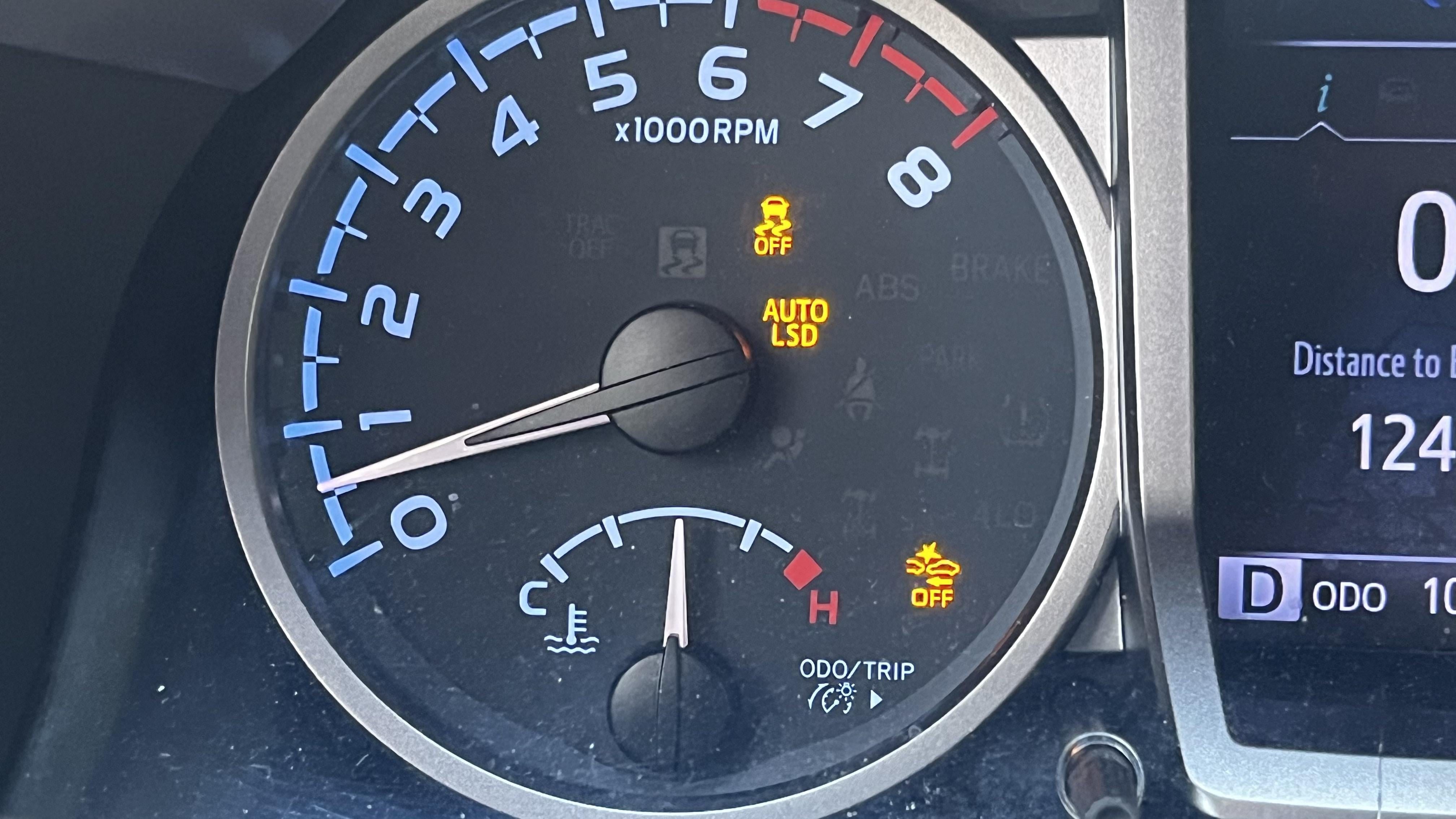
Auto LSD in Toyota trucks and SUVs is an electronic traction aid that uses the ABS system to brake a spinning wheel and redirect torque to the wheel with grip, rather than a true mechanical limited-slip differential.
What is Auto LSD on Toyota vehicles and how does it actually work?
Auto LSD is Toyota’s brake-based traction control system found on many 4×2 and 4×4 models including the Tacoma, Tundra, 4Runner, and Sequoia.
It monitors wheel speed sensors and applies the brake on the slipping wheel to send power to the opposite wheel.
Unlike a mechanical limited-slip differential, Auto LSD does not use clutch packs or helical gears.
It relies entirely on the ABS hydraulic unit, wheel speed sensors, and the skid control ECU.
This design keeps manufacturing costs low but creates specific failure points that shops often misdiagnose as differential problems.
Key components that control Auto LSD operation
- Wheel speed sensors: Located at the front and rear to track rotation.
- ABS actuator: The brake pressure modulator that physically applies the brakes.
- Skid control ECU: The computer brain containing the Auto LSD logic.
- Transfer case position switch: Specifically for 4WD models to detect range.
- Brake fluid: Ensuring proper level and condition for hydraulic pressure.
Why does my Toyota say “Auto LSD” on the dash and when should it activate?
The Auto LSD indicator illuminates when the system is enabled and actively managing traction.
On most Tacomas and Tundras, it only functions in 2WD and requires the driver to press the Auto LSD button below the dash.
Normal activation occurs during low-traction situations such as snow, mud, or when one rear wheel loses grip on pavement.
If the light stays on constantly or flashes without wheel slip, a sensor or wiring fault is present.
Conditions required for Auto LSD to engage
- 2WD Mode: Vehicle must be in 2WD mode on most models.
- Speed Threshold: Speed must be below approximately 25 mph.
- Input Detection: Throttle input must be present and a wheel speed difference detected.
- System Health: No active ABS or stability control faults can be stored.
Common Toyota Auto LSD problems reported by owners and technicians
Real-world failures usually stem from wheel speed sensor issues, contaminated tone rings, or problems inside the ABS module.
Many owners report the system engaging on dry pavement or failing to work when needed.
Dealerships frequently quote full differential replacement because they skip basic sensor diagnostics.
Independent shops familiar with Toyota ABS systems can often repair the fault for a fraction of that cost.
Wheel speed sensor and tone ring failures
Rear wheel speed sensors on Tacomas built between 2005 and 2015 commonly accumulate metallic debris that interferes with the signal.
Tone rings pressed onto the axle shafts can also crack or rust, creating erratic readings that trigger false Auto LSD activation.
ABS module and hydraulic unit faults
The skid control ECU can develop internal solder joint failures after 80,000–120,000 miles.
When this happens, the module may command brake pressure incorrectly or disable Auto LSD entirely and set C-series ABS codes.
How to diagnose Auto LSD issues step by step
Begin with a thorough scan of the ABS and skid control modules using a bidirectional scan tool capable of Toyota-specific data.
Generic OBD-II scanners often miss the Auto LSD enablement parameters.
Step-by-step diagnostic sequence
- Retrieve Codes: Pull all codes from ABS, engine, and transmission modules.
- Live Data: Check rear wheel speed sensor readings while driving in a straight line.
- Visual Inspection: Inspect tone rings for cracks or missing teeth using a borescope.
- Resistance Test: Measure sensor resistance (typically 1.0–1.4 kΩ).
- Actuator Test: Perform an ABS actuator test to verify solenoid operation.
- Fluid Check: Check brake fluid condition and bleed if contaminated.
Model-specific repair solutions for Toyota Auto LSD problems
Tacoma (2005–2015): Replace both rear wheel speed sensors and clean tone rings. If the ABS module stores repeated C1231 or C1232 codes, remove and resolder the module or replace it with a remanufactured unit.
Tundra and Sequoia (2007–2019): These models often suffer from rear axle tone ring rust. Remove the axle shafts, replace tone rings, and apply a rust inhibitor. The ABS module rarely fails on these trucks.
4Runner (2010–2023): Auto LSD faults are frequently caused by front wheel speed sensor harness chafing near the strut tower. Repair the harness and apply protective loom.
Can you drive with a faulty Auto LSD system?
Yes, but traction control and stability functions are compromised.
The vehicle remains drivable in most conditions; however, one-wheel spin will occur instead of torque being redirected.
Continued driving with a faulty system can mask developing brake or ABS issues.
Address the root cause before winter or off-road use.
Preventive maintenance to keep Auto LSD reliable
‘) no-repeat left 5px;”>
Replace brake fluid every 30,000 miles to prevent moisture damage.‘) no-repeat left 5px;”>
Use OEM or high-quality aftermarket sensors when replacement is needed.
FAQ
Does Auto LSD work in 4WD mode on Toyota trucks?
Auto LSD is disabled when the transfer case is shifted into 4WD on most Toyota models because the center differential or locking mechanism takes over torque distribution.
How much does it cost to fix a Toyota Auto LSD problem?
Sensor and tone ring repairs typically range from $250–$450 at an independent shop. ABS module replacement or repair usually costs $600–$950.
Will aftermarket wheels affect Auto LSD operation?
Wheels with different offsets or diameters can alter wheel speed readings and cause false activation. Always maintain the same overall diameter on all four tires.
Is Auto LSD the same as a locking differential?
No. Auto LSD only brakes one wheel. A true locker physically connects both wheels so they turn at the same speed regardless of traction.
Conclusion
Toyota’s Auto LSD system provides useful low-speed traction when functioning correctly, but its reliance on the ABS platform creates predictable failure points.
Accurate diagnosis begins with wheel speed data and tone ring inspection rather than assuming the differential itself has failed.
Owners who follow the step-by-step checks above can resolve most issues without expensive dealership repairs.
Leave a Reply