
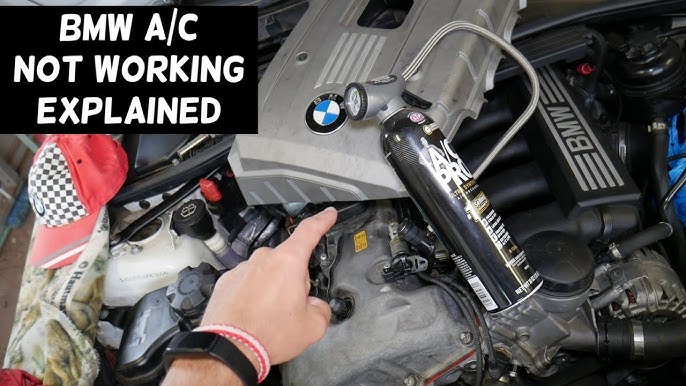
The most common reasons a BMW X5 air conditioning stops working are low refrigerant from a leaking condenser or evaporator core, a failed AC compressor, a faulty blend door actuator, or an electrical issue with the AC pressure sensor or IHKA climate control module. Proper diagnosis with an AC manifold gauge set and BMW-specific scan tool (ISTA) is critical before replacing any parts.
If your BMW X5 is blowing warm air or the AC has quit entirely, you are not alone. Across every generation—from the E53 to the current G05—BMW’s AC systems have a documented pattern of specific failures that most shops either misdiagnose or overquote.
This guide walks you through every known cause, how to diagnose each one yourself, and what a fair repair actually costs.
Why Is My BMW X5 AC Blowing Warm Air?
A BMW X5 blowing warm air usually points to low refrigerant, a seized compressor, or a blend door actuator stuck on the heat setting. The fastest way to narrow it down is to check if the compressor clutch engages when you turn the AC on MAX with the engine running. If the clutch does not spin, the system is either low on refrigerant, has an electrical fault, or the compressor itself has failed.
Before spending money at a shop, pop the hood and look at the AC compressor with the engine idling. Turn the AC to the coldest setting and max fan speed. Watch the center of the compressor pulley—on models with a visible clutch, it should click and start spinning.
On newer X5 models (2014+), the compressor is electronically controlled with no visible clutch, so you will need a scan tool to verify activation.
🔍 Quick Visual and Listening Checks
- Compressor clutch not engaging: Usually low refrigerant, bad pressure switch, or failed clutch coil.
- Compressor engages but blows warm: Likely low refrigerant, clogged expansion valve, or failed compressor internals.
- AC works then goes warm intermittently: Freezing evaporator (overcharged system or faulty expansion valve) or intermittent compressor clutch failure.
- Clicking or grinding from the compressor area: Internal compressor damage or failing bearing on the pulley.
- Musty smell with AC on: Evaporator drain is clogged, causing standing water and mold buildup behind the dash.
BMW X5 AC Compressor Failure: Symptoms, Causes, and Replacement Cost
The AC compressor on the BMW X5 is a known weak point, especially on E70 and F15 models with the N55 and N63 engines. Compressor failure typically presents as warm air, unusual noise from the front of the engine, or metallic debris circulating through the system.
A failed compressor often contaminates the entire AC system with metal shavings, which means a simple compressor swap is not enough—you must flush the lines and replace the receiver drier and expansion valve.
⚠️ Common Causes of Compressor Failure
- Internal valve failure: The variable displacement compressor used in most X5 models can lose its ability to modulate pressure internally. You will feel lukewarm air even though the compressor is technically spinning.
- Clutch coil burnout (E53, early E70): The electromagnetic clutch coil overheats and fails, preventing the compressor from engaging. You can test this with a multimeter—measure resistance across the clutch coil terminals. A reading of infinite resistance means the coil is open and needs replacement.
- Bearing failure: A growling or squealing noise that changes with engine RPM points to the compressor bearing. If caught early, you can replace just the bearing and clutch assembly rather than the entire compressor.
- Lack of use: BMW compressors seize when the AC is not run regularly. The refrigerant oil circulates only when the system operates. If you go months without using the AC, the seals dry out and internal components corrode.
💲 Compressor Replacement Cost by Model
| Model/Generation | Part Cost (OEM) | Labor Hours | Total Estimated Cost |
|---|---|---|---|
| E53 (2000-2006) | $350-$500 | 2-3 hours | $550-$900 |
| E70 (2007-2013) | $500-$800 | 3-4 hours | $800-$1,400 |
| F15 (2014-2018) | $600-$1,000 | 3-5 hours | $900-$1,600 |
| G05 (2019+) | $800-$1,200 | 4-5 hours | $1,200-$2,000 |
Important: If metal debris is found in the system, you must replace the condenser, expansion valve, and receiver drier along with the compressor. Skipping this step will cause the new compressor to fail within months.
BMW X5 Evaporator Core Leak: The $3,000 Repair Shops Don’t Want to Explain
The evaporator core is the component behind your dashboard that actually cools the air inside the cabin. On the BMW X5 E70 and F15, the evaporator is notorious for developing slow refrigerant leaks.
This is the single most expensive AC repair on the X5 because the entire dashboard must be removed to access it. Many shops will quote $3,000-$5,000 for this job, but the actual repair can be done for significantly less if you understand what is involved.
🔎 How to Confirm an Evaporator Leak
- Dye test: If your system has been charged with UV dye, use a black light behind the dash area near the evaporator drain hose. Visible glowing dye confirms the leak location.
- Electronic leak detector: Place the probe near the cabin air intake or the evaporator drain tube under the vehicle. Freon is heavier than air and will settle downward.
- Slow loss pattern: If your AC works great after a recharge but goes warm again within 2-8 weeks, and no external leak is found at the condenser or hose fittings, the evaporator is almost always the culprit.
📋 Model-Specific Evaporator Issues
E70 (2007-2013)
The E70 X5 has the highest rate of evaporator failure. The dash removal is labor-intensive, running 12-16 hours at most shops.
The evaporator itself costs $150-$300, but the labor is what drives the price. An experienced independent BMW shop can do this in 8-10 hours.
F15 (2014-2018)
Similar evaporator design to the E70 with slightly improved sealing. Still a dash-out job, but BMW revised the evaporator fitting connections, so a leak at the connections is less common than at the core itself.
G05 (2019+)
The G05 uses a different evaporator configuration, and while failures are less common at this age, early reports suggest the same pattern is developing. Refrigerant loss without visible external leaks should trigger an evaporator inspection.
BMW X5 Blend Door Actuator Failure: Fixing Hot Air on One Side
If your BMW X5 blows cold air on the driver’s side but hot air on the passenger side—or vice versa—the blend door actuator is the most likely cause. These small electric motors control the flaps that mix hot and cold air inside the HVAC housing. They fail frequently across all X5 generations.
🔔 Symptoms of a Bad Blend Door Actuator
- Temperature does not change on one or both sides when adjusted
- Clicking, ticking, or knocking sounds behind the dashboard
- AC blows cold initially then shifts to hot after a few minutes
- Climate control display shows correct setting but output does not match
🔧 How to Diagnose and Replace
- Use ISTA or BimmerLink to run an actuator calibration test. This cycles all blend door motors and flags the one that is not responding correctly.
- Access the faulty actuator. On the E70 and F15, the most common failure is the passenger-side temperature actuator, accessible by removing the lower glove box and trim panel. The driver-side actuator is behind the knee bolster.
- Remove the two or three screws holding the actuator to the HVAC housing. Disconnect the electrical connector and pull the actuator off the blend door shaft.
- Install the new actuator and run a calibration through the scan tool. This teaches the new actuator the full range of the blend door.
Actuator cost: $40-$80 aftermarket, $100-$180 OEM. This is a 30-60 minute DIY job on most X5 models and saves you $300-$500 in shop labor.
BMW X5 AC Not Turning On: Electrical and Sensor Faults
Sometimes the AC system has adequate refrigerant and a working compressor, but the system refuses to activate due to an electrical fault. The BMW X5 uses multiple sensors and control modules to decide whether the AC can run, and a single bad signal can shut the entire system down.
⚡ AC Pressure Sensor Failure
The high-pressure sensor on the BMW X5 monitors refrigerant pressure and tells the DME (engine computer) whether it is safe to engage the compressor. A faulty sensor can report zero pressure even when the system is fully charged, preventing compressor activation.
This sensor is located on the high-pressure line near the condenser or the receiver drier, depending on the model year. It costs $30-$60 and takes 15 minutes to replace.
🔌 Fuse and Relay Issues
- Check fuse F40 (E70) or the designated AC compressor fuse in your model’s fuse box. A blown fuse usually indicates a shorted compressor clutch coil or wiring fault, not just a random failure.
- The AC compressor relay is integrated into the fuse box on newer models. On the E53, it is a standalone relay in the fuse box in the engine bay. Swap it with an identical relay to test.
💻 IHKA Climate Control Module Glitch
The Integrated Heating and Climate Control (IHKA) module can develop software glitches that prevent AC operation. A hard reset—disconnecting the battery for 15 minutes—sometimes resolves this.
If the issue persists, the module may need to be reprogrammed with ISTA or replaced entirely. This is more common on the E70 and F15 after water intrusion into the footwell area from clogged sunroof drains.
BMW X5 AC Recharge: How Much Refrigerant Does It Need?
If your X5 AC system is confirmed low on refrigerant with proper gauge readings, a full recharge with R-134a (2000-2018 models) or R-1234yf (2019+ models) is necessary. The system capacity varies by model year and engine configuration.
🧊 Refrigerant Capacity Chart
| Model Year | Refrigerant Type | Capacity | Oil Type |
|---|---|---|---|
| 2000-2006 (E53) | R-134a | 750-850g | PAG 46 |
| 2007-2013 (E70) | R-134a | 800-900g | PAG 46 |
| 2014-2018 (F15) | R-134a | 850-950g | PAG 46 |
| 2019+ (G05) | R-1234yf | 750-850g | PAG YF |
Warning: Overcharging the system by even 100g can cause the evaporator to freeze, resulting in intermittent warm air. Always charge by weight using a digital scale, not by pressure readings alone, which fluctuate with ambient temperature.
🛠️ DIY Recharge Procedure
- Connect a manifold gauge set to the low and high side service ports.
- Evacuate the system with a vacuum pump for a minimum of 30 minutes to remove moisture.
- Close the valves and monitor gauges for 10 minutes. Any pressure rise indicates a leak that must be fixed before charging.
- Weigh the refrigerant can on a digital scale and charge to the exact specification listed on the underhood sticker.
- Run the engine at 1,500 RPM with AC on MAX and verify low-side pressure of 25-35 PSI and high-side pressure of 150-250 PSI depending on ambient temperature.
Frequently Asked Questions About BMW X5 AC Problems
Can I drive my BMW X5 with a bad AC compressor?
If the compressor pulley bearing is intact and the serpentine belt routes around the compressor, some models allow the AC compressor to freewheel without issue. However, if the compressor is seized, it will snap the serpentine belt and leave you stranded. Check your specific serpentine belt routing diagram to determine if a bypass is possible.
Why does my BMW X5 AC smell like mildew?
The evaporator drain tube is likely clogged, allowing water to pool inside the HVAC housing and breed mold. Locate the drain tube under the vehicle on the passenger side and clear it with a pipe cleaner or compressed air. Then treat the evaporator with an antibacterial spray through the cabin air filter housing.
How often should I run the AC in my BMW X5 to prevent problems?
Run your AC at least once a week for 10 minutes, even in winter. This circulates refrigerant oil through the seals, keeps the compressor internals lubricated, and prevents the compressor from seizing due to inactivity.
BMW’s system also runs the compressor automatically in defrost mode for this reason, but only if the outside temperature is above approximately 37°F.
Is it safe to use aftermarket refrigerant stop-leak products on my BMW X5?
No. Stop-leak products contain sealant compounds that can clog the expansion valve, damage the compressor, and contaminate shop AC machines.
BMW’s system uses precise metering components that are extremely sensitive to debris. Find and fix the actual leak instead.
Why does my BMW X5 AC shut off when I accelerate hard?
The DME (engine management module) temporarily disables the AC compressor under full throttle to maximize engine power output. This is normal BMW behavior. If the AC shuts off during normal driving acceleration, you may have an engine overheating issue or a failing compressor relay that drops out under voltage fluctuation.
Do BMW X5 models have cabin air filters that affect AC performance?
Yes. All X5 generations have a cabin air filter (also called a microfilter) located behind the glove box.
A clogged cabin air filter restricts airflow through the evaporator, reducing cooling efficiency and potentially causing the evaporator to freeze. Replace it every 15,000-20,000 miles or once a year.
Final Word: Diagnose Before You Replace
The single most important thing you can do before spending money on BMW X5 AC repairs is to get a proper diagnosis. A $50 AC manifold gauge set and a $30 electronic refrigerant leak detector will tell you more than any shop estimate written in five minutes.
Understand what has failed, get the specific part number for your model year and engine, and you will save yourself hundreds if not thousands of dollars in unnecessary repairs. The AC system on the X5 is not complicated—it is just unforgiving of neglect and misdiagnosis.
Leave a Reply