
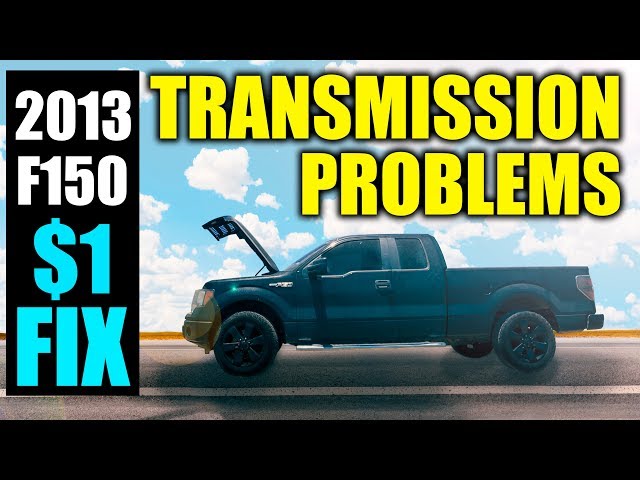
The most common Ford F-150 transmission problems include harsh or delayed shifting, torque converter shudder, transmission fluid leaks, slipping gears, and complete loss of forward or reverse gear. These issues affect the 6R80 (2011–2017) and 10R80 (2017–present) transmissions most frequently, with the 10-speed 10R80 being the most problematic unit Ford has ever put in a half-ton truck.
What Are the Most Common Ford F-150 Transmission Problems?
The Ford F-150 has suffered from widespread transmission complaints across multiple generations, but the issues intensified dramatically with the introduction of the 10-speed 10R80 automatic in 2017. Owners report harsh shifts between gears 1 through 4, delayed engagement when shifting from Park to Drive or Reverse, torque converter shudder between 40–60 mph, and sudden loss of power under load.
The 6R80 six-speed used from 2011 to 2016 had its own set of problems, primarily centered around valve body wear, solenoid failures, and premature clutch pack degradation. However, the sheer volume of complaints about the 10R80 has overshadowed nearly every prior transmission issue Ford has dealt with in the F-150 lineup.
Below is a quick comparison of the two most problematic transmissions found in the F-150:
| Transmission | Years Used | Most Reported Problem | Average Repair Cost |
|---|---|---|---|
| 6R80 (6-speed) | 2011–2017 | Valve body failure, solenoid sticking | $1,500–$3,500 |
| 10R80 (10-speed) | 2017–Present | Harsh shifting, torque converter shudder, adaptive learning failures | $2,000–$6,500 |
Why Does My Ford F-150 10-Speed Transmission Shift So Hard?
Hard shifting in the 10R80 transmission is almost always caused by a combination of adaptive shift strategy failures and worn or sticking solenoids inside the valve body. The transmission control module (TCM) learns your driving habits over time, but when the adaptive tables become corrupted or the solenoids fail to respond precisely, the result is violent gear changes—especially between 1st through 4th gear and during the 3-5 upshift.
Cause 1: Corrupted Adaptive Learning Tables
The 10R80 relies heavily on software-based adaptive learning. When the TCM accumulates bad shift data—often from city driving, towing, or aggressive throttle inputs—it begins commanding incorrect line pressures. This causes the transmission to slam into gear rather than making a smooth transition.
- Disconnect the battery for 30 minutes to force a full adaptive reset.
- Drive the truck gently for 50–100 miles so the TCM relearns your driving pattern.
- If the problem returns within a few thousand miles, the issue is hardware, not software.
Cause 2: Worn or Sticking Valve Body Solenoids
The valve body inside the 10R80 contains multiple solenoids that control fluid flow to each clutch pack. Over time, debris from worn clutch material clogs the solenoid screens, causing them to stick or respond sluggishly. This is the single most common hardware failure on these transmissions.
- Perform a full transmission fluid flush with Mercon ULV fluid.
- If flushing does not resolve the issue, the valve body must be removed and rebuilt or replaced.
- Aftermarket Sonnax solenoid kits are available and often outlast the OEM parts.
Cause 3: Software Calibration Issues
Ford has released multiple TSBs (Technical Service Bulletins) and PCM/TCM reflash updates specifically addressing shift quality on the 10R80. Many trucks leaving the factory had calibration software that commanded excessively high line pressures during certain shift points.
- Check with your dealer for the latest TCM calibration update for your specific VIN.
Common TSBs include 20-2100, 21-2200, and 22-2350, though availability depends on your model year.
- A dealer reflash is typically covered under powertrain warranty or can be done for 0.5–1.0 hour of labor.
What Causes Torque Converter Shudder in the Ford F-150?
Torque converter shudder in the F-150 feels like driving over rumble strips at 40–65 mph and is caused by degraded transmission fluid failing to maintain proper friction modifier levels inside the converter clutch. This problem affects both the 6R80 and 10R80 transmissions and is one of the most misdiagnosed issues at dealerships.
How to Confirm It Is Torque Converter Shudder and Not Something Else
Many shops will misdiagnose torque converter shudder as a bad U-joint, tire balance issue, or even a failing driveshaft. The key diagnostic test is simple: if the shudder disappears when you lightly press the brake pedal while maintaining throttle (which unlocks the converter clutch), you have confirmed a torque converter shudder problem.
- Drive at 45–55 mph on a flat road where the shudder is most noticeable.
- Maintain steady throttle and lightly tap the brake pedal with your left foot—just enough to trigger the brake light switch.
- If the vibration immediately stops and returns when you release the brake, the torque converter clutch is the culprit.
Fix 1: Transmission Fluid Exchange with Updated Formulation
Ford updated the Mercon ULV fluid formulation in 2020 to include improved friction modifiers. If your truck still has the original fluid or an older batch, a complete fluid exchange with the updated formulation often eliminates the shudder entirely.
- You need approximately 12–13 quarts for a full exchange on the 10R80.
- Use only genuine Ford Mercon ULV—aftermarket equivalents have been reported to cause additional shudder.
- A fluid exchange costs $250–$400 at most shops and is the cheapest first step.
Fix 2: Torque Converter Replacement
If a fluid exchange does not resolve the shudder, the friction material on the converter clutch disc is already glazed or worn beyond recovery. The torque converter must be replaced. This is a labor-intensive job because the transmission must be removed from the truck.
- Parts cost for an OEM replacement converter: $400–$700.
- Labor for removal and reinstallation: $800–$1,200.
- Always replace the transmission fluid and filter at the same time.
Why Does My Ford F-150 Transmission Slip or Lose Gears?
Transmission slipping in the F-150—where the engine revs but the truck does not accelerate proportionally—is typically caused by worn clutch packs, a failing pump, or low fluid levels from an undetected leak. On the 6R80, the most common cause is worn direct clutch plates. On the 10R80, it is usually a failed CDF drum bushing.
6R80 Direct Clutch Pack Failure
The direct clutch pack in the 6R80 handles a significant portion of the load during 3rd, 5th, and 6th gear operation. When the friction plates wear out, you will notice slipping during highway passing or while towing. This failure typically occurs between 80,000 and 130,000 miles.
- Check the transmission fluid for a dark brown or burnt smell.
- If caught early, a clutch pack rebuild can save the transmission without a full overhaul.
- Expect $2,500–$4,000 for a rebuild at an independent transmission shop.
10R80 CDF Drum Bushing Failure
This is a well-known design flaw in the 10R80. The CDF (Clutch Drum Front) bushing can spin out of position, causing internal fluid leaks that result in delayed engagement, slipping, and eventually complete loss of certain gears. Ford issued a revised CDF drum in 2022 to address this, but trucks built before that date remain vulnerable.
- Symptoms include a 2–3 second delay when shifting into Drive or Reverse.
- You may also notice the truck momentarily losing power during a 3-4 or 4-5 upshift.
- The only permanent fix is replacing the CDF drum with the updated part number and performing a full rebuild.
- This repair typically costs $3,500–$6,500 depending on the shop and region.
Is There a Ford F-150 Transmission Recall?
As of 2024, Ford has not issued a blanket recall for the 10R80 or 6R80 transmissions in the F-150, despite tens of thousands of complaints filed with the NHTSA. However, Ford has issued multiple TSBs and extended warranty coverage for specific components on certain model years. The NHTSA opened a preliminary evaluation (PE 22-017) into 10-speed transmission failures but has not escalated it to a full defect investigation.
What TSBs and Warranty Extensions Exist
- TSB 20-2100: Addresses harsh shifting on 2017–2020 F-150 with 10R80. Recommends TCM reflash.
- TSB 21-2200: Covers torque converter shudder on 2018–2021 models. Recommends fluid exchange with updated Mercon ULV.
- TSB 22-2350: Addresses delayed engagement and slipping on 2021–2022 models. Recommends CDF drum inspection and replacement.
- Customer Satisfaction Program 21N03: Extended warranty coverage for the valve body assembly on select 2017–2020 F-150s to 10 years/150,000 miles.
Always check with your dealer using your VIN to see if any open TSBs or warranty extensions apply to your specific truck. Many owners are unaware they qualify for free or reduced-cost repairs.
How Much Does It Cost to Rebuild a Ford F-150 Transmission?
A full transmission rebuild for a Ford F-150 ranges from $2,800 to $6,500 depending on the transmission type, the extent of internal damage, and whether you go to a dealership or an independent transmission specialist. Dealerships almost always quote on the higher end and often recommend a full replacement unit rather than a rebuild.
| Repair Type | 6R80 Cost | 10R80 Cost |
|---|---|---|
| Fluid and filter change | $150–$300 | $250–$400 |
| Valbody replacement | $1,200–$2,000 | $1,800–$3,000 |
| Torque converter replacement | $1,000–$1,800 | $1,200–$2,000 |
| Full rebuild | $2,800–$4,500 | $3,500–$6,500 |
| Remanufactured unit (installed) | $3,500–$5,000 | $4,500–$7,500 |
Dealership vs. Independent Shop: Which Is Better?
For warranty-covered work, always go to the dealership. For out-of-warranty repairs, an independent transmission specialist will almost always save you 30–50% compared to dealer pricing, and many independent shops have more hands-on experience with these specific failures than dealership techs who may only see a few transmission jobs per month.
- Ask any shop if they have specific experience with the 10R80 or 6R80 before authorizing work.
- Request that all replaced parts be returned to you so you can verify the work was done.
- Get a written warranty on the rebuild—minimum 12 months/12,000 miles is standard.
Frequently Asked Questions About Ford F-150 Transmission Problems
What year F-150 has the worst transmission problems?
The 2018 and 2019 Ford F-150 model years receive the highest volume of transmission complaints, particularly for harsh shifting and torque converter shudder with the 10R80 10-speed automatic. The 2021 model year also sees significant complaints related to CDF drum failure and delayed engagement.
Can I drive my F-150 with a shuddering transmission?
You can drive it temporarily, but you should not ignore it. Torque converter shudder accelerates wear on the converter clutch and sends debris through the entire transmission, turning a $300 fluid exchange into a $5,000 rebuild if left unaddressed for thousands of miles.
How long does a Ford F-150 transmission last?
With regular fluid changes every 40,000–60,000 miles, a Ford F-150 transmission can last 150,000–200,000 miles. However, the 10R80 has shown premature failures as early as 30,000–50,000 miles in some trucks, particularly those used for frequent towing or city driving.
Does the Ford F-150 PowerBoost hybrid have the same transmission problems?
The 2021 and newer F-150 PowerBoost uses a modified version of the 10R80 called the 10R80 MHT, which integrates an electric motor. It shares many of the same shift quality complaints as the standard 10R80, though the hybrid-specific components add another layer of potential failure points.
Should I buy a used F-150 with a rebuilt transmission?
A used F-150 with a documented, professionally rebuilt transmission can actually be a smart buy—especially if the rebuild addressed the known weak points like the CDF drum and valve body. Ask for the rebuild invoice and verify that updated parts were used.
Final Thoughts: Protecting Your F-150 Transmission
The single most effective thing you can do to extend the life of your Ford F-150 transmission is to change the fluid every 40,000 miles—regardless of what Ford’s “lifetime fluid” marketing claims suggest. There is no such thing as lifetime transmission fluid. Use genuine Mercon ULV for the 10R80 and Mercon LV for the 6R80, and avoid cheap aftermarket alternatives that may not have the correct friction modifier package.
If you are experiencing any of the symptoms described in this article, do not let a dealership tell you it is “normal characteristic operation.” Ford has used that phrase to dismiss legitimate transmission defects for years. Push for a TSB check, request a TCM reflash, and if the problem persists, escalate to Ford’s Customer Relationship Center or file a complaint with the NHTSA. Enough complaints are what eventually force recalls and extended warranty coverage.
Leave a Reply