
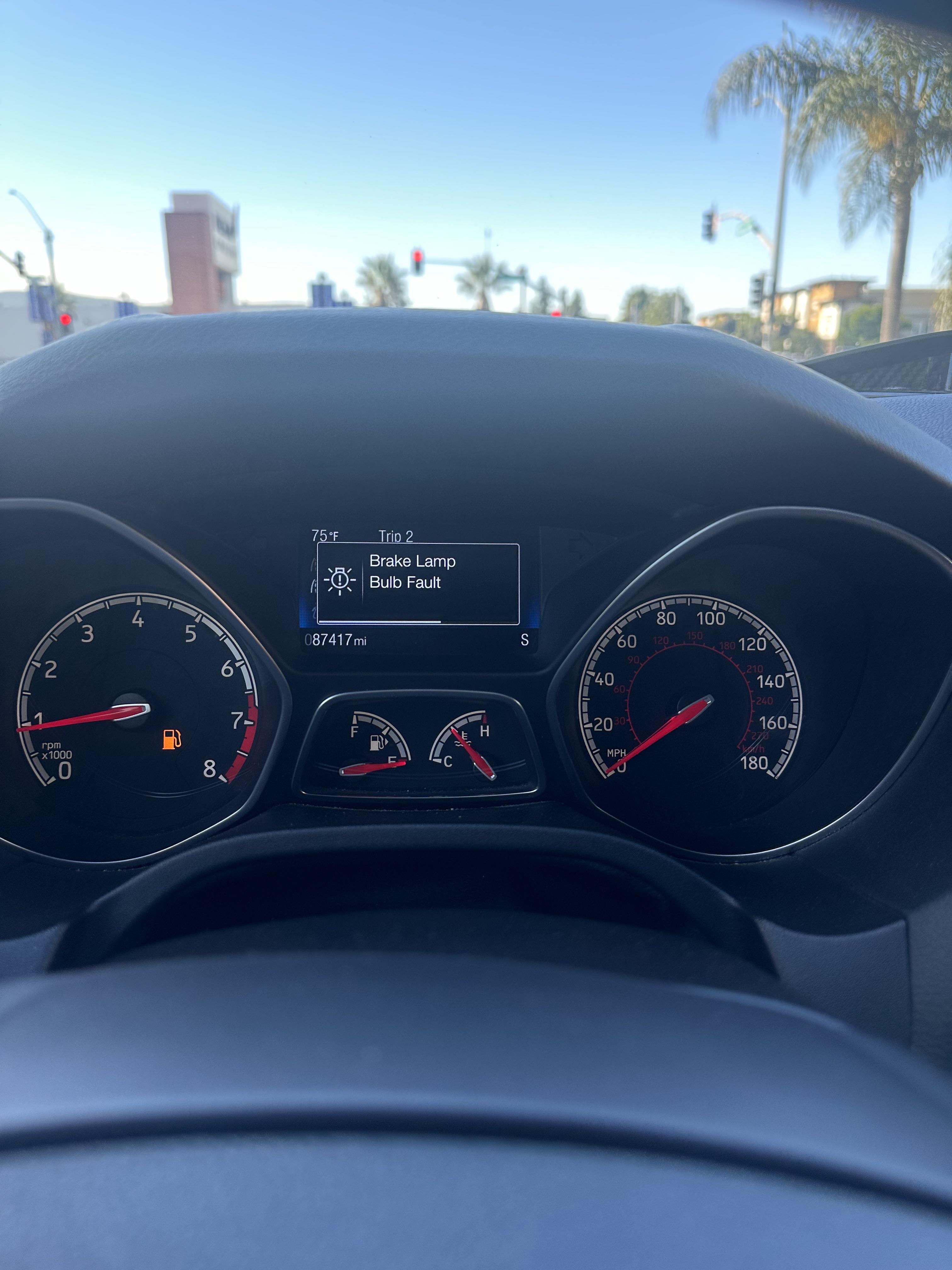
A “Brake Lamp Bulb Fault” message on a Ford Focus is most commonly caused by a blown brake light bulb, a corroded or melted bulb socket, a faulty brake light switch, or a burned-out third brake light (CHMSL). On 2012-2018 Focus models, the most frequent culprit is a corroded rear bulb socket harness that fails even with a brand-new bulb installed, tricking the Body Control Module (BCM) into displaying the fault.
What Does “Brake Lamp Bulb Fault” Mean on a Ford Focus?
This warning message appears on your instrument cluster when the Body Control Module (BCM) detects an open circuit or abnormal resistance in the brake lamp circuit. It means one or more of your brake lights are not functioning correctly. The BCM monitors current flow to the brake lamps, and when it sees a drop below the expected threshold, it triggers the message and may illuminate a warning light on the dash.
Unlike older vehicles where a blown bulb was always the answer, the Ford Focus uses a BCM-monitored system that is sensitive to even minor electrical faults. A bulb that looks visually fine can still trigger the fault if its filament resistance has shifted or if the socket contact is compromised.
Which Brake Lights Are Monitored?
- Left rear brake light — Tail lamp assembly, lower bulb
- Right rear brake light — Tail lamp assembly, lower bulb
- Center High-Mount Stop Lamp (CHMSL) — Rear window or spoiler-mounted LED or bulb
- Left and right rear fog lamps — On some European-spec models, these are part of the monitored circuit
If any one of these fails, the BCM will display the fault. This is critical to understand because many owners replace both rear bulbs and still see the message, not realizing the CHMSL or a fog lamp is the actual failure point.
What Are the Most Common Causes of Ford Focus Brake Lamp Bulb Fault?
The most common causes are a burned-out brake bulb, a corroded or melted bulb socket, a defective brake light switch near the pedal, a failed CHMSL unit, or a BCM software glitch. On higher-mileage vehicles, moisture intrusion into the tail lamp housing accelerates socket corrosion dramatically.
1. Burned-Out Brake Light Bulb
This is the simplest and most obvious cause. Ford Focus models typically use a dual-filament bulb (commonly 3157 or 7443) for the brake and tail light combination.
When the brake filament burns out, the tail light portion may still work, making it deceptive during a visual inspection. Always test with the brake pedal pressed and have someone watch, or back up to a reflective surface at night.
2. Corroded or Melted Bulb Socket
This is the number one hidden killer on 2012-2018 Ford Focus models. The rear tail lamp sockets are prone to corrosion from moisture that enters through the tail light housing gaskets.
The brass contacts inside the socket develop a white or green oxidation layer that increases resistance beyond the BCM’s acceptable threshold. Even a brand-new bulb will not fix the fault if the socket contacts are corroded.
In some cases, you will see the plastic socket housing itself is melted or discolored. This happens when high-resistance connections create localized heat. If your socket is melted, do not just replace the bulb — the entire socket pigtail harness needs to be replaced.
3. Faulty Brake Light Switch
The brake light switch is mounted above the brake pedal on a bracket. On certain Focus model years, notably 2012-2014, the switch can develop intermittent internal contact failure.
The brake lights may flicker, work intermittently, or not work at all. This switch also feeds the BCM, the cruise control system, and the shift interlock, so you may notice other symptoms like cruise control not engaging or the gear shifter being stuck in Park.
4. Failed CHMSL (Third Brake Light)
Many owners overlook the center brake light entirely. On the 2012-2018 Focus, the CHMSL uses either a small bulb or an LED array depending on trim level.
If the LED board fails or the small incandescent bulb burns out, the BCM flags it the same way as a rear brake lamp failure. This is a frequently missed diagnosis at both dealerships and independent shops.
5. Wiring Damage or Ground Fault
The wiring harness running to the rear tail lamps can rub against the body of the car, especially near the trunk hinge area or along the rear wheel well. Over time, the insulation wears through and exposes bare copper, which can short to ground or corrode. This creates an intermittent fault that may come and go depending on trunk lid position or road vibrations.
6. BCM Software Glitch
In rare but well-documented cases, the Body Control Module itself can develop a software fault that falsely reports a brake lamp bulb fault. This is most commonly seen after a battery replacement or jump start, where a voltage spike confuses the BCM. A hard reset by disconnecting the battery for 15 minutes or a BCM software update at the dealer may resolve it.
How to Diagnose Ford Focus Brake Lamp Bulb Fault at Home
Start by pressing the brake pedal and checking all brake lights with a helper. Then inspect the bulb sockets for corrosion, test the brake light switch with a multimeter, and check the CHMSL. This sequential process catches 95% of faults without any special tools.
Step-by-Step Diagnostic Procedure
- Check all brake lights visually. Have someone press the pedal while you stand behind the car. Check left, right, and the CHMSL (third brake light).
- Remove the tail lamp assemblies. On most Focus models, there are two 8mm or 10mm nuts behind the trunk trim panel holding each tail lamp in place. Pull the assembly straight back.
- Inspect the bulb sockets. Look for green or white corrosion on the brass contacts. Look for melted or discolored plastic. Wiggle the bulb — if it is loose, the socket tension is worn out.
- Test the bulbs with a multimeter. Set to continuity or resistance. The dual-filament bulb should show two separate circuits — a low resistance reading for the tail filament and a higher current path for the brake filament.
- Check the CHMSL. Remove the cover on the rear deck or spoiler and inspect. If it uses a bulb, test it. If it uses an LED board, look for darkened or dead LEDs.
- Test the brake light switch. With the switch unplugged, use a multimeter to check continuity across the switch terminals. It should show continuity when the pedal is pressed and open circuit when released. Replace if it fails this test.
- Inspect wiring. Trace the harness from the tail lamp connector back into the body. Look for chafing, exposed copper, green corrosion on wires, or pinch points near the trunk hinge.
Ford Focus Brake Lamp Bulb Fault by Model Year
Different generations of the Ford Focus have distinct weak points. The 2005-2011 models suffer from socket corrosion similar to the 2012-2018 but with easier access.
The 2012-2018 models have the most reported issues with the BCM, socket corrosion, and CHMSL failure. The 2019-2024 models (where available) have fewer reports but occasional LED module failures.
| Model Year Range | Most Common Cause | Typical Fix | Average DIY Cost |
|---|---|---|---|
| 2005-2011 (Mk2) | Blown bulb or corroded socket | Replace bulb (3157) or socket pigtail | $5-$25 |
| 2012-2014 (Mk3) | Corroded socket, brake light switch failure | Replace socket harness, replace brake switch | $10-$40 |
| 2015-2018 (Mk3.5 Facelift) | Corroded socket, CHMSL failure, BCM glitch | Replace socket or CHMSL, BCM reset or reflash | $10-$80 |
| 2019-2024 (Mk4 where available) | LED module failure in tail lamp | Replace LED tail lamp assembly | $80-$200 |
How to Replace a Ford Focus Brake Light Bulb
Replacing the brake light bulb on a Ford Focus is a straightforward 10-minute job. Open the trunk, remove the two retaining nuts behind the tail lamp, pull the assembly out, twist the socket counterclockwise, and swap the bulb. Always replace bulbs in pairs to maintain even brightness.
Tools Needed
- 8mm or 10mm socket or wrench
- Replacement bulb (3157 or 7443 — check your owner’s manual)
- Dielectric grease
- Electrical contact cleaner (if socket is corroded)
Replacement Steps
- Open the trunk and locate the trim panel covering the backside of the tail lamp.
- Remove the two mounting nuts securing the tail lamp assembly.
- Gently pull the tail lamp assembly straight back to release it from the body clips.
- Locate the brake light bulb socket — it is typically the lower socket on the outer portion of the assembly.
- Turn the socket counterclockwise (approximately one quarter turn) and pull it out.
- Remove the old bulb by pulling it straight out of the socket.
- Insert the new bulb. Apply a thin layer of dielectric grease to the base of the bulb and the socket contacts to prevent future corrosion.
- Reinstall the socket into the tail lamp, turn clockwise to lock.
- Test by pressing the brake pedal before reinstalling the assembly.
- Reinstall the tail lamp assembly and tighten the mounting nuts. Do not overtighten.
How to Fix a Corroded Brake Light Socket on Ford Focus
If your socket contacts are corroded, you can attempt to clean them with electrical contact cleaner and a small wire brush or sandpaper. However, if the plastic housing is melted or the contacts are severely pitted, the entire socket pigtail harness must be replaced. Ford sells replacement socket harnesses, and aftermarket options are widely available for under $15.
Cleaning vs. Replacing the Socket
- Clean if: The contacts have surface corrosion but are still structurally intact, the plastic is not melted, and the bulb fits snugly.
- Replace if: The plastic is discolored or melted, the contacts are deeply pitted or green, the bulb wobbles in the socket, or cleaning did not resolve the fault message.
How to Replace the Socket Pigtail Harness
- Cut the old socket out, leaving as much wire length as possible.
- Strip approximately half an inch of insulation from each wire on the vehicle harness and the new pigtail.
- Use heat-shrink butt connectors (not just electrical tape) to splice the wires together, matching color to color.
- Apply dielectric grease to the new socket contacts before installing the bulb.
- Test the brake light function and confirm the dash message clears.
When to Suspect the Brake Light Switch
Suspect the brake light switch when none of the brake lights work, when you also have cruise control issues, or when the gear shifter will not move out of Park. The switch is a $10-$20 part that sits above the brake pedal and can be replaced in 15 minutes without any special tools.
Symptoms of a Bad Brake Light Switch
- Brake lights do not illuminate at all
- Brake lights stay on constantly even without pedal input
- Cruise control will not set or disengages unexpectedly
- Shift interlock prevents moving shifter from Park to Drive
- “Brake Lamp Bulb Fault” message with no visibly failed bulbs
Replacement Procedure
- Lie on your back in the driver footwell and locate the switch mounted to the brake pedal bracket.
- Disconnect the electrical connector by pressing the release tab.
- Twist the switch approximately 45 degrees counterclockwise and pull it out.
- Install the new switch by inserting it into the bracket and twisting clockwise to lock.
- Reconnect the electrical connector.
- Test brake lights, cruise control, and shift interlock function.
Will a Ford Focus Brake Lamp Bulb Fault Fail an Inspection?
Yes, a non-functional brake light will fail a state safety inspection in virtually every US state and MOT test in the UK. The brake lamp system is a critical safety feature, and any brake light — including the CHMSL — that does not illuminate when the pedal is pressed will result in an automatic failure. Resolve the fault before your inspection date.
How Much Does It Cost to Fix Brake Lamp Bulb Fault at a Dealership?
A Ford dealership will typically charge $80-$250 for diagnosis and repair of a brake lamp bulb fault. The diagnostic fee alone ranges from $80-$150.
If the socket harness needs replacement, expect $120-$200 total including parts and labor. A brake light switch replacement at the dealer runs $100-$180.
An independent shop will usually be 30-40% less. DIY repair costs between $5-$80 depending on the part needed.
Frequently Asked Questions
Can I drive with a brake lamp bulb fault message on?
You can drive, but you should not. At least one of your brake lights is non-functional, which reduces your visibility to following drivers and is a traffic violation in most jurisdictions. Fix it as soon as possible — many of the repairs take less than 20 minutes.
Why does the brake lamp bulb fault keep coming back after replacing the bulb?
The most likely reason is a corroded or worn socket that cannot maintain proper contact with the new bulb. The second most common reason is a different brake light source that you did not check, such as the CHMSL. Check every brake light and inspect every socket before assuming the problem is elsewhere.
Does the Ford Focus use LED brake lights?
Most 2012-2018 Ford Focus models use traditional incandescent dual-filament bulbs for the rear brake lights. The CHMSL may use an LED array on higher trim levels. The 2019 and newer models in some markets switched to full LED tail lamps, which require assembly replacement rather than bulb replacement when they fail.
Why does my brake lamp fault message appear only when it is cold or rainy?
This points directly to moisture intrusion in the tail lamp housing. When humidity or rain water gets into the assembly, it accelerates corrosion on the socket contacts.
In cold weather, condensation forms inside the housing and temporarily disrupts the electrical connection. Inspect the tail lamp gasket and seal any gaps with RTV sealant.
Can a weak battery cause a false brake lamp bulb fault?
Yes. Low system voltage can cause the BCM to misread the resistance in the brake lamp circuit and throw a false fault.
If the message appeared right after a battery replacement, jump start, or during cold weather when your battery is struggling, try a hard reset by disconnecting the negative battery terminal for 15 minutes. If the message does not return, voltage was likely the cause.
Fix It Right the First Time
The Ford Focus brake lamp bulb fault is one of the most common and most misdiagnosed warning messages on this platform. Do not fall into the trap of blindly replacing bulbs and hoping the message clears.
Work through the diagnostic steps methodically — check every light, inspect every socket, and test the switch before spending money at a shop. In the majority of cases, a $10 socket pigtail or a $7 bulb and five minutes of your time is all it takes to resolve the problem permanently.
Apply dielectric grease on reassembly, and you likely will not see this fault again for years.
Leave a Reply