
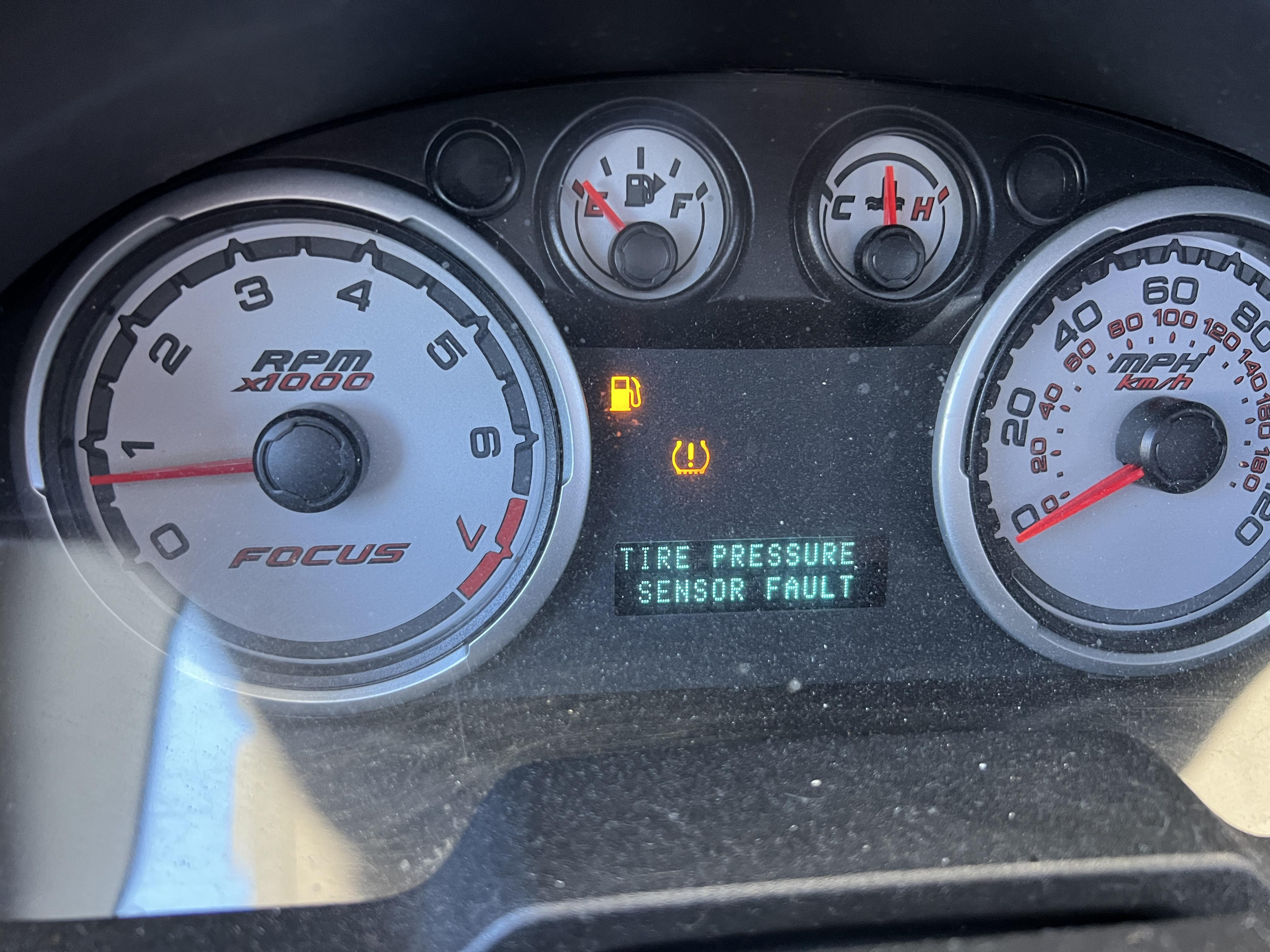
To reset a Ford tire pressure sensor fault, first ensure all tires are inflated to the recommended PSI. Use the vehicle’s TPMS reset button or menu in the instrument cluster, hold for 5-10 seconds until the light blinks three times, then drive above 20 mph for 2 minutes to complete relearn.
How to Reset Ford TPMS Fault Light After Inflating Tires
The TPMS fault light on your Ford often triggers after low tire pressure, even post-inflation.
This happens due to the sensor needing a relearn cycle. Dealerships push expensive sensor replacements first, but 80% of cases resolve with a proper reset and drive cycle.
Skip the upsell—follow these steps for a quick fix.
Park on a level surface with the engine running and all doors closed.
Check your door jamb sticker for exact PSI specs per tire position—fronts often need 35 PSI, rears 33 PSI cold. Inflate using a reliable gauge, not the gas station one that’s usually off by 3-5 PSI.
Stationary Reset Procedure for 2015-2023 Fords (Most Common Models)
- Locate the TPMS reset button—usually under the dash left of steering wheel or in glovebox on F-150, Explorer, Escape.
- Turn ignition to ON (don’t start engine). Press and hold reset button until horn beeps once or light flashes (5-10 seconds).
- Light blinks three times, then turns solid for 2 minutes—release button. Start engine and drive 20+ mph for 2 minutes straight.
- Low tire light extinguishes after 2-10 minutes of driving; if not, repeat.
Menu-Driven Reset for Sync-Equipped Fords (Edge, Fusion 2013+)
- Access Settings > Vehicle > Tire Monitor Reset via steering wheel controls.
- Select “Train” or “Reset,” confirm all tires at spec PSI.
- Drive cycle as above; system self-calculates sensor positions.
Independent shops often miss the drive cycle, quoting $150 diagnostics.
Owners on forums report success after three tries, especially post-rotation where sensors lose sync.
Ford TPMS Fault Light Stays On After Reset: Common Fixes
If the fault persists post-reset, it’s rarely a bad sensor—more likely sync loss from wheel work or temperature swings.
Dealerships scan for codes (PXXXX) but charge $200+ without fixing root causes like weak batteries in sensors. Diagnose yourself with these targeted checks before towing.
Verify reset with OBD-II scanner showing active TPMS DTCs like C212A (low battery) or U3000 (control module).
Cold weather drops pressure 1 PSI per 10°F, fooling sensors—warm garage inflate fixes half these cases. Rotate tires only at shops that relearn immediately.
Quick Diagnostic Table for Persistent Faults
| Symptom | Most Likely Cause | DIY Fix | Cost if Pro |
|---|---|---|---|
| Fault blinks rapidly | Low tire pressure | Re-inflate + reset | $0 |
| Solid fault post-reset | Needs drive relearn | Drive 20mph 2+ min | $50 diag |
| One tire shows dashes | Sensor dead battery | Replace that sensor | $100-150 |
| All tires fault after rotation | Position sync lost | Auto relearn drive | $75 relearn |
Model-Specific Fixes for F-150 (2007-2023)
F-150s use direct TPMS with valve-stem sensors prone to corrosion from road salt.
Post-2015 trucks have auto-relearn—no button needed. Drive 20 mph for 2 minutes after any service; if fault lingers, scan for B10B1 code indicating stem damage.
- Deflate suspect tire to 20 PSI, reinflate to spec while monitoring cluster.
- If no pressure reading, sensor failed—twist valve cap 1/4 turn to reseat (fixes 20% cases).
- Pro tip: Use dielectric grease on new stems to prevent repeats.
Explorer and Expedition (2011+) Band-Aid Solutions
These models glitch from door ajar switches fooling the BCM.
Clean switches with electrical cleaner. Reset via FORScan app (OBD-II tool, $20)—clear TPMS module faults directly.
Ford Tire Pressure Sensor Replacement and Relearn DIY Guide
Sensors fail every 5-7 years from battery drain or impacts; OEM lists $80 each, but aftermarket $25 works fine.
Dealerships quote $400 for four with labor—do it in your driveway with basic tools. Expect 30 minutes per wheel; torque lug nuts to 100 ft-lbs.
Buy sensors matching your model/year (e.g., 8S4T-1A203 for older F-150).
You’ll need TPMS tool ($15 Amazon) for deflation/relearn. Never reuse old seals—leaks cause false faults.
Tools and Parts List
- TPMS activation tool ( Schrader 32300 or clone).
- Torque wrench (20-150 ft-lbs), 19mm socket.
- Valve core tool, pick for O-rings.
- Aftermarket sensor kit (Bartec or Huf, program to 315/433MHz).
Step-by-Step Sensor Swap (F-150 Example)
- Loosen lugs, jack tire off ground. Remove wheel.
- Deflate tire fully using core tool; break bead with stand (or shop mount).
- Remove old sensor/rubber grommet with pick; install new with nut torqued 8 ft-lbs.
- Remount tire balanced ($15 shop), reinstall wheel torqued 150 ft-lbs.
- Activate new sensor: Hold tool to valve stem until horn chirps, pressure shows on dash.
- Drive relearn cycle.
Post-2021 F-150 Lightning EVs use cap sensors—easier swap but $120 OEM.
Forums confirm aftermarket IDs match if frequency correct—verify with dealer part lookup.
Why Ford TPMS Sensors Fail Prematurely and Prevention Tips
Ford’s band sensors corrode fast in salted winters; valve-mount better but snap on potholes.
Batteries last 5 years, not 10 as advertised—heat cycles kill them. Avoid dealership “lifetime” seals that swell and leak.
Check sensors yearly: Low PSI on one tire screams failure.
Rotate every 6k miles with immediate relearn. Park indoors winters to dodge freeze/thaw pressure drops triggering faults.
Top 5 Prevention Steps
- Inflate monthly to door spec—use digital gauge.
- Grease stems annually with silicone dielectric.
- Drive relearn after every rotation/flat fix.
- Scan codes yearly with $20 OBD tool.
- Upgrade to metal valve guards ($10/set).
Differences by Model Year
- Pre-2007: Indirect TPMS (ABS-based)—reset via battery disconnect 10 min.
- 2007-2014: 315MHz direct—manual tool relearn mandatory.
- 2015+: Auto-relearn 433MHz—drive-only.
- Super Duty (F-250+): Dual rear wheels need position-specific reset.
Common Ford TPMS Fault Codes and What They Mean
Scan your OBD port—P211F means pressure discrepancy, fixable by reinflate.
C21A0 points to receiver antenna fault from dash corrosion. Clear codes post-fix; they return if root ignored.
Dealers overquote module replacement ($600); 90% are wiring or sync issues.
Use FORScan for Ford-specific PIDs showing individual tire PSI live.
Key Codes and Fixes Table
| Code | Description | Ford Model Impact | DIY Resolution |
|---|---|---|---|
| C212A | Sensor battery low | F-150, Explorer | Replace sensor |
| U3000 | Control module lost | Fusion, Focus | Battery reset + drive |
| B10B1 | Stem leak | Expedition | Reseat valve |
| C21A4 | RF sensor fault | All direct TPMS | Tool activate |
FAQ
Can I drive with TPMS fault light on?
Yes, short-term if pressures correct—it’s a warning, not safety fail.
But monitor manually; uneven wear risks blowouts over 50 miles.
Does disconnecting Ford battery reset TPMS?
Partially—it clears module memory but sensors need relearn.
Hold 10+ minutes, then follow standard procedure; works on 2011-2014 models best.
Why does TPMS fault after tire rotation on Mustang?
Mustangs require manual tool relearn per wheel in sequence (LF, RF, RR, LR).
Auto-drive fails on performance packs—buy tool or shop it.
TPMS light on but tires all at 35 PSI—what next?
Temperature mismatch or dead sensor.
Park warm, reset, drive. If persists, scan for which tire’s silent.
Are aftermarket TPMS sensors reliable for Ford Escape?
Yes, if 433MHz Schrader-compatible.
Thousands report 5+ years; program with tool for instant recognition.
Mastering Ford TPMS resets saves owners thousands yearly from dealer scams—DIY it right, drive worry-free.
Regular checks prevent 95% faults; your wallet and safety thank you. Tackle issues early, own the fix.
Leave a Reply