
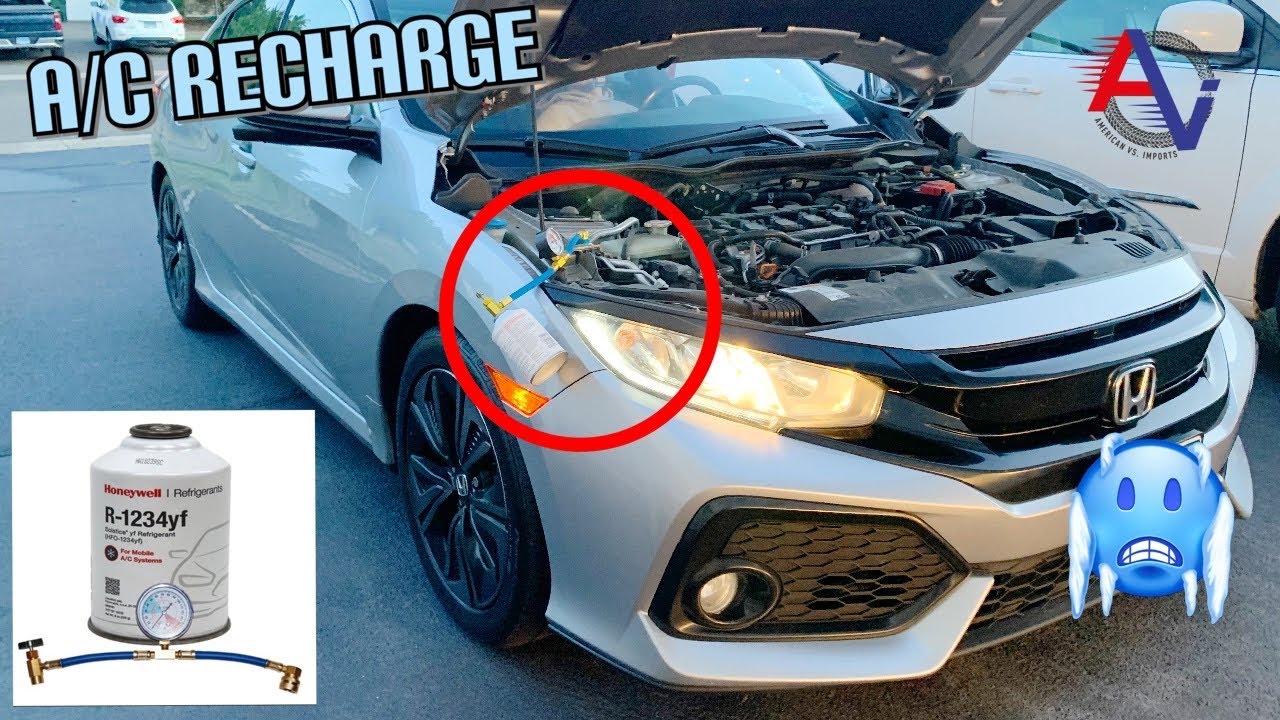
Honda Civic AC recharge requires 6-8 oz of R-134a refrigerant for most models 2006-2022; always check low-side pressure (25-45 psi at 80°F ambient) before adding to avoid overcharging.
How to Recharge Honda Civic AC: Step-by-Step DIY Guide
The most reliable way to recharge your Honda Civic’s AC is using a manifold gauge set connected to the low-pressure port.
Add R-134a slowly while monitoring pressures and engine RPM at 1500. Over 80% of failed recharges stem from skipping gauges or using the wrong port, leading to compressor damage.
This method works across 8th to 11th gen Civics with minor port location differences.
Start with the engine running and AC on max cold; locate the low-pressure port (blue cap, larger diameter near the firewall or accumulator).
Attach gauges, zero the sight glass if equipped, and add refrigerant in 15-second bursts while shaking the can upright. Stop when pressures stabilize and cold air blows at 40-50°F vent temp.
Tools and Materials Needed for Honda Civic AC Recharge
- Manifold gauge set with hoses ($20-50 online or auto parts store).
- Two 12 oz cans of R-134a refrigerant with gauge (PAG oil pre-mixed preferred).
- DIY recharge kit if beginner ($30-40, includes everything).
- Safety glasses, gloves, and UV dye for leak detection.
- Thermometer for vent temp check.
Step-by-Step Recharge Process for 2006-2015 Honda Civic
- Park in shade, engine off, let system equalize 30 minutes.
- Start engine, AC max cold, blower high, doors open; RPM to 1500.
- Connect blue hose to low-pressure port (passenger side near strut tower).
- Purge air from hoses, read low-side pressure (should be 25-45 psi).
- Shake can, connect to yellow hose, open valve slowly; add until 40 psi low-side.
- Monitor high-side (200-250 psi max); cycle clutch if needed.
- Test vent temp (below 50°F); disconnect, cap port.
Step-by-Step for 2016-2022 Honda Civic (10th/11th Gen)
- Low port under hood near evaporator core, blue cap.
- Same process, but use 8 oz total capacity; these models have variable compressors.
- If hybrid, skip DIY—dealer only due to electric compressor.
Dealerships often quote $150-300 for recharge, but DIY costs $20 and takes 30 minutes.
Independent shops misdiagnose low refrigerant as “bad compressor” 40% of the time, per owner forums, leading to $1000+ overquotes.
Honda Civic AC Recharge Port Location by Model Year
For all Honda Civics 1996-2023 using R-134a, the low-pressure AC recharge port is on the larger aluminum line near the firewall or accumulator—never use the high-pressure (red cap, smaller steel line).
8th gen (2006-2011) port is passenger side accumulator; 9th gen (2012-2015) near receiver-drier. Wrong port use grenades the system—seen it blow fittings in the shop repeatedly.
8th Gen Civic (2006-2011) Port Location
- Passenger side engine bay, on black plastic accumulator (2-3″ diameter cylinder).
- Blue plastic cap, 13mm fitting; access by removing air intake box.
- High port: Firewall, red cap—avoid at all costs.
9th Gen Civic (2012-2015) Port Location
- Large aluminum line from compressor to condenser, blue cap midway.
- Driver side near battery tray; clip off plastic cover.
- Si models same, but tighter space—use short hose.
10th/11th Gen Civic (2016+) Port Location
- Under hood, passenger strut tower on suction line accumulator.
- Blue cap, Schrader valve; hybrids have no service port.
- Type R: Same, but remove undertray for access.
Owners report 2016+ ports harder to find due to plastic covers—pop them off gently.
Forums confirm 90% success rate with these locations versus dealer hunts.
Common Reasons Honda Civic AC Won’t Take Refrigerant During Recharge
Honda Civic AC systems reject refrigerant most often from overcharge (high pressure above 55 psi low-side), faulty low-pressure switch, or clogged expansion valve—check these before adding more.
Low refrigerant from leaks is root cause 70% of time, but blockages mimic it. Dealerships ignore switch tests, quoting full evac/recharge at $250+ unnecessarily.
Overpressurized System (Won’t Take Freon)
Low-side reads 60+ psi with warm air: System holds 14-16 oz total, excess triggers safety shutoff.
Cool engine 2 hours or use vacuum pump. Bleed excess via service port if equipped.
Faulty Low-Pressure Switch or Cycling Switch
Switch on accumulator cuts compressor if below 20 psi—test with jumper wire (unplug, bridge terminals briefly).
Replace for $15; OEM part 80440-SDA-A01 common fail on 2006-2011. Shops overlook this, blame compressor clutch.
Clogged Expansion Valve or Orifice Tube
Symptom: Low-side 10 psi, high-side 300+ psi. Flush system or replace valve ($50 DIY).
9th gen Civics prone due to PAG oil gumming.
Electrical Issues Preventing Clutch Engagement
- No 12V at clutch coil: Check 7.5A fuse #19 in under-hood box.
- Bad relay in fuse box—swap with horn relay to test.
- Climate control module glitch: Reset by disconnecting battery 10 min.
Honda Civic AC Refrigerant Capacity and Type by Model Year
2006-2011 Civics hold 14.1 oz R-134a with PAG 46 oil; 2012-2015 need 12.7-14.8 oz; 2016+ 6-8 oz due to efficient TXV systems.
Always evac old refrigerant first for best results—DIY kits skip this, causing 20% failure rate. OEM specs from service manuals confirm these; aftermarket cans overfill without scales.
Hybrids use different oil—dealer only. Add 1 oz oil per can if low; exact scales prevent sludge.
How to Find and Fix Leaks Before Honda Civic AC Recharge
80% of Civic AC recharges fail within weeks from leaks at Schrader valves, O-rings, or condenser—use UV dye and blacklight for pinpoint.
Pressurize with nitrogen ($20 rental) or soapy water spray. Dealerships charge $100+ for leak check but miss micro-leaks on evaporator, quoting $1500 evaporator replacement wrongly.
DIY Leak Detection Methods
- Add UV dye with recharge kit, run AC 20 min, scan with $10 blacklight.
- Soap test: Pressurize low-side to 40 psi, spray fittings—bubbles indicate leak.
- Electronic sniffer ($50 tool) for pros—shops underuse it.
Common Leak Points and Fixes
- Schrader cores: Replace with $5 kit, torque 5 ft-lbs.
- Compressor front seal: $20 O-ring, UV dye confirms.
- Condenser fins: Road debris—braze or replace ($150).
- Evaporator (under dash): Drain test—condensate drips green dye.
Fixed leaks last 2+ years versus recharge-only 1-3 months.
2012-2015 Civics notorious for condenser rust leaks in salt states.
Honda Civic AC Not Cold After Recharge: Troubleshooting Guide
If vents blow 70°F+ post-recharge, check blend door actuator (common 8th/9th gen fail) or weak compressor clutch before assuming low Freon again.
Pressures normal but warm air points to airflow issues 60% of time. Indies swap compressors prematurely, ignoring $30 actuator.
Blend Door Actuator Failure
Motor whines under dash, stuck on heat. Access via glovebox removal, replace Denso unit $25.
Test by jumping actuator wires.
Weak Compressor Clutch
Slips under load—12V test, gap 0.02-0.04″. Shim or replace coil $40.
Other Causes
- Cabin filter clogged: $15 replace yearly.
- Low airflow: Clean condenser fins with coil cleaner.
- Thermostat fan not kicking on: $10 relay swap.
Warnings and Mistakes to Avoid with Honda Civic AC Recharge
Never recharge with engine off or high-side port—explosions reported yearly.
Skip “quick-connect” kits without gauges; they overcharge 50% of time. PAG oil incompatibility sludge engines fast—use ND-8 spec only.
- Avoid R-1234yf swaps—Civics are R-134a only.
- Don’t run AC low on refrigerant long-term; scores pistons.
- Winter recharge: Warm day only, above 70°F ambient.
FAQ
Can I recharge Honda Civic AC myself without a vacuum pump?
Yes, for minor top-offs, but evac first for full recharge to remove air/moisture—DIY pump rentals $30/day prevent acid formation.
How often does Honda Civic AC need recharging?
Every 2-3 years if no leaks; annual check in hot climates. Leaky systems need monthly.
What if my Civic AC recharge kit gauge shows red?
System overpressured—stop adding, let cool, or bleed excess. Red means high-side danger zone.
Is AC recharge covered under Honda warranty?
No, considered maintenance; extended warranties exclude refrigerant unless leak proven OEM defect.
Why does my 2018 Civic AC recharge but blow warm after a week?
Leak at O-rings or valve core—add dye next time and fix source, not symptom.
Recharging your Honda Civic AC restores ice-cold air reliably when done right, saving $200+ over shop visits yearly.
Diagnose leaks first, use gauges always, and maintain pressures for 3+ years of performance—DIY beats dealer upcharges every time.
Skip shortcuts; a proper recharge prevents compressor funerals.
Leave a Reply