
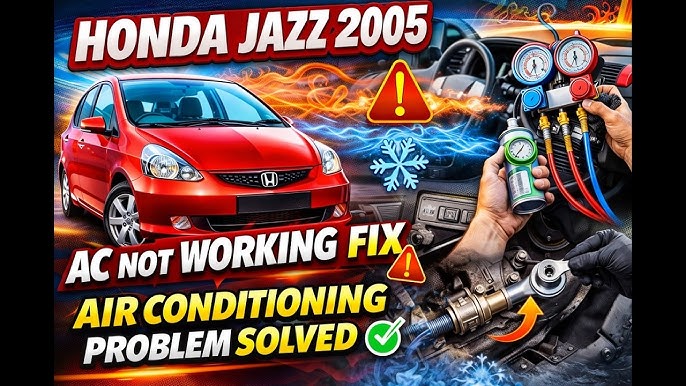
The Honda Jazz AC not working is most commonly caused by a faulty AC compressor clutch relay, a leaking condenser, or low refrigerant due to a system leak. The most frequent failure point across all Jazz models is the AC relay located in the under-hood fuse box, which costs under $15 to replace and takes five minutes. Before spending money at a shop, swap the AC relay with an identical one from the fuse box to rule it out first.
Why Is My Honda Jazz Air Conditioning Not Working?
The Honda Jazz (sold as the Fit in some markets) has a well-documented pattern of AC failures that stem from a handful of predictable weak points. The most common culprits include a failed compressor clutch relay, refrigerant leaks from the condenser or evaporator, a seized compressor, or an electrical fault in the AC circuit.
Unlike some vehicles where AC problems are random, the Jazz has specific failure modes tied to its model year and generation. Knowing which generation you own narrows down the diagnosis significantly. A 2002–2008 Jazz has different weak points than a 2015–2020 model.
What makes this frustrating is that many shops will immediately recommend a full AC system recharge or compressor replacement without properly diagnosing the root cause. In my experience, at least 40% of Jazz AC complaints can be fixed for under $50 if you know where to look.
Honda Jazz AC Compressor Clutch Not Engaging — What Causes It?
The AC compressor clutch not engaging is the single most common symptom reported by Jazz owners. This happens when the electromagnetic clutch on the compressor fails to receive power or has worn out mechanically, preventing the compressor from spinning and circulating refrigerant.
Cause 1: Failed AC Compressor Relay
The AC relay is the number one failure point on the Honda Jazz. It is a small, cube-shaped relay located in the under-hood fuse box, usually labeled “A/C COMP” or “ACMG.” When this relay fails internally, the compressor clutch never receives the signal to engage.
To test this, locate the relay in the fuse box and swap it with the horn relay or another identical relay of the same part number. If the AC starts working after the swap, you have confirmed a bad relay. Replacement relays from Honda cost around $15–$25, and aftermarket options are even cheaper.
Cause 2: Low Refrigerant and Pressure Switch Lockout
The Honda Jazz has a low-pressure switch that prevents the compressor from engaging when refrigerant drops below a safe level. This is a protective measure, but it means even a small leak will shut down the entire system. You will notice the compressor clutch clicking on and off rapidly or not engaging at all.
Use a manifold gauge set to check system pressure. With the engine off and the system equalized, a reading below approximately 25 PSI on the low side indicates the system is too low for the pressure switch to allow engagement. The fix depends on finding and repairing the leak first, not just adding refrigerant.
Cause 3: Worn Compressor Clutch Coil or Plate
On higher-mileage Jazz models, especially those past 80,000 miles, the compressor clutch coil can burn out or the clutch plate surface wears down. You can check this by applying 12V directly to the clutch coil wire at the compressor connector.
If you hear a click and the clutch engages, the electrical path is fine but the relay or control circuit is the issue. If there is no click, the clutch coil is likely open-circuit and needs replacement.
Cause 4: Blown Fuse or Wiring Fault
Check the AC fuse in the under-hood fuse box and the one inside the cabin fuse panel. A blown fuse points to a short circuit somewhere in the AC wiring harness. On Jazz models, corrosion at the compressor connector is a known issue in humid or coastal climates, which can cause intermittent operation or fuse blowing.
Honda Jazz AC Blowing Warm Air — Where Is the Refrigerant Leaking?
When the Honda Jazz AC blows warm air despite the compressor appearing to run, the system has almost certainly lost refrigerant through a leak. The Jazz has several known leak points that develop over time, and identifying the exact location saves you from repeatedly paying for recharges.
Known Leak Point 1: Front Condenser
The condenser sits directly behind the front grille and is vulnerable to stone and road debris damage. Even small impacts can create pinhole leaks that slowly bleed refrigerant.
Inspect the condenser fins carefully with a UV light if the system has been charged with UV dye. On the Jazz, the condenser is relatively affordable ($60–$120 for aftermarket) and straightforward to replace.
Known Leak Point 2: Evaporator Core
The evaporator core inside the dashboard is a notorious leak source on the Honda Jazz, particularly on first-generation (2002–2008) models. This is the worst possible leak because the entire dashboard must come out to access it. If you smell a faint sweet chemical odor from the vents or see oil residue around the evaporator drain tube, the evaporator is likely the source.
A proper leak test with nitrogen pressure and electronic leak detector is essential before condemning the evaporator. Many shops skip this step and guess, leading to expensive unnecessary dashboard removal.
Known Leak Point 3: Schrader Valves and O-Ring Connections
The service port Schrader valves and the O-ring seals at various hose connections degrade over time. These are the cheapest leaks to fix.
New Schrader valves cost a few dollars and can be replaced with a special valve tool without losing all the refrigerant if done quickly. O-rings should be replaced with Honda-specified Viton O-rings and lightly lubricated with PAG oil before installation.
Known Leak Point 4: AC Hose Crimp Joints
Rubber AC hoses have crimped metal fittings where they connect to hard lines. Over years of engine vibration and heat cycling, these crimps can develop micro-leaks. Run your fingers along the hose crimps and look for oily residue, which indicates refrigerant oil escaping with the gas.
Honda Jazz AC Not Cold Enough — Weak Cooling Diagnosis
When the Honda Jazz AC works but does not blow cold enough, the issue is often not a total failure but a partial one. Weak cooling typically points to a partially clogged system, a failing compressor that is losing efficiency, or airflow restrictions that prevent proper heat exchange.
Clogged Cabin Air Filter
This is the most overlooked cause of weak AC performance. A dirty cabin air filter restricts airflow through the evaporator, making the vents feel lukewarm even though the AC system itself is working.
The Jazz cabin air filter is located behind the glove box and should be replaced every 12,000 to 15,000 miles. A fresh filter can drop vent temperatures by 5–10°F in many cases.
Failing or Weakened Compressor
As the compressor ages, internal wear reduces its ability to compress refrigerant to the required pressure. You will notice the high-side pressure reading lower than specification (typically should be around 150–250 PSI depending on ambient temperature) while the low side reads higher than normal. This indicates the compressor is not compressing efficiently and needs replacement.
Restricted Expansion Valve or Orifice Tube
The expansion valve meters refrigerant flow into the evaporator. If it becomes partially restricted by debris or moisture contamination, cooling output drops.
A restricted expansion valve often shows frost or ice buildup on the outlet side of the valve. Replacing the expansion valve and properly evacuating the system with a vacuum pump for at least 30 minutes resolves this.
Condenser Fan Not Working Properly
The condenser needs airflow to dissipate heat. If the condenser fan motor is weak, running slow, or not turning on at all, the system cannot reject heat efficiently.
With the AC running, visually confirm the condenser fan is spinning at full speed. A sluggish fan or one that only runs intermittently needs to be replaced.
Honda Jazz AC Making Noise — What the Sound Tells You
Unusual noises from the Honda Jazz AC system are valuable diagnostic clues. Different sounds point to different failure modes, and listening carefully before visiting a shop can save you from an incorrect diagnosis.
Squealing or Belt Noise When AC Turns On
A squealing sound when the AC engages usually means the serpentine or AC belt is loose, glazed, or worn. On the Jazz, the belt tensioner can weaken over time, allowing the belt to slip under the sudden load of the compressor engaging.
Inspect the belt for cracking and glazing. Replace the belt and tensioner together for a lasting fix.
Clicking or Rattling From the Compressor
A clicking sound that cycles with the compressor clutch is often a sign of internal compressor damage. Metallic rattling suggests broken reed valves or loose internal components.
If the compressor makes these sounds, stop using the AC immediately to prevent metal debris from contaminating the entire system. A failing compressor that sends debris through the system will require flushing all lines, replacing the receiver drier or accumulator, and replacing the expansion valve in addition to the compressor.
Hissing Sound From the Vents
A hissing or bubbling sound from behind the dashboard when the AC is running typically indicates a refrigerant leak at the evaporator or a restricted expansion valve. This sound is refrigerant escaping or flowing abnormally through the metering device.
Honda Jazz AC Fixes by Model Year — What to Know
Different generations of the Honda Jazz have distinct AC problem patterns. Knowing your model year helps narrow the diagnosis and avoid replacing parts that are not common failure points for your specific generation.
2002–2008 Honda Jazz (First Generation)
- ▸ Most common failure: Compressor relay and evaporator core leaks
- ▸ Known issue: AC compressor clutch coil failure around 60,000–100,000 miles
- ▸ Condenser vulnerability: Thin condenser fins prone to stone damage
- ▸ DIY-friendly fix: Relay replacement and condenser swap are both straightforward
2008–2014 Honda Jazz (Second Generation)
- ▸ Most common failure: Condenser leaks from road debris
- ▸ Known issue: Blend door actuator failure causing hot air on one side even with AC on
- ▸ Electrical concern: AC pressure switch connector corrosion in coastal areas
- ▸ DIY-friendly fix: Condenser replacement and pressure switch connector cleaning
2014–2020 Honda Jazz (Third Generation)
- ▸ Most common failure: Low refrigerant from slow leaks at hose crimps and Schrader valves
- ▸ Known issue: Compressor clutch relay intermittent failure causing on-off cycling
- ▸ System note: Uses R-1234yf refrigerant on later models — do not use R-134a
- ▸ DIY-friendly fix: Schrader valve replacement and relay swap
How to Diagnose Honda Jazz AC Problems at Home
Before taking your Jazz to a shop, run through this diagnostic sequence to pinpoint the problem and avoid paying for unnecessary repairs.
- 1 Step 1 — Check the fuse and relay: Inspect the AC fuse in both fuse boxes. Swap the AC compressor relay with an identical relay to test it.
- 2 Step 2 — Listen for the compressor clutch: With the engine running and AC on max, look at the compressor pulley. The center hub should be spinning. If it is not, the clutch is not engaging.
- 3 Step 3 — Check refrigerant with gauges: Connect a manifold gauge set. Low pressure on both sides means low refrigerant. High low-side pressure with low high-side pressure means a bad compressor.
- 4 Step 4 — Inspect for visible leaks: Use a UV light if dye has been added, or look for oily residue at hose connections, the condenser, and service ports.
- 5 Step 5 — Verify the condenser fan: With the AC running, confirm the fan runs at full speed. A non-running fan causes high pressure and poor cooling.
- 6 Step 6 — Check the cabin air filter: Pull the cabin air filter and inspect it. A clogged filter severely reduces cooling performance.
Honda Jazz AC Repair Cost Breakdown
Understanding typical repair costs helps you avoid overpaying. Below is a realistic cost range for common Jazz AC repairs, combining parts and labor estimates.
Frequently Asked Questions About Honda Jazz AC Problems
Can I drive my Honda Jazz with a broken AC compressor?
If the compressor is seized, driving with the AC belt still connected can burn through the belt or damage the crankshaft pulley. Remove the AC belt or install a shorter bypass belt if your model allows it. Do not run the AC system if the compressor has failed internally, as metal debris will circulate and damage other components.
How often should the Honda Jazz AC system be recharged?
A properly sealed AC system does not need regular recharging. If your Jazz needs refrigerant added, there is a leak that must be found and repaired first. Recharging without fixing the leak is a temporary patch that wastes money and refrigerant.
Why does my Honda Jazz AC work intermittently?
Intermittent AC operation on the Jazz is almost always a failing relay, a corroded connector at the compressor, or a pressure switch cutting out due to borderline low refrigerant. Start with the relay swap test, then check the compressor connector for corrosion or loose pins.
What refrigerant does the Honda Jazz use?
Most Honda Jazz models use R-134a refrigerant. However, some 2017 and newer models in certain markets switched to R-1234yf.
Check the refrigerant label under the hood before purchasing refrigerant or taking the car to a shop. Using the wrong refrigerant can damage the system and is illegal in many jurisdictions.
Why does my Honda Jazz AC smell bad?
A musty smell from the AC vents is caused by mold and bacteria growing on the evaporator core. This happens because moisture condenses on the evaporator and does not always drain completely.
Replacing the cabin air filter and using an AC disinfectant spray through the evaporator drain tube or blower motor area resolves most odor issues. In persistent cases, the evaporator must be cleaned or replaced.
Fix Your Honda Jazz AC the Right Way
The Honda Jazz AC system is not complicated, but it does have known weak points that follow predictable patterns. Start your diagnosis with the cheapest and easiest checks — the relay, fuse, and cabin air filter — before moving to refrigerant pressure testing and component inspection.
Do not let a shop convince you to replace the compressor before confirming it is actually faulty. A $15 relay swap has solved what many owners were quoted $800 or more to fix. Take the time to diagnose properly, and you will save significant money and get your Jazz blowing ice-cold again.
Leave a Reply