
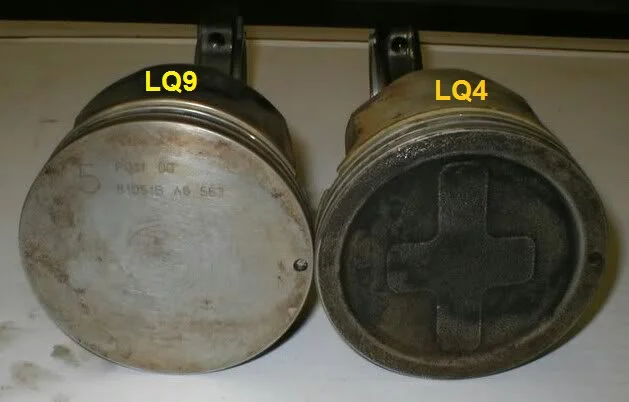
The LQ4 is a 6.0L iron-block engine with 9.4:1 compression producing around 300-325 horsepower, while the LQ9 uses 10:1 compression pistons for 345 horsepower in the same displacement.
What are the key specification differences between an LQ4 and LQ9 engine?
The LQ4 and LQ9 share the same 6.0L displacement, iron block, and Gen III architecture, yet they diverge in compression ratio and internal components that affect power delivery.
Both engines feature the same 3.78-inch bore and 3.62-inch stroke, but the LQ9 employs flat-top pistons instead of the dished pistons found in the LQ4. This raises static compression from 9.4:1 to 10:1.
Camshaft profiles also differ slightly, with the LQ9 receiving a more aggressive grind that supports higher peak output. Connecting rods remain interchangeable, though some LQ9 units received upgraded powdered-metal rods in later production.
Power and torque ratings across model years
| Engine Model | Horsepower | Torque (lb-ft) |
|---|---|---|
| 1999-2006 LQ4 | 300-325 hp | 360-380 lb-ft |
| 2002-2007 LQ9 | 345 hp | 380 lb-ft |
Which engine performs better for towing and heavy loads?
The LQ9 delivers stronger low-end torque response due to its higher compression, making it preferable for sustained towing above 8,000 pounds when paired with the correct transmission and gearing.
Real-world owners report the LQ9 maintains cylinder pressure better under load without requiring extensive tuning. In contrast, the LQ4 often needs spark advance adjustments to avoid detonation on pump gas when towing.
Towing capacity considerations by truck platform
- ➤ Chevrolet Silverado 2500HD with LQ4: Rated for 12,000-13,000 pounds when equipped with the 4L80E and proper cooling.
- ➤ GMC Sierra Denali with LQ9: Often rated 500-800 pounds higher due to factory tuning and stronger accessory drive components.
- ➤ Aftermarket Upgrades: Upgraded radiators and transmission coolers close the gap for LQ4-equipped trucks.
How do you identify an LQ4 versus an LQ9 in a used truck?
Check the eighth digit of the VIN first: U denotes an LQ4 while N indicates an LQ9. Physical inspection of the pistons through the spark plug holes confirms the difference, as LQ9 pistons sit flat at top dead center.
Measure compression with a gauge after a warm-up cycle. LQ4 engines typically show 150-170 psi across all cylinders, while LQ9 engines read 175-195 psi. Mismatched readings often point to prior head gasket work or piston damage.
Common misidentification issues at shops
- Labeling Errors: Dealerships sometimes label any 6.0L iron block as an LQ4 even when the engine has been swapped with LQ9 internals.
- Casting Numbers: Independent shops overlook the rod casting numbers; LQ9 rods carry a distinct part number visible on the beam.
- ECU Calibration: Calibration must be verified with a scan tool, as many LQ4 trucks received LQ9 programming during recalls.
What common problems affect LQ4 and LQ9 engines differently?
Both engines suffer from AFM lifter failures when equipped with active fuel management, yet the LQ9’s higher cylinder pressures accelerate lifter collapse and camshaft lobe wear.
The LQ4 tends to develop valley cover gasket leaks more frequently due to its lower operating temperatures. Oil consumption from worn piston rings appears earlier on LQ9 engines because the tighter ring gaps were optimized for higher boost potential rather than daily driver longevity.
Step-by-step diagnosis for lifter failure
- Listen for a ticking noise that increases with engine speed above 1,500 RPM.
- Perform a compression test followed by a leak-down test to isolate affected cylinders.
- Remove the intake manifold and inspect the lifter trays for metal debris.
- Replace all lifters and the camshaft together, then upgrade to a non-AFM valley cover plate.
Can you swap an LQ9 into an LQ4 truck without major modifications?
Direct swaps require only ECU reprogramming and piston clearance verification because external dimensions match. Fuel system upgrades become necessary once horsepower exceeds 400, as the factory LQ4 injectors flow only 25 lb/hr.
Owners frequently retain the LQ4’s lower compression by swapping only the camshaft and springs when budget limits full LQ9 conversion. This hybrid approach avoids the need for premium fuel while gaining 25-30 horsepower.
Required steps for a reliable swap
- ECU Flash: Flash the ECU with LQ9 calibration or use a stand-alone controller such as Holley Terminator X.
- Fuel System: Upgrade the fuel pump to a 255 lph unit and install 30 lb/hr injectors.
- Clearance Check: Verify piston-to-valve clearance with clay method after camshaft installation.
- Cooling: Install a transmission cooler rated for at least 30,000 BTU if towing remains part of the duty cycle.
How does fuel economy compare between LQ4 and LQ9 in daily driving?
The LQ4 returns slightly better highway mileage, averaging 14-16 mpg in 2500-series trucks, because its lower compression allows more aggressive timing without knock sensors pulling advance.
The LQ9 typically achieves 12-14 mpg under identical conditions. City driving widens the gap further when short trips prevent either engine from reaching full operating temperature.
Aftermarket tuning can recover 1-2 mpg on the LQ9 by optimizing the air-fuel ratio at part throttle.
FAQ
Do LQ4 and LQ9 share the same intake manifold bolt pattern?
Yes, both engines accept LS1, LS2, and LQ4-style cathedral-port intakes without modification, though port matching improves flow on the LQ9.
Is premium fuel required for an LQ9 engine?
Premium fuel prevents detonation under heavy load, yet many owners run 89 octane successfully with timing pulled 2-3 degrees at wide-open throttle.
Can you rebuild an LQ4 to LQ9 compression without new pistons?
Milling the cylinder heads 0.030 inches raises compression to approximately 9.8:1, but this method risks valve-to-piston contact and requires careful chamber volume measurement.
Which engine holds more value on the used market?
LQ9 engines command 15-20 percent higher prices because of documented higher output and desirability for performance builds.
Conclusion
Choose the LQ4 when budget and fuel economy matter most for daily driving and moderate towing. Select the LQ9 when maximum factory output and future modification potential are priorities.
Proper identification and targeted maintenance prevent the expensive misdiagnoses that frequently occur at general repair facilities.
Leave a Reply