
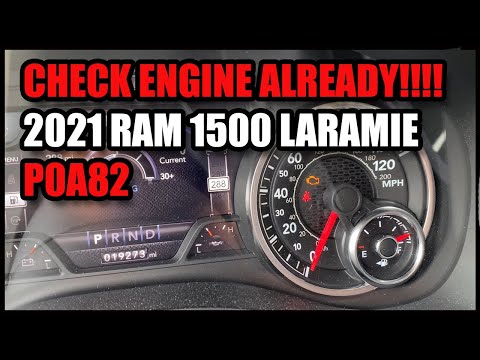
The most common check engine light codes on a Ram 1500 are P0300 (random misfire), P0456 (small EVAP leak), P0562 (low system voltage), P0440 (EVAP system malfunction), P0128 (coolant thermostat below temp), P0420/P0430 (catalyst efficiency below threshold), and P219A (air-fuel ratio imbalance).
These codes typically stem from failing sensors, worn ignition components, vacuum leaks, or emissions system faults—not catastrophic engine failure.
What Does the Check Engine Light Mean on a Ram 1500?
The check engine light (CEL) on your Ram 1500 is triggered by the powertrain control module (PCM) when it detects a fault in the engine, transmission, or emissions system. The light itself does not tell you what is wrong—it only tells you that the onboard diagnostic system has stored one or more trouble codes.
There are two types of CEL behavior you need to understand:
- ▶ Steady light: Indicates a fault that needs attention but is not immediately dangerous. You can usually drive to a shop or diagnose at home.
- ▶ Flashing light: Means an active misfire is occurring and raw fuel is hitting the catalytic converter. Pull over immediately and shut the engine off to prevent converter damage.
On Ram 1500 models—whether it is the 3.6L Pentastar V6, 5.7L HEMI V8, or the 3.0L EcoDiesel—the PCM uses two trip detection logic. This means a fault must occur on two consecutive drive cycles before the CEL illuminates. If the code is pending, you may not see the light yet.
What Are the Most Common Ram 1500 Check Engine Light Codes?
Based on thousands of owner reports and repair shop data, these are the codes that show up most frequently on Ram 1500 trucks across all model years from 2009 to 2024.
How Do I Read Check Engine Light Codes on My Ram 1500 Without a Scanner?
You can pull basic OBD-II codes on a Ram 1500 using the key-on-off method if you do not have a scan tool. Here is how:
- Insert your key into the ignition.
- Turn the key to the ON position (do not start the engine).
- Turn it back to OFF.
- Repeat this cycle three times rapidly, ending in the ON position.
- The odometer display will show any stored Diagnostic Trouble Codes (DTCs).
This method works on most 2009–2018 Ram 1500 models. On 2019 and newer trucks with push-button start, you need a Bluetooth OBD-II scanner. An affordable ELM327 adapter paired with an app like Torque Pro or BlueDriver will give you code definitions, freeze-frame data, and live sensor readings.
Why Does My Ram 1500 HEMI Keep Throwing Misfire Codes?
If your 5.7L HEMI is showing P0300 or individual cylinder misfire codes, there are several known causes that repeat across the entire 2009–2024 production run.
1. Worn or Fouled Spark Plugs
Ram recommends replacing spark plugs every 30,000 miles on the HEMI because it uses 16 plugs—two per cylinder. Owners who push past 50,000 miles on a set almost always see misfire codes appear. Use OEM Champion or NGK Iridium plugs only.
2. Failed Ignition Coil Pack
Each coil pack on the HEMI serves two cylinders. When one coil starts failing, it throws misfire codes on both cylinders it feeds. Swap the suspect coil with one from a known-good cylinder and see if the code follows the coil—that confirms the failure.
3. HEMI Lifter Tick and MDS Failure
On 2013 and newer HEMI engines, the Multi-Displacement System (MDS) lifters are a known failure point. When a lifter collapses or sticks, it causes a persistent misfire on that cylinder.
You will often hear a ticking noise at idle before the code appears. This requires lifter and cam replacement—not a cheap fix, typically $2,500 to $4,000 at a shop.
What Causes the P0456 EVAP Code on a Ram 1500?
P0456 means the PCM has detected a very small leak (0.020 inch or smaller) in the evaporative emissions system. This is the single most common code reported by Ram 1500 owners and is rarely an expensive repair.
Most Likely Causes
- ● Loose or worn gas cap: This accounts for nearly 40% of P0456 codes. Tighten it until you hear three clicks. If the seal looks cracked or dry-rotted, replace it with an OEM Mopar cap.
- ● Cracked EVAP hose: The rubber lines running from the fuel tank to the purge valve dry out and crack over time, especially in hot climates.
- ● Faulty ESIM (Evaporative System Integrity Monitor): On 2013+ models, this small switch on the charcoal canister is a known weak point. It is a $20 part and takes 15 minutes to replace.
- ● Purge valve sticking open: The purge solenoid on the intake manifold can stick and cause both P0456 and rough idle conditions.
How Do I Fix the P0128 Thermostat Code on My Ram 1500?
P0128 sets when the engine coolant temperature does not reach the expected level within a specific time frame. On the 3.6L Pentastar and 5.7L HEMI, this almost always means the thermostat is stuck open.
When the thermostat stays open, coolant circulates constantly and the engine never reaches proper operating temperature. You may notice the temperature gauge sitting lower than normal, poor heater output, and slightly worse fuel economy.
The fix is straightforward:
- Purchase an OEM thermostat and gasket (Mopar part or equivalent).
- On the 3.6L V6, the thermostat housing is on the front of the engine, passenger side. The 5.7L HEMI has it on the lower radiator hose outlet.
- Drain the coolant to below the thermostat level.
- Remove the housing bolts, swap the thermostat, replace the gasket, and torque to spec.
- Refill with the correct OAT coolant (Mopar purple or equivalent 10-year formula).
This is a 1–2 hour DIY job and costs under $50 in parts. Dealerships typically quote $300 to $500 for the same repair.
When Should I Worry About the P0420 or P0430 Code?
These codes indicate the downstream oxygen sensor is reading voltage patterns too similar to the upstream sensor, meaning the catalytic converter is not efficiently converting exhaust gases. Before you spend $800 to $1,500 on a new converter, check these things first:
- ● Swap the downstream O2 sensor: A lazy or degraded O2 sensor can falsely trigger these codes. Replacing a $40 sensor is far cheaper than replacing a converter.
- ● Check for exhaust leaks upstream: Leaks before the converter introduce fresh oxygen and skew sensor readings.
- ● Inspect for oil consumption: On high-mileage HEMIs, oil burning coats the converter substrate and kills efficiency. Fix the oil consumption issue before replacing the converter, or you will destroy the new one.
Real-World Tip: If your truck runs fine, has no power loss, and passes emissions, P0420/P0430 may be a slow degradation that you can monitor for months before committing to converter replacement. Clear the code and see how many miles it takes to come back.
Frequently Asked Questions
Can I drive my Ram 1500 with the check engine light on?
If the light is steady and the truck is running normally with no loss of power, rough idle, or overheating, you can drive it short distances until you diagnose the code. If the light is flashing, stop driving immediately because active misfires can destroy the catalytic converter within minutes.
How much does it cost to diagnose a check engine light at a Ram dealership?
Most Ram dealerships charge between $100 and $150 for a diagnostic scan. This fee is usually credited toward the repair if you have them fix it. Independent shops often charge $50 to $80 for the same scan, and many auto parts stores will scan codes for free.
Will the check engine light reset itself on a Ram 1500?
Yes. If the fault does not reoccur over approximately 40 warm-up cycles, the PCM will turn off the light automatically. However, the code will remain stored in memory as a history code until it is cleared with a scan tool or by disconnecting the battery.
What oil pressure sensor does the Ram 1500 5.7L HEMI use?
The 5.7L HEMI uses a two-wire oil pressure sensor located on the back of the engine near the firewall, passenger side. Part number 56031005 is the most common replacement.
This sensor fails so frequently that many shops stock it in bulk. It triggers code P0520 and can cause the gauge to read zero or peg at maximum.
Does disconnecting the battery clear codes on a Ram 1500?
Disconnecting the negative battery terminal for 15 minutes will clear most codes, including the check engine light. However, it also resets your fuel trim adaptations, radio presets, and on newer models, it can trigger a throttle body relearn procedure. Using a scan tool to clear codes is the cleaner method.
Final Word: Do Not Ignore Stored Codes—Diagnose Them
The check engine light on your Ram 1500 is not something to tape over or ignore. Even harmless-sounding codes like P0456 can mask a developing issue that turns expensive if left alone.
Invest $20 in a basic Bluetooth OBD-II scanner, learn to read freeze-frame data, and you will save yourself hundreds—sometimes thousands—of dollars in unnecessary shop visits and misdiagnosed repairs. Know your truck, read the codes, and fix the actual problem instead of guessing.
Leave a Reply