
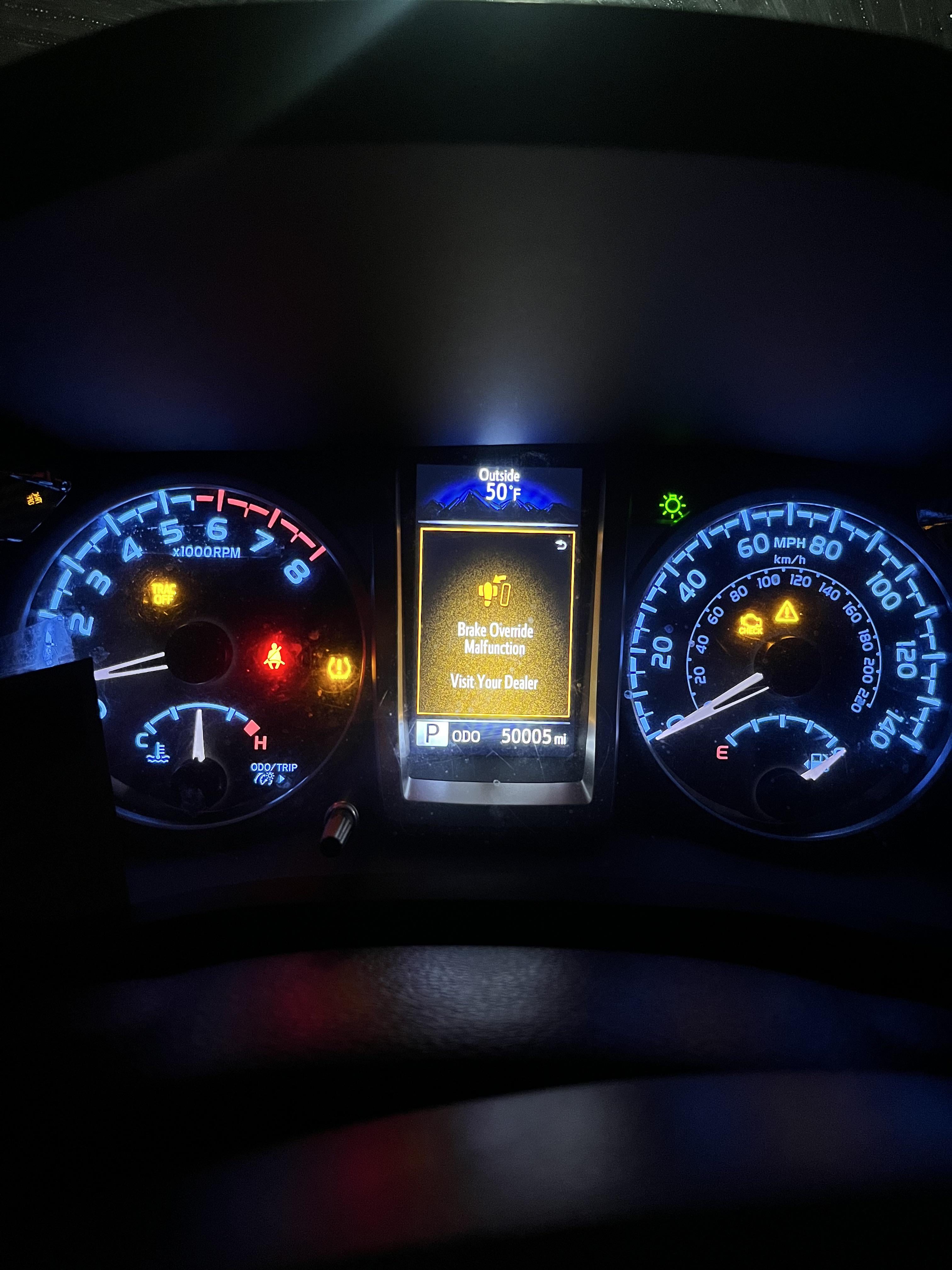
A Toyota brake override malfunction means the vehicle’s Smart Stop Technology has detected simultaneous brake and accelerator input, or there is a fault in the brake light switch, accelerator pedal position sensor, or the engine control module. This system cuts engine power to prevent unintended acceleration, but it can trigger falsely due to sensor failures, wiring issues, or outdated ECU software.
What Does the Brake Override Malfunction Warning Mean on a Toyota?
The brake override malfunction warning indicates that Toyota’s Smart Stop Technology system has either activated abnormally or detected an internal fault. This safety system was introduced after the massive unintended acceleration recalls of 2009–2010. It works by prioritizing brake input over throttle input, cutting engine power when both pedals are pressed at the same time.
When the warning appears, your vehicle may experience reduced power, hesitation during acceleration, or even enter a limp mode. Many owners panic, assuming a catastrophic failure. In most cases, the root cause is a faulty brake light switch or a dirty accelerator pedal position sensor—both of which are inexpensive to fix.
The system relies on communication between the brake pedal sensor, the accelerator pedal position sensor, and the engine control module. If any of these components send conflicting or out-of-range signals, the override system activates as a safety precaution.
How Smart Stop Technology Actually Works
- The ECU monitors both the brake pedal signal and the accelerator pedal signal simultaneously.
- If the brake pedal is pressed and the throttle is open beyond a calibrated threshold, fuel injection is cut.
- The system recalculates every few milliseconds and restores power once the conflict resolves.
- A malfunction warning triggers when the ECU detects a sensor reading outside its expected operating range for a sustained period.
What Causes the Toyota Brake Override Malfunction to Activate?
The most common causes are a failing brake light switch, a worn accelerator pedal position sensor, corroded wiring harness connectors, or outdated ECU calibration software. In rarer cases, a sticking throttle body or a vacuum leak can confuse the system into thinking the throttle is open when the driver is braking.
Cause 1: Faulty Brake Light Switch
The brake light switch is the number one culprit behind false brake override warnings. Toyota uses a dual-contact switch mounted behind the brake pedal.
When the internal contacts wear down or corrode, the switch can send intermittent or incorrect signals to the ECU. The ECU interprets this as the driver pressing the brake while accelerating.
On many Toyota models, this switch costs between $15 and $40 for the part. It is located above the brake pedal arm under the dash.
Replacing it takes about 15 minutes with basic hand tools. You will need a 10mm socket and a flathead screwdriver to release the clip holding the switch in place.
Cause 2: Accelerator Pedal Position Sensor (APPS) Degradation
The APPS is an electronic sensor built into the accelerator pedal assembly. Over time, the internal potentiometer tracks wear out and begin sending erratic voltage signals. This confuses the ECU, which may interpret a slight throttle signal as an open throttle condition while the brake is applied.
Common symptoms include intermittent throttle hesitation, the check engine light flashing, and the brake override warning appearing during normal driving. A scan tool reading of the APPS voltage at idle should show a steady reading between 0.5V and 0.9V. If the voltage fluctuates wildly at rest, the sensor is failing.
Cause 3: Wiring Harness and Connector Corrosion
Toyota vehicles in regions with heavy road salt exposure or high humidity frequently develop corrosion in the connectors for the brake switch and throttle body harness. Green or white oxidation on the pins causes resistance changes that the ECU misreads as abnormal pedal input.
Cause 4: Outdated ECU Software Calibration
Toyota released multiple ECU software updates for affected models between 2010 and 2015. Vehicles that never received these TSB (Technical Service Bulletin) updates are more likely to experience false brake override triggers. A dealership can flash the latest calibration in under 30 minutes.
Cause 5: Sticking or Dirty Throttle Body
Carbon buildup on the throttle plate can cause it to stick slightly open. When the ECU commands the throttle closed and the plate does not respond quickly enough, the system reads a conflict between commanded throttle position and actual throttle position. This triggers the override.
Which Toyota Models Are Most Affected by Brake Override Malfunction?
The Toyota Camry (2007–2015), Corolla (2009–2014), RAV4 (2006–2012), Highlander (2008–2013), and Tacoma (2005–2015) have the highest reported rates of brake override malfunction warnings. The Prius (2010–2015) also has a unique variant of this issue tied to its regenerative braking system interaction.
How to Diagnose the Brake Override Malfunction at Home
Start by scanning the vehicle with an OBD-II scanner that supports enhanced Toyota codes. Look for codes P0571 (brake switch circuit malfunction), P2121 or P2122 (throttle position sensor range), and P2138 (throttle position sensor correlation). These codes point directly to the root cause in most cases.
Step-by-Step Diagnostic Procedure
- Check the brake light switch: Press the brake pedal and have someone verify both brake lights illuminate. If one or both do not light up, or if they flicker, replace the switch.
- Test the APPS voltage: Using a multimeter, probe the APPS signal wire at the pedal connector. At idle (pedal released), the voltage should read between 0.5V and 0.9V. Floor the pedal slowly—voltage should rise smoothly to approximately 4.5V. Any jumps, dead spots, or erratic readings confirm a bad sensor.
- Inspect the throttle body: Remove the air intake hose and visually inspect the throttle plate. Heavy black carbon deposits mean the plate is likely sticking. Clean it with throttle body cleaner and a lint-free cloth.
- Check connector pins: Disconnect the brake switch connector, the APPS connector, and the throttle body connector. Look for green corrosion, bent pins, or moisture intrusion. Clean with electrical contact cleaner and apply dielectric grease before reconnecting.
- Verify ECU software version: A Toyota dealer can check if your ECU has the latest calibration. If a TSB update exists for your model year and your vehicle has not received it, get it flashed.
How to Fix the Toyota Brake Override Malfunction
The fix depends entirely on the root cause. A brake light switch replacement resolves the issue in roughly 60% of cases.
Cleaning or replacing the throttle body fixes another 20%. The remaining 20% requires APPS replacement, wiring repair, or an ECU update.
Fix 1: Replace the Brake Light Switch
Disconnect the negative battery terminal. Locate the switch above the brake pedal—it clips into a bracket with a push-and-twist lock. Disconnect the electrical connector, twist the old switch out, and install the new one.
Adjust the switch plunger so it fully depresses when the pedal is at rest and fully releases when the pedal is pressed. Reconnect the battery and test.
Fix 2: Clean or Replace the Throttle Body
Remove the air intake tube. Spray throttle body cleaner onto a clean rag and wipe the throttle plate and bore.
Avoid spraying cleaner directly into the sensor housing. After cleaning, perform an idle relearn by disconnecting the battery for 10 minutes, then reconnecting and letting the engine idle for 10 minutes without touching the accelerator.
Fix 3: Replace the Accelerator Pedal Position Sensor
The APPS is integrated into the pedal assembly on most Toyota models. You must replace the entire pedal unit.
Unbolt the two mounting nuts, disconnect the harness connector, and remove the pedal assembly. Install the new unit, torque the mounting nuts to spec (typically 12 ft-lbs), and clear the codes with a scan tool.
Fix 4: Repair Wiring and Connectors
Cut out corroded sections of wire and solder in new sections using automotive-grade wire of the same gauge. Seal all connections with heat-shrink tubing. Apply dielectric grease to all connector pins to prevent future corrosion.
Fix 5: ECU Software Update
This is a dealer-only procedure. The technician connects the Toyota Techstream scan tool and flashes the latest ECU calibration.
This process takes 20–30 minutes. Some dealers may charge a diagnostic fee, but if a TSB applies to your vehicle, the flash may be covered under warranty or goodwill.
Can You Drive with the Brake Override Malfunction Warning On?
You can drive cautiously for short distances, but you should not ignore the warning. The vehicle may unexpectedly cut power during acceleration, which is dangerous in highway merging or overtaking situations. If the warning is persistent, the vehicle may be operating in a reduced-power limp mode.
If the warning appears intermittently and the vehicle drives normally otherwise, the issue is likely a borderline brake light switch. Schedule a repair within a few days. If the warning is constant and the engine feels sluggish or unresponsive, tow the vehicle to a shop to avoid a dangerous driving condition.
Frequently Asked Questions
Does the brake override malfunction affect fuel economy?
Not directly. However, if the system causes the engine to run in a modified fuel map or limp mode, you may notice slightly reduced fuel efficiency until the fault is resolved.
Will a brake override malfunction void my Toyota warranty?
No. The brake override system is an emissions and safety-related component. If your vehicle is within the federal emissions warranty period (8 years/80,000 miles for major components), related repairs may be covered.
How much does a Toyota dealer charge to diagnose this issue?
Most Toyota dealers charge between $100 and $160 for a diagnostic scan. If the issue is a simple brake light switch, the total repair with parts and labor typically stays under $120. An ECU flash alone is often $0–$80 depending on the dealer and whether a TSB applies.
Can aftermarket brake pads trigger a brake override warning?
No. The brake override system does not monitor brake pad condition or friction material.
It only reads the brake pedal position sensor signal. Aftermarket pads will not cause this warning unless the installation damaged the brake light switch wiring.
Is the Toyota brake override system the same as Toyota Safety Sense?
No. Brake override (Smart Stop Technology) is a powertrain control function that cuts throttle during simultaneous brake and gas input.
Toyota Safety Sense is a suite of active safety features including pre-collision warning, lane departure alert, and adaptive cruise control. They operate on entirely separate systems.
Get It Fixed Before It Becomes a Real Problem
The Toyota brake override malfunction is almost always a sensor or switch issue—not a major mechanical failure. Do not let a dealership convince you that you need a new throttle body assembly ($400+) or an ECU replacement ($800+) without first checking the brake light switch and APPS.
Start with the cheapest and most common fix, and work your way up. In the vast majority of cases, the repair costs less than $100 in parts and under an hour of your time.
Leave a Reply