
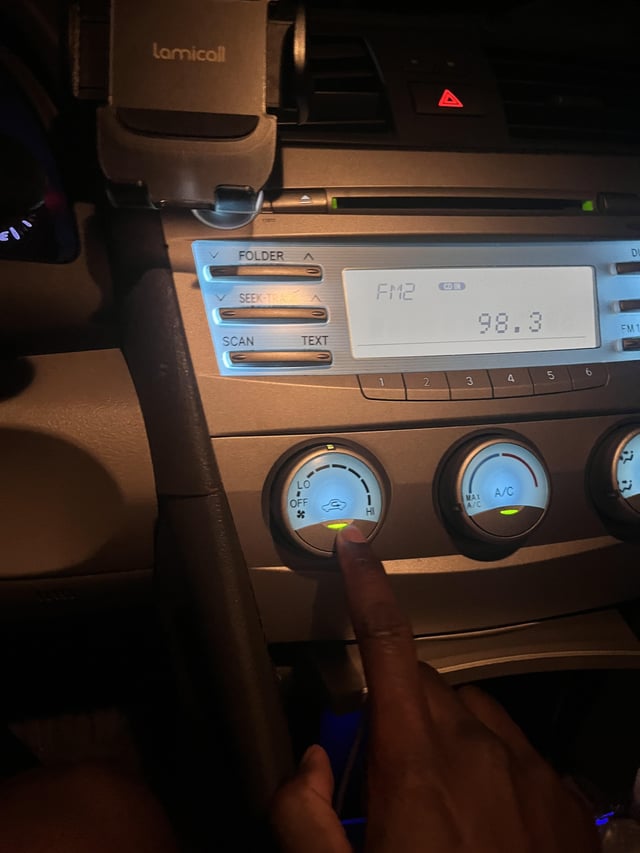
If your Toyota Camry AC is blowing hot air, the most common causes are a failed blend door actuator, low refrigerant from a leak, a faulty AC compressor clutch, a blown AC fuse or relay, or a clogged condenser. The blend door actuator failure is the single most misdiagnosed issue on 2012–2024 Camry models, often mistaken for a refrigerant problem and resulting in unnecessary recharge costs.
Why Is My Toyota Camry AC Blowing Hot Air All of a Sudden?
If your Camry was cooling fine yesterday and suddenly started blowing hot air, the problem is usually electrical or mechanical—not a slow refrigerant loss. Sudden failures point to a blown fuse, a failed compressor clutch relay, or a seized AC compressor.
Start with the cheapest checks first. Pop the hood with the AC set to max cold and the engine running. Watch the AC compressor clutch on the front of the compressor.
If it is not engaging and spinning, the issue is electrical or the compressor itself has failed.
Quick Diagnostic Checklist
- Check the AC fuse in the underhood fuse box (usually labeled A/C or MG CLT).
- Swap the AC relay with an identical relay from another circuit to test it.
- Listen for a click at the compressor when you turn AC on and off.
- Check refrigerant pressure with a gauge set if the clutch engages but air stays warm.
- Inspect the condenser for physical damage, bent fins, or debris blockage.
Toyota Camry AC Compressor Not Engaging—What Causes It?
The AC compressor clutch will not engage if the system detects low refrigerant pressure, if the clutch coil has failed, or if the relay or fuse is blown. The system has a low-pressure cutoff switch that prevents the compressor from running when refrigerant is too low to protect the compressor from damage.
Common Causes by Model Year
How to Test the Compressor Clutch
- Turn the engine off and locate the compressor clutch wire connector near the compressor body.
- Disconnect the connector and use a multimeter to measure resistance across the clutch coil terminals. A healthy coil reads 3 to 5 ohms.
- If you read open circuit (OL), the clutch coil is burned out and needs replacement.
- If resistance is within spec but the clutch still will not engage, apply 12V battery power directly to the clutch wire. If it clicks and engages, the problem is upstream—relay, fuse, or pressure switch.
Toyota Camry Blend Door Actuator Failure—The Most Misdiagnosed AC Problem
This is the number one issue I see on 2012 and newer Camry models, and it is routinely misdiagnosed by both dealerships and independent shops. The blend door actuator controls a small flap that directs air through the heater core or the evaporator.
When it fails, the flap gets stuck on the heat side, and the AC blows hot air even though the compressor is running perfectly.
The telltale sign is this: the compressor clutch is engaged, the refrigerant pressure is normal, but the air coming out of the vents is hot. Sometimes you will hear a faint clicking or ticking noise behind the dashboard when you adjust the temperature dial.
That clicking is the actuator motor trying and failing to move the blend door.
Symptoms of a Bad Blend Door Actuator
- ➤ AC blows hot air on one side or both sides while the compressor is running.
- ➤ Clicking, ticking, or knocking noise behind the dash when changing temperature.
- ➤ Temperature does not change when you move the dial from cold to hot.
- ➤ AC works intermittently—cold sometimes, hot other times without any pattern.
How to Replace the Blend Door Actuator on a Toyota Camry
- Disconnect the negative battery terminal and wait 5 minutes.
- Remove the lower dash panel under the steering column by pulling it straight down. It is held by clips—no screws on most model years.
- Locate the blend door actuator on the driver side of the HVAC housing. It is a small rectangular motor with a wiring harness connector and two or three mounting screws.
- Disconnect the wiring harness connector from the actuator.
- Remove the mounting screws using a 5.5mm or Phillips screwdriver depending on the model year.
- Pull the old actuator off the blend door shaft. Note the position of the shaft slot.
- Install the new actuator, aligning it with the door shaft. Do not force it. The shaft should slide into the actuator slot naturally.
- Reinstall the screws, reconnect the harness, reconnect the battery, and test before reassembling the dash panel.
The part costs between $25 and $60 from Toyota or aftermarket sources. A dealership will quote $300 to $500 for this job.
Do it yourself in under 45 minutes.
How to Recharge Toyota Camry AC System Properly
If you have confirmed the compressor engages but the air is lukewarm, the system is likely low on refrigerant due to a slow leak. Toyota Camry systems use R-134a refrigerant.
The 2018 and newer models with the redesigned system also use R-134a, while some 2024 and up models may transition to R-1234yf—always check the underhood sticker.
Recharge Steps
- Connect a manifold gauge set to the low-pressure and high-pressure service ports under the hood.
- With the engine running and AC on max, fan on high, read the low-side pressure. At idle with 75–85°F ambient temperature, it should read 25–45 psi. The high side should read 150–250 psi.
- If the low side reads below 20 psi, the system is low. Connect a refrigerant can to the low-side port and add slowly until pressures normalize.
- Do not overcharge. Overcharging causes high-pressure shutdown and can damage the compressor.
- If the system is completely empty, you must find and fix the leak first, then vacuum the system with a pump for 30 minutes before recharging.
Real-World Tip: If you recharge the system and it goes warm again within a few weeks, you have a leak. Common leak points on the Camry are the condenser (stone damage), the evaporator core (corrosion on 2007–2011 models), and the Schrader valve cores at the service ports. Replace the valve cores first—they cost a dollar each and fail constantly.
Toyota Camry AC Blows Hot on One Side—What Is Wrong?
If your Camry has dual-zone automatic climate control and the AC blows cold on one side but hot on the other, the issue is almost always the blend door actuator on the affected side. Each side has its own actuator. The passenger side actuator on 2012–2017 Camry models is particularly prone to failure.
How to Tell Which Actuator Has Failed
- ➤ If the driver side is hot and passenger side is cold, the driver side actuator has failed.
- ➤ If the passenger side is hot and driver side is cold, the passenger side actuator has failed.
- ➤ Set both zones to the same temperature. If one side blows noticeably warmer, that side’s actuator is the culprit.
Fixing the Passenger Side Actuator
The passenger side actuator is harder to access than the driver side. On most Camry models, you need to remove the glove box by squeezing the stoppers on both sides and dropping it down. The actuator is behind the glove box opening, mounted to the HVAC housing.
The replacement procedure is the same—remove screws, disconnect the harness, swap the actuator, and reinstall.
Toyota Camry AC Condenser Damage—How It Causes Hot Air
The condenser sits right in front of the radiator behind the front bumper. Road debris, rocks, and even bugs can damage the condenser fins or puncture the condenser tubes. A punctured condenser leaks refrigerant, and the system will eventually blow hot air as pressure drops below the compressor cutoff threshold.
Signs of a Damaged Condenser
- ➤ Visible oily residue or green UV dye on the front or back of the condenser if dye was previously added.
- ➤ AC worked fine until after a road trip or highway driving where debris strikes are common.
- ➤ System holds no refrigerant at all after a recharge—rapid loss points to condenser puncture.
Condenser Replacement Cost and Procedure
An OEM Toyota condenser costs $150 to $250. Aftermarket units run $60 to $120. The job requires evacuating the refrigerant, disconnecting the AC lines at the condenser, removing the bumper or upper support to access it, and swapping the unit.
After installation, the system must be vacuumed and recharged. This is a job most DIYers can do with a manifold gauge set and a vacuum pump rental from an auto parts store.
Frequently Asked Questions
Can a dirty cabin air filter cause my Toyota Camry AC to blow hot air?
A clogged cabin air filter restricts airflow and reduces cooling efficiency, but it will not cause the AC to blow genuinely hot air. If the air is warm despite the AC running, the filter is not the root cause.
Replace it every 15,000 to 20,000 miles to maintain airflow and air quality, but continue diagnosing the actual AC problem.
How much does it cost to fix the AC on a Toyota Camry at a dealership?
Dealership costs vary widely. A simple refrigerant recharge costs $150 to $250. A blend door actuator replacement is quoted at $300 to $500.
A full compressor replacement runs $800 to $1,400 depending on the model year. Independent shops typically charge 30 to 50 percent less for the same work.
Is it safe to drive my Toyota Camry with the AC blowing hot air?
Yes, it is safe to drive. The AC system is separate from the engine cooling system. However, hot air from the vents combined with defrost mode not working properly can be a safety issue in humid or foggy conditions.
Get the AC repaired before cold or wet weather arrives.
Why does my Toyota Camry AC smell bad and blow warm air?
A musty smell combined with warm air suggests mold or mildew buildup on the evaporator core, possibly combined with a refrigerant leak or blend door issue. Have the evaporator inspected.
If it is leaking refrigerant through corrosion, the entire dash may need to come out for replacement, which is a $1,000-plus job. Address the warm air issue first—the smell can be treated with an antimicrobial spray through the drain tube independently.
Final Verdict—Do Not Skip the Diagnosis
The biggest mistake Toyota Camry owners make when the AC blows hot air is jumping straight to a refrigerant recharge without proper diagnosis. I have seen hundreds of cases where owners spent $150 on a recharge only to have the problem return in two weeks because the real issue was a $30 blend door actuator.
Start with the compressor clutch engagement test, check fuses and relays, listen for dash clicking, and read system pressures before spending money on refrigerant. Nine out of ten Camry AC complaints can be diagnosed with a visual inspection, a multimeter, and a basic gauge set.
Leave a Reply