
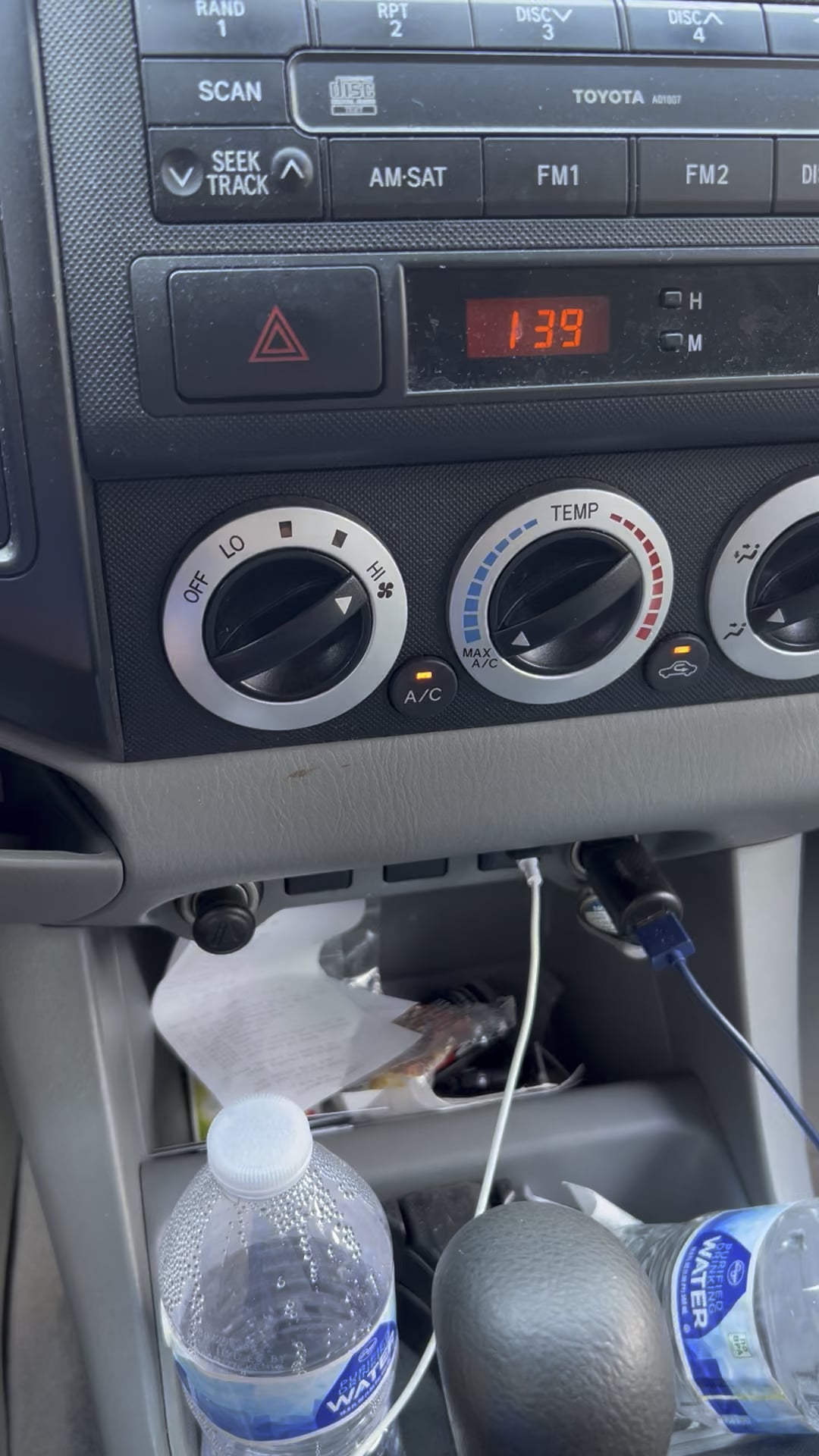
The Toyota Tacoma AC light blinking means the air conditioning system has detected a fault, most commonly low refrigerant charge, a faulty pressure switch, a bad AC compressor clutch, or wiring issues. The blinking light is the system’s way of disabling the compressor to prevent damage until the underlying problem is diagnosed and repaired.
What Does It Mean When Your Toyota Tacoma AC Light Is Blinking?
The blinking AC indicator light on a Toyota Tacoma is not a random glitch. It is a deliberate fault signal built into Toyota’s climate control system. When the AC amplifier detects an abnormality in refrigerant pressure, compressor operation, or sensor readings, it cuts power to the compressor clutch and flashes the light to alert you.
Unlike a check engine light, this warning does not always trigger an OBD-II code you can read with a standard scanner. Toyota stores these faults within the HVAC system, and you often need a capable scan tool or the manual diagnostic mode to retrieve them.
Many shops and dealerships skip this step entirely and jump straight to expensive compressor replacements.
How the Toyota AC System Detects Faults
The AC amplifier monitors signals from the refrigerant pressure sensor, the evaporator thermistor, the engine RPM signal, and the compressor clutch feedback circuit. When any reading falls outside the expected range for more than a set duration, the amplifier disengages the compressor clutch and initiates the blinking pattern.
On most Tacoma generations, the light will blink at a steady rate of roughly once per second. Some model years use a faster or slower flash depending on the specific fault. The pattern itself does not differentiate between causes, which is why proper diagnosis matters more than guessing.
Why Is My Toyota Tacoma AC Light Blinking?
The most frequent causes are low refrigerant from a leak, a failing compressor clutch coil, a defective dual or triple pressure switch, corroded wiring connectors, or a weak evaporator thermistor. Each of these problems has distinct diagnostic steps and repair paths that do not require replacing the entire AC system.
Cause 1: Low Refrigerant Charge or Leak
This is the number one cause across all Tacoma model years. When refrigerant drops below the minimum threshold, the low-pressure switch opens and the AC amplifier shuts down the compressor. Owners often notice the AC blows cool but not cold before the light starts blinking.
- ▸Hook up a manifold gauge set and check static and running pressures against the specification on the underhood sticker.
- ▸If the system is low but not empty, you likely have a slow leak at a Schrader valve, condenser seam, evaporator core, or hose crimp fitting.
- ▸Use a UV dye injection or electronic refrigerant leak detector to pinpoint the exact location before recharging.
- ▸Do not simply top off the refrigerant without finding the leak. It will come back, and repeated undercharges damage the compressor from oil starvation.
Cause 2: Faulty Pressure Switch
The Tacoma uses either a dual-pressure or triple-pressure switch mounted on the receiver drier or the liquid line. These switches can fail internally and send a false high or low pressure signal even when actual pressures are normal. This is extremely common on 2005 to 2015 Tacomas.
- ▸With a scan tool that reads HVAC live data, compare the pressure sensor reading to your manifold gauge reading. If they disagree significantly, the switch is bad.
- ▸Without a scan tool, you can carefully jumper the pressure switch connector with a short piece of wire to see if the compressor engages. Do this only briefly and only if pressures are verified normal.
- ▸Replacement switches from Toyota cost between 40 and 80 dollars and take about 30 minutes to swap with basic hand tools.
Cause 3: AC Compressor Clutch Failure
The clutch coil can develop high resistance from heat cycling over the years. When the coil resistance drifts out of specification, the clutch will not engage, and the AC amplifier interprets this as a compressor fault. You might also hear a clicking or rapid cycling sound from the compressor area.
- ▸Measure the clutch coil resistance with a multimeter at the compressor connector. Toyota specifications vary by engine, but most fall between 3 and 5 ohms at room temperature.
- ▸If resistance reads open or infinite, the coil is burned out and needs replacement.
- ▸You can often replace just the clutch and coil assembly without removing or replacing the entire compressor, saving hundreds of dollars.
- ▸Check the clutch air gap while you are in there. It should typically be between 0.015 and 0.030 inches. Shim kits are available if the gap is out of spec.
Cause 4: Wiring and Connector Corrosion
Tacomas that operate in humid climates, coastal areas, or salted-road regions develop corrosion in the AC-related electrical connectors. The compressor clutch connector, the pressure switch pigtail, and the AC amplifier harness plug are the most vulnerable points.
- ▸Disconnect each connector visually and look for green or white corrosion on the pins.
- ▸Clean the pins with electrical contact cleaner and a small pick or brush.
- ▸Apply dielectric grease before reconnecting to prevent future corrosion.
- ▸Inspect the wiring harness for chafing near the compressor and along the frame rail where it can rub against metal brackets.
Cause 5: Evaporator Thermistor Issues
The evaporator temperature sensor, also called the thermistor, tells the AC amplifier how cold the evaporator is getting. If it reads incorrectly, the system may think the evaporator is freezing and shut down the compressor as a protective measure.
- ▸Access the thermistor, usually located behind the glove box area near the evaporator housing.
- ▸Measure its resistance at a known temperature and compare it to Toyota’s resistance-versus-temperature chart.
- ▸A thermistor that reads significantly off at room temperature needs replacement. The part is inexpensive, usually under 20 dollars.
Toyota Tacoma AC Light Blinking by Model Year
Different Tacoma generations have unique weak points. Knowing your model year helps narrow the diagnosis faster and avoid wasting money on parts that are not the problem.
| Model Year Range | Most Common Cause | Typical Fix | Average DIY Cost |
|---|---|---|---|
| 1995 to 2004 (1st Gen) | Compressor clutch coil failure | Clutch and coil replacement | 50 to 120 dollars |
| 2005 to 2015 (2nd Gen) | Pressure switch malfunction | Pressure switch replacement | 40 to 80 dollars |
| 2016 to 2023 (3rd Gen) | Refrigerant leak at condenser or hose crimp | Condenser or hose replacement plus recharge | 150 to 400 dollars |
| 2024 and newer (4th Gen) | Software calibration or sensor glitch | Dealership HVAC reflash or sensor reset | Covered under warranty in most cases |
How to Reset the Toyota Tacoma AC Light Blinking
Resetting the blinking light is not a fix by itself. It is a diagnostic step that confirms whether the fault is still active after a repair. If the light comes back immediately, the root cause has not been addressed.
Method 1: Disconnect the Battery
- Turn off the ignition and remove the key.
- Disconnect the negative battery terminal.
- Wait at least 10 minutes to allow the AC amplifier capacitors to fully discharge.
- Reconnect the negative terminal and start the engine.
- Turn on the AC and check if the light stays solid. If it blinks again within seconds, the fault is still present.
Method 2: Use Toyota HVAC Diagnostic Mode
- Turn the ignition to the ON position without starting the engine.
- Press and hold the AUTO button and the recirculation button simultaneously on the climate control panel.
- While holding both buttons, turn the ignition off and then back to ON within 5 seconds.
- Release the buttons. The display should show diagnostic codes if any are stored.
- Write down any codes shown and cross-reference them with Toyota’s HVAC fault code chart for your model year.
Method 3: Scan Tool Reset
Use a professional-grade scan tool that supports Toyota HVAC system access. Tools like the Autel MaxiCOM, Toyota Techstream, or Launch X431 can read and clear AC fault codes directly. After clearing the code, run the AC system for several minutes and rescan to verify the fault does not return.
How to Prevent the Tacoma AC Light From Blinking Again
Prevention beats repair every time. A few maintenance habits keep the AC system healthy and the blinking light away for years.
- ▸Run the AC regularly, even in winter. Running the compressor at least once a week for 10 minutes circulates oil through the system and keeps seals from drying out.
- ▸Check refrigerant levels annually. A shop can do a quick performance test that catches slow leaks before they become a blinking light.
- ▸Inspect the condenser for road debris damage. The condenser sits right behind the front grille and is vulnerable to rock strikes. Even a small puncture causes a slow leak that eventually triggers the fault.
- ▸Keep electrical connectors clean. Once a year, spray AC compressor and pressure switch connectors with electrical contact cleaner, especially if you live near the coast or in a snowy region.
- ▸Replace the cabin air filter on schedule. A clogged cabin filter forces the system to work harder, increasing evaporator icing risk and thermistor stress.
Frequently Asked Questions
Can I drive my Toyota Tacoma with the AC light blinking?
Yes, you can drive without any risk to engine or drivetrain. The blinking light only disables the AC compressor.
Your heating, defrost, and ventilation will continue to work normally. However, ignoring it long term can allow a small refrigerant leak to become a bigger and more expensive repair.
Does the blinking AC light mean my compressor is bad?
Not necessarily. The compressor itself is actually one of the less common causes.
Low refrigerant, a bad pressure switch, or corroded wiring are far more frequent culprits. Diagnosing before replacing saves you from throwing a 500 to 900 dollar compressor at a 50 dollar pressure switch problem.
How much does a Toyota dealership charge to diagnose a blinking AC light?
Most dealerships charge a one-hour diagnostic fee ranging from 120 to 180 dollars. Some will waive the fee if you approve the repair with them. An independent AC specialist shop typically charges 60 to 100 dollars for the same diagnosis and often has more hands-on experience with Tacomas specifically.
Will a refrigerant recharge fix the blinking light permanently?
Only if the system was simply low on refrigerant and had no active leak. If the recharge gets the light to stop but it comes back within weeks or months, you have a leak that must be found and repaired first. Adding refrigerant to a leaking system is a temporary bandage, not a fix.
Is the AC light blinking issue covered under Toyota warranty?
If your Tacoma is still under the basic or powertrain warranty and the fault is due to a manufacturing defect, Toyota should cover the repair. For vehicles outside warranty, Toyota has occasionally issued Technical Service Bulletins related to AC system faults for certain model years. Check with your dealer using your VIN to see if any apply to your truck.
Fix It Right the First Time
The Toyota Tacoma AC light blinking is a solvable problem that does not require panic or a blank check to the dealership. Start with pressure readings and refrigerant level checks. Move to the pressure switch and compressor clutch measurements if pressures look normal.
Work through the wiring connectors and thermistor if everything else checks out. Methodical diagnosis beats parts-cannon repair every single time, and your wallet will thank you for it.
Leave a Reply