
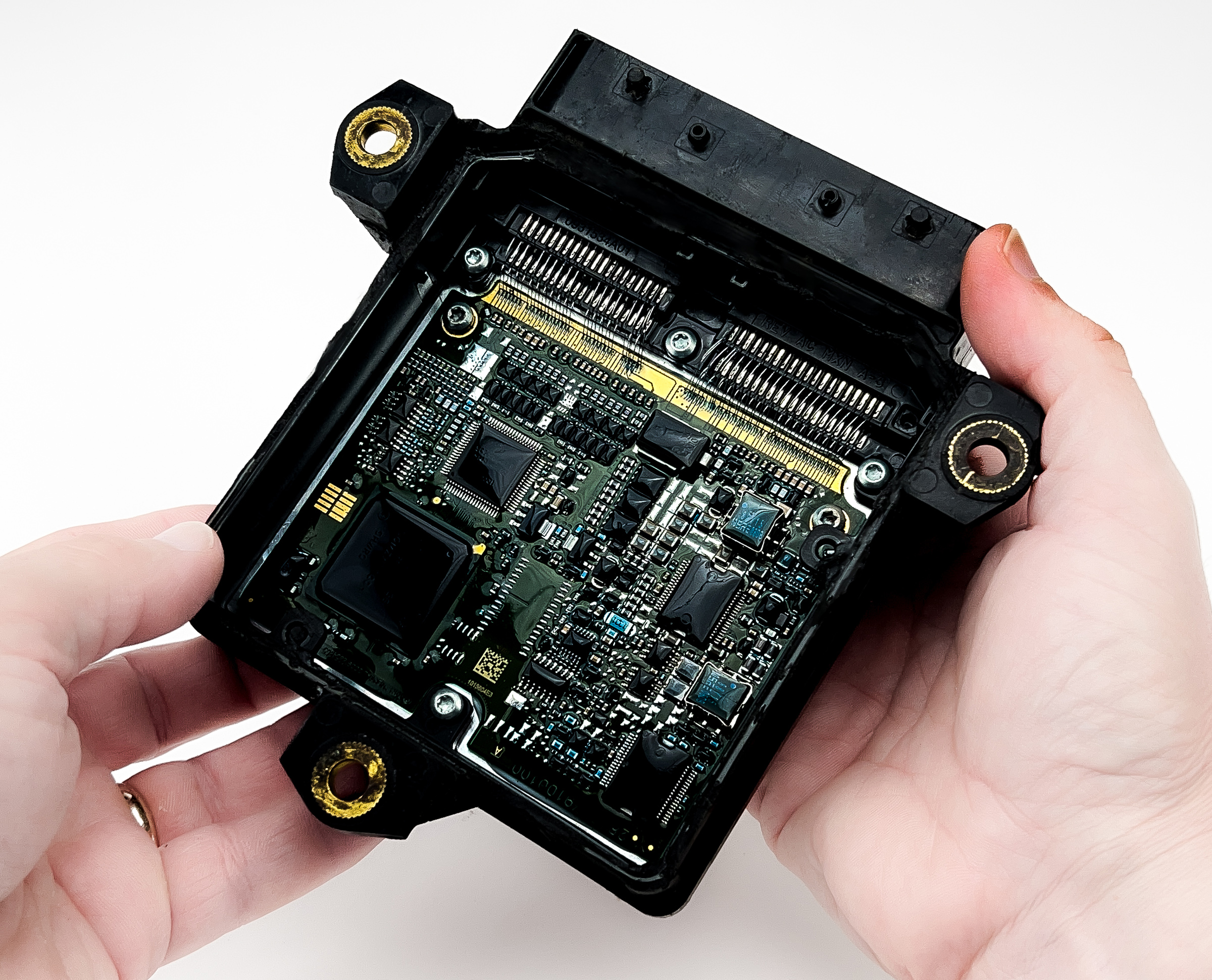
The Allison Transmission Control Module (TCM) commonly fails due to internal solder joint fractures, corroded wiring harness connectors, voltage irregularities from a weak chassis ground, or heat-damaged circuit boards. Symptoms include harsh or delayed shifts, the transmission staying in one gear, check engine light with codes like P0700, P0872, or U0100, and limp mode. In many cases, the TCM can be repaired or reprogrammed rather than fully replaced, saving owners $1,500 to $3,000.
What Are the Most Common Signs of a Failing Allison Transmission Control Module?
The Allison TCM rarely dies overnight. It degrades over time, and the symptoms creep in gradually—which is exactly why most owners and even some techs misdiagnose it as a valve body or internal transmission failure.
If you know what to look for, you can catch it early and avoid a catastrophic repair bill.
The most common early sign is not a dramatic failure—it is a shift that just feels “off” on a Tuesday morning when it was fine on Monday.
Symptom 1: Harsh or Flared Shifts
The TCM calculates shift timing and pressure based on throttle position, vehicle speed, and load data. When its internal circuits start failing, it sends erratic commands to the solenoid body.
You feel this as a hard 1-2 shift, a flare between 3rd and 4th, or a delayed engagement when placing the shifter into Drive or Reverse.
Symptom 2: Transmission Stuck in One Gear (Limp Mode)
When the TCM loses its ability to communicate with the Engine Control Module (ECM), the transmission defaults to a single gear—usually 3rd or 5th depending on the model. The dashboard will illuminate the check engine light and may display “TRANS FAULT” or a similar message.
This is the transmission protecting itself from damage caused by uncontrolled shift commands.
Symptom 3: Intermittent No-Crank or No-Start Condition
This one catches people off guard. The Allison TCM is part of the starting circuit on many GM medium-duty trucks and motorhomes.
If the TCM fails to send the “neutral confirmed” signal to the ECM, the engine will not crank. Owners often chase starter, ignition switch, or neutral safety switch problems for weeks before discovering the TCM is the culprit.
Symptom 4: Erratic Torque Converter Clutch (TCC) Behavior
A failing TCM can command the TCC to lock and unlock rapidly at highway speed, causing a shudder or vibration that feels like a bad U-joint or warped brake rotor. If you have already ruled out driveline and brake issues, the TCM is the next logical suspect.
What Causes an Allison TCM to Fail?
Allison TCMs are robust units by design, but several real-world conditions accelerate failure. Understanding the root cause helps you prevent repeat failures after replacement or repair.
Cause 1: Heat Cycling and Circuit Board Fractures
The TCM mounts on the outside of the transmission case on most Allison 1000, 2000, 2400, and 3000 series units. Exhaust routing and engine-bay temperatures push operating temperatures well above design limits over time.
Solder joints on the circuit board develop micro-fractures from constant thermal expansion and contraction.
- Most affected models: Allison 1000 in 2001–2007 GM Silverado/Sierra HD, Allison 2000/2400 in medium-duty trucks
- Repair option: A qualified electronics repair shop can reflow or replace fractured solder joints for $200–$400
- Prevention: Install a heat shield or reflective barrier between the TCM and exhaust components
Cause 2: Corroded or Melted Connector Pins
The 80-pin or 104-pin connector on the TCM harness is exposed to road salt, water intrusion, and chemical splash. Over time, pins develop green corrosion, and the connector housing becomes brittle.
In some cases, high-resistance corrosion causes localized overheating that melts the plastic connector body around specific pins.
Cause 3: Chassis Ground Deficiency
This is the single most overlooked root cause. The Allison TCM is sensitive to voltage drops as small as 0.2V on its ground circuit. A corroded or loose chassis ground strap—even one that looks clean to the naked eye—can cause the TCM to behave erratically, set communication codes, and trigger limp mode.
- Locate the main transmission ground strap (typically bolted to the frame rail near the transmission crossmember)
- Remove the ground bolt, sand both contact surfaces to bare metal, apply dielectric grease, and retorque
- Add a supplemental 10-gauge ground wire from the TCM mounting bolt directly to the battery negative terminal
- Clear codes and perform a road test to verify the fix
Cause 4: Low or Contaminated Transmission Fluid
The TCM relies on fluid pressure data from internal sensors. When fluid degrades or drops below the proper level, the TCM receives inaccurate pressure feedback and compensates with incorrect shift commands.
Over time, this “confuses” the adaptive learning tables stored in the TCM memory, compounding the problem.
How Do You Diagnose an Allison TCM Problem Accurately?
Proper diagnosis separates a $300 repair from a $4,500 valve body and solenoid replacement that does not fix the issue. Here is how experienced technicians isolate TCM faults.
Step 1: Pull All Module Codes, Not Just Engine Codes
A basic OBD-II scanner only reads engine and powertrain codes. You need a tool capable of reading TCM-specific codes from the Allison module.
Acceptable tools include Allison DOC, a Snap-on scan tool with the Allison software license, or a Tech2/MDI2 for GM applications. Pay close attention to U-codes (communication faults) and P0700-series codes.
Step 2: Check the TCM Connector and Harness
Disconnect the TCM connector and inspect every pin for corrosion, pushed-back pins, or melted plastic. Use a contact cleaner and a pick to clean individual pins.
Check harness continuity with a multimeter set to ohms. Any reading above 0.5 ohms on a single wire indicates a problem.
Step 3: Monitor Live Data for Voltage and Communication
With the engine running, monitor TCM supply voltage and communication status. Voltage should read 13.5V to 14.5V with the alternator charging.
If voltage drops below 12.5V or fluctuates, check the charging system and ground circuits before condemning the TCM.
Allison TCM Repair vs. Replacement: Which Route Saves the Most Money?
Option 1: Remanufactured TCM (Most Common)
A remanufactured Allison TCM typically costs $800 to $1,800 depending on the series and model year. The unit comes programmed to your vehicle’s specifications but still requires a learn procedure after installation.
This is the most common route dealerships and large shops take.
Option 2: Circuit Board Repair (Most Cost-Effective)
If the failure is confirmed as solder joint fractures or a specific board-level component, a specialty electronics repair shop can fix it for $200 to $500. Turnaround is usually 3 to 5 business days.
This option requires you to remove and ship the TCM yourself.
Option 3: Full New Unit from Allison
A factory-new TCM from Allison runs $2,000 to $3,500 for the part alone. This is typically reserved for fleet operations or situations where no reman unit is available.
Installation and programming add another $300 to $600 in labor.
How to Prevent Allison TCM Problems from Coming Back
- ✓ Replace transmission fluid and filter every 30,000 to 40,000 miles using Dexron VI or Allison-approved TES 295 fluid
- ✓ Inspect and clean the TCM connector and ground points during every major service interval
- ✓ Install a supplemental heat shield if the TCM sits near exhaust components
- ✓ Never jump-start the truck with a high-amperage charger connected directly to the battery without disconnecting the TCM harness—voltage spikes above 16V can destroy TCM circuitry
- ✓ Update the TCM software whenever Allison releases a calibration update for your transmission model
Frequently Asked Questions
Can you drive with a bad Allison TCM?
You can drive in limp mode for a short distance, but it is not recommended for extended use. The transmission operates in a single gear, which puts extra stress on the torque converter, clutch packs, and fluid.
Prolonged limp-mode driving can cause secondary internal transmission damage that makes the repair significantly more expensive.
Does an Allison TCM need to be programmed after replacement?
Yes. Even a pre-programmed reman unit requires a TCM learn procedure and throttle position relearn using Allison DOC or compatible diagnostic software. Skipping this step results in poor shift quality and possible return of fault codes.
How long does an Allison TCM typically last?
In ideal conditions, the TCM can last the life of the vehicle—200,000 miles or more. In high-heat environments, plow trucks, or vehicles with chronic ground issues, failure can occur as early as 80,000 to 120,000 miles.
Will a bad TCM damage the transmission itself?
If the TCM sends incorrect pressure or timing commands for an extended period, yes. Erratic shift commands can burn clutch packs, score valve body bores, and overheat the fluid. Catching TCM problems early is the best way to protect the internal transmission hardware.
Is the Allison TCM the same as a valve body?
No. The TCM is the electronic brain—the computer.
The valve body is the hydraulic component that the TCM controls. They work together, but they are separate assemblies.
Many people replace the valve body when the TCM is actually the failing component, which wastes money and does not fix the problem.
The Bottom Line: Diagnose Before You Replace
The single most expensive mistake owners make with Allison transmission control module problems is throwing parts at the truck without proper diagnosis. A $20 multimeter check on the ground circuit has fixed more TCM issues than most people realize.
Before you authorize a $3,000 replacement, verify the connector, confirm clean power and ground supply, pull TCM-specific codes with the right scanner, and consider a board-level repair if the unit itself is the confirmed failure. Taking these steps puts you—and your wallet—in control of the repair, not the shop.
Leave a Reply