
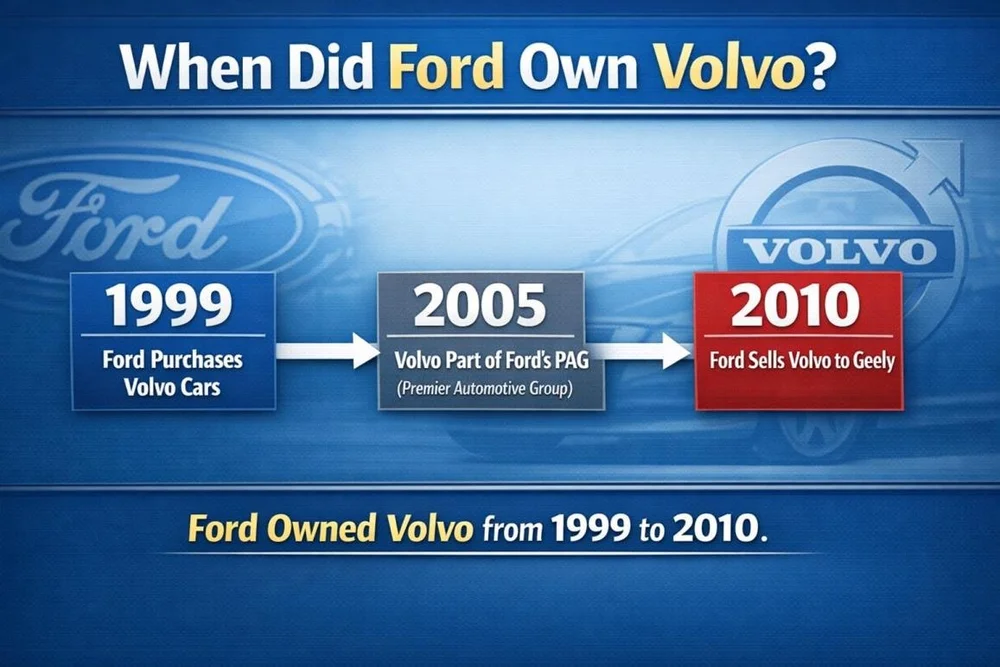
No, Ford does not own Volvo. Ford Motor Company owned Volvo Cars from 1999 to 2010 but sold it to the Chinese automaker Geely Holding Group for approximately $1.8 billion. Today, Volvo Cars is a subsidiary of Geely, while the separate Volvo Group (trucks and commercial vehicles) remains an independent Swedish company.
Did Ford Ever Own Volvo?
Yes, Ford owned Volvo Cars from 1999 until 2010. Ford purchased Volvo’s car division from the Swedish Volvo Group for $6.45 billion as part of its Premier Automotive Group strategy.
Ford acquired Volvo Cars in January 1999 during a period when the American automaker was aggressively collecting European luxury brands.
At the time, Ford’s Premier Automotive Group also included Lincoln, Jaguar, Land Rover, and Aston Martin. The deal gave Ford control over Volvo’s passenger car operations, design studios, and manufacturing plants in Sweden and Belgium.
However, it is critical to understand that Ford never owned the entire Volvo brand. The Volvo Group—responsible for trucks, buses, construction equipment, and marine engines—remained a completely separate publicly traded Swedish corporation. Only the car division changed hands.
Why Did Ford Buy Volvo in the First Place?
Ford saw Volvo as a way to tap into the European premium market. Volvo’s reputation for safety engineering and Scandinavian design philosophy offered something Ford’s mainstream lineup lacked.
- ▶Safety technology leadership: Volvo held patents and engineering expertise in crumple zones, side-impact protection, and pedestrian safety systems that Ford wanted to integrate across its fleet.
- ▶European market expansion: Volvo gave Ford a legitimate premium European brand to compete with BMW, Audi, and Mercedes-Benz.
- ▶Platform sharing potential: Ford planned to share engineering platforms between Volvo and its other brands to reduce development costs.
Why Did Ford Sell Volvo?
Ford sold Volvo Cars because it was losing billions during the 2008 global financial crisis and needed to raise cash quickly. Volvo had become a financial burden, costing Ford an estimated $1 billion or more annually in losses by the late 2000s.
During Ford’s ownership, Volvo Cars never delivered the profitability the company expected. Several factors contributed to this failure:
- Currency fluctuations: Volvo’s manufacturing costs were in Swedish kronor and euros, while most revenue came in US dollars. This exchange rate mismatch ate into margins constantly.
- Product overlap: Ford struggled to differentiate Volvo models from its own lineup. Sharing platforms sometimes diluted Volvo’s premium positioning rather than strengthening it.
- Restructuring costs: Ford poured money into Volvo’s aging product portfolio and retooling factories, but sales volumes never justified the investment.
- Global recession: When the 2008 financial crisis hit, Ford was hemorrhaging cash across all operations. CEO Alan Mulally initiated a restructuring plan that required selling non-core assets.
Ford also sold Jaguar and Land Rover to Tata Motors in 2008, and Aston Martin in 2007. Volvo was the last brand divested. Ford officially completed the sale to Geely in August 2010.
How Much Did Ford Lose on the Volvo Sale?
Ford paid $6.45 billion for Volvo Cars in 1999 and sold it to Geely for approximately $1.8 billion in 2010. That represents a loss of roughly $4.65 billion on the acquisition alone, not counting the billions Ford invested in Volvo’s operations over the eleven-year period.
Who Owns Volvo Now?
Geely Holding Group, a Chinese multinational automotive company, owns Volvo Cars. Geely acquired Volvo Cars from Ford in 2010 and has since transformed the brand into one of the fastest-growing premium automakers in the world.
Under Geely’s ownership, Volvo Cars has thrived in ways it never did under Ford. Geely took a hands-off management approach, allowing Volvo’s Swedish leadership to maintain creative and engineering independence while providing the financial resources needed for a complete product renaissance.
What Has Changed Under Geely Ownership?
- ▶Entire product lineup refreshed: Volvo replaced every model in its range using the Scalable Product Architecture (SPA) and Compact Modular Architecture (CMA) platforms, both developed after the Geely acquisition.
- ▶Electrification commitment: Volvo announced that it would become a fully electric car brand by 2030, launching the EX90, EX30, and other EV models.
- ▶Revenue growth: Volvo Cars went public on the Stockholm Stock Exchange in 2021 with a valuation exceeding $25 billion, dwarfing what Ford paid or received for the brand.
- ▶Polestar separation: Geely helped spin off Polestar as a standalone electric performance brand, further expanding Volvo’s market reach.
Is Volvo Group the Same as Volvo Cars?
No, Volvo Group and Volvo Cars are two entirely separate companies. Volvo Group (AB Volvo) is a publicly traded Swedish company focused on trucks, buses, construction equipment, and marine engines. Volvo Cars is privately held by Geely and manufactures only passenger vehicles.
This is one of the most common points of confusion for consumers. The two companies share a common origin—they were once part of the same Swedish industrial conglomerate. However, Volvo Group sold its car division to Ford in 1999, and the two entities have operated independently ever since.
What About Volvo Trucks and Volvo Penta?
Volvo Trucks, Renault Trucks, Mack Trucks, and Volvo Penta all fall under the Volvo Group umbrella. They have no connection to Geely or Volvo Cars. If you see a Volvo semi-truck on the highway, that is a Volvo Group product, not a Volvo Cars product.
Does Ford Still Share Technology With Volvo?
No, Ford and Volvo no longer share technology or platforms. Since the 2010 sale, Volvo has developed its own architectures, engines, and software systems independently and through Geely’s broader technology ecosystem.
During Ford’s ownership era, some Volvo models did share platforms with Ford and Mazda vehicles. For example, the first-generation Volvo S40 and V50 shared a platform with the Mazda 3 and Ford Focus.
The Volvo XC90 (first generation) used some Ford-derived components. These shared platforms often frustrated Volvo purists who felt the brand was losing its identity.
After the Geely acquisition, Volvo moved rapidly to develop proprietary platforms. The SPA architecture debuted in the 2015 XC90, and the CMA platform followed for smaller models like the XC40. Today, no new Volvo model shares any significant engineering with Ford products.
Common Misconceptions About Volvo Ownership
- ✘“Volvo is still a Ford brand”: This has not been true since 2010. Over a decade has passed since the sale, and Volvo’s entire product range has been redesigned under Geely.
- ✘“Volvo is fully Chinese now”: While Geely is a Chinese company, Volvo Cars maintains its headquarters, design center, and primary engineering operations in Sweden. The brand retains its Swedish identity and design philosophy.
- ✘“Ford sold Volvo because the cars were bad”: Volvo made safe, well-built cars. The problem was financial, not mechanical. Ford’s mismanagement and the global recession made the brand unsustainable within Ford’s portfolio.
- ✘“Volvo Group owns Volvo Cars”: They are completely separate entities and have been since 1999. They merely share a name and historical origin.
Frequently Asked Questions
When exactly did Ford sell Volvo?
Ford completed the sale of Volvo Cars to Geely Holding Group on August 2, 2010. The deal had been announced in December 2009, and regulatory approvals took several months to finalize.
How much did Geely pay Ford for Volvo?
Geely paid approximately $1.8 billion for Volvo Cars. This was significantly less than the $6.45 billion Ford originally paid in 1999, reflecting Volvo’s financial struggles at the time of the sale.
Is Volvo a Chinese car company now?
Volvo Cars is owned by a Chinese parent company, but its operations, design, and engineering remain rooted in Sweden. Geely has been careful to preserve Volvo’s Scandinavian brand identity rather than rebranding it as a Chinese product.
Does owning a Ford-era Volvo mean parts are harder to find?
No. Ford-era Volvo parts remain widely available through Volvo dealers, independent suppliers, and aftermarket retailers.
Volvo’s parts distribution network did not collapse after the sale. Models like the S60, V70, XC90, and C30 from the Ford era still have strong parts support.
What Ford models shared platforms with Volvo?
The Volvo S40 and V50 shared a platform with the Ford Focus and Mazda 3 (Ford’s C1 platform). The Volvo S80 shared some engineering with the Ford Five Hundred and Lincoln. The first-generation XC90 used some Ford-sourced components in its drivetrain and electronics.
Bottom line: Ford has not owned Volvo since 2010. Geely Holding Group owns Volvo Cars, and the brand is healthier, more profitable, and more technologically advanced today than it ever was under Ford’s ownership. If you are researching Volvo’s ownership for a purchase decision or just satisfying curiosity, rest assured that the Ford era is firmly in the past.
Leave a Reply