
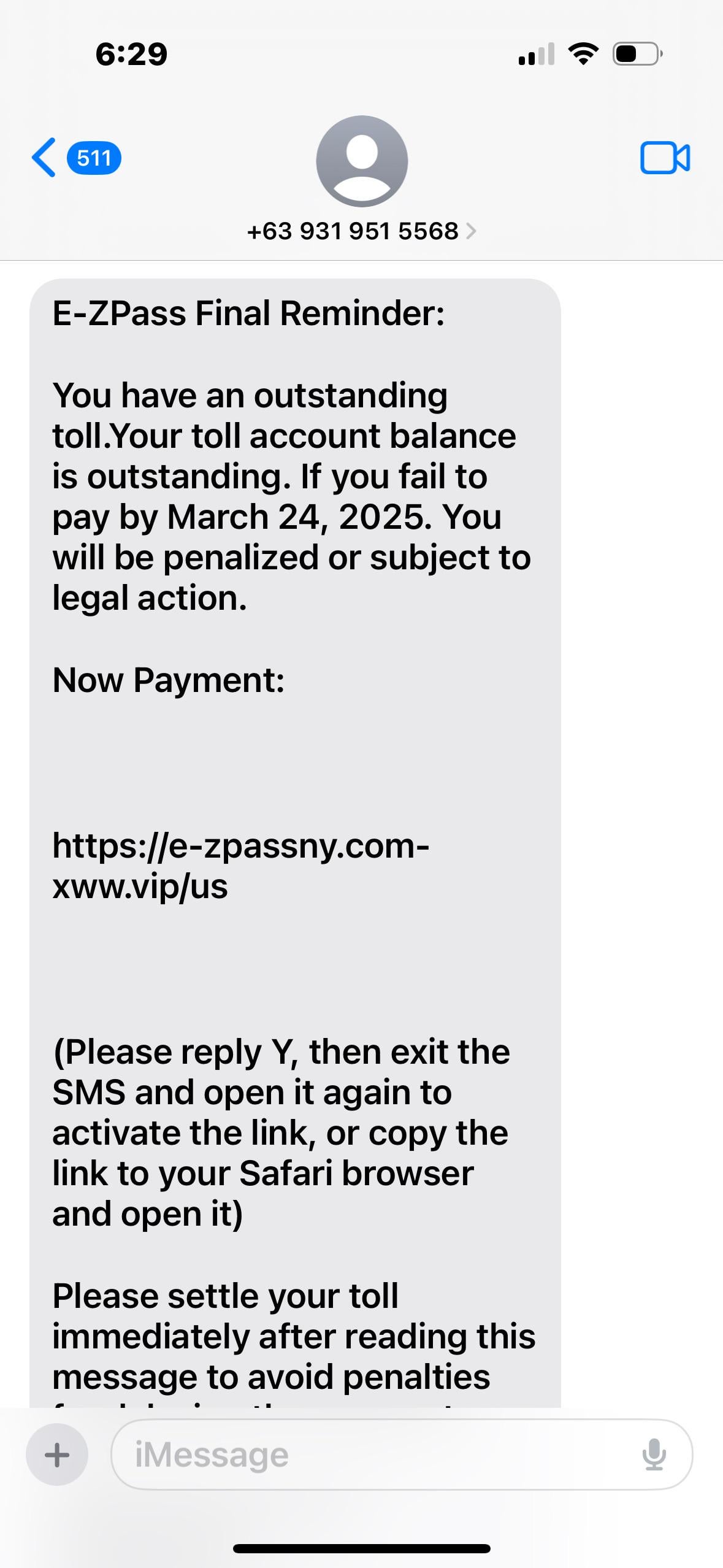
E-ZPass scams are fraudulent text messages, emails, websites, and phone calls impersonating E-ZPass or toll agencies to steal your personal information, credit card numbers, or install malware on your device. The most common scam in 2024 and 2025 is a smishing (SMS phishing) text claiming you have an unpaid toll balance with a link to a fake payment site.
What Are E-ZPass Scams and How Do They Work?
E-ZPass scams are phishing attacks where criminals impersonate toll collection agencies to trick you into paying fake invoices or surrendering personal data. These scams surged dramatically starting in late 2023 and exploded through 2024, with the FBI’s Internet Crime Complaint Center (IC3) receiving over 2,000 complaints in a single reporting period.
The scam works by exploiting urgency and fear. You receive a message claiming your E-ZPass account has a past-due balance, a failed payment, or a violation. The message includes a link to what looks like an official toll website.
Once you click, you are directed to a convincing but entirely fake website designed to harvest your credit card number, Social Security number, or other sensitive data.
These scams are not limited to E-ZPass users. Criminals target people who have never used toll roads. They send mass messages knowing that statistically, some recipients will have recently driven on tolled highways and believe the message is legitimate.
Why E-ZPass Scams Are So Effective
- Urgency triggers: Messages claim you face late fees, license suspension, or collections if you do not pay immediately.
- Low dollar amounts: Scam invoices typically ask for $4.75 to $12.50, amounts small enough that many people pay without questioning.
- Believable formatting: Fake websites clone the look and feel of legitimate toll agency portals, using similar logos, color schemes, and URL structures.
- Wide net targeting: Scammers blast millions of texts to random numbers, knowing a percentage of recipients will have used toll roads recently.
What Does an E-ZPass Scam Text Message Look Like?
An E-ZPass scam text typically arrives from an unknown number or short code and contains a brief message with a link. The text usually says something like “E-ZPass: Your account has an outstanding balance of $4.75. Pay now to avoid a $50 late fee” followed by a shortened or spoofed URL.
These messages often impersonate specific toll agencies including E-ZPass (used across the Northeast and Midwest), SunPass (Florida), TxTag (Texas), FasTrak (California), or generic “toll services” language. The URLs use domains that look official at a glance, such as ezpass-tollservices.com, usaezpass-pay.net, or similar variations that are not affiliated with any legitimate toll authority.
Common Scam Text Examples
- ⚠ Example 1: “E-ZPass: You have an unpaid toll balance of $6.50. To avoid additional charges of $50.00, settle your balance at [fake link].”
- ⚠ Example 2: “[Toll Services] Final notice: Your vehicle registration will be suspended due to unpaid toll violations. Pay immediately at [fake link].”
- ⚠ Example 3: “E-ZPass NY: Your payment of $11.23 was declined. Update your payment method now to avoid penalties: [fake link].”
- ⚠ Example 4: “Department of Motor Vehicles Notice: Unpaid E-ZPass toll violation found. Pay within 24 hours to avoid license suspension: [fake link].”
Notice how none of these messages include your name, account number, vehicle information, or any specific identifying details. Legitimate E-ZPass communications always reference your actual account and include verifiable details.
How Can You Tell if an E-ZPass Message Is a Scam?
You can identify E-ZPass scam messages by checking the sender’s number, examining the URL carefully, and verifying the message against your actual account. Legitimate E-ZPass agencies will never ask you to pay via an unsolicited text link, threaten immediate license suspension by text, or request sensitive personal information through SMS or email.
Red Flags That Identify a Scam
- 🚩 Unsolicited messages: You never signed up for text alerts from E-ZPass but suddenly receive one.
- 🚩 Generic greetings: The message does not address you by name or include your account number.
- 🚩 Suspicious URLs: The link does not match the official toll agency domain. Legitimate E-ZPass websites end in .org, .gov, or verified official domains.
- 🚩 Urgency and threats: Messages threaten license suspension, collections, or legal action within 24 to 72 hours.
- 🚩 Requests for sensitive data: The linked page asks for your Social Security number, full credit card details beyond a standard payment, or login credentials for unrelated accounts.
- 🚩 Poor grammar or formatting: Many scam messages contain awkward phrasing, unusual capitalization, or spacing errors.
- 🚩 Area code mismatch: The text comes from an area code that has no connection to your state or the toll authority’s region.
How to Verify a Legitimate E-ZPass Communication
- ✓ Step 1: Do not click any links in the message. Close the text and open your browser manually.
- ✓ Step 2: Navigate directly to your official E-ZPass website by typing the URL yourself (e.g., ezpass.com or your state’s specific E-ZPass site).
- ✓ Step 3: Log into your actual account and check for any outstanding balances or violations.
- ✓ Step 4: Call the customer service number listed on the back of your physical E-ZPass transponder or on the official website.
- ✓ Step 5: If no balance or violation appears in your account, the message was a scam.
What Should You Do if You Clicked an E-ZPass Scam Link?
If you clicked the link but did not enter any information, close the page immediately, clear your browser cache, and run a malware scan on your device. If you entered personal or financial information, take immediate steps to protect your accounts because scammers act fast to exploit stolen data.
Immediate Steps After Clicking
- If you only clicked the link: Close the browser tab, clear your cache and cookies, and run a full antivirus scan. Monitor your phone for unusual behavior such as unexpected app installations or battery drain, which could indicate malware.
- If you entered payment information: Call your credit card company or bank immediately. Report the charges as fraudulent and request a new card number. Most banks can freeze the card instantly through their app.
- If you entered your Social Security number: Place a fraud alert or credit freeze with all three major credit bureaus: Equifax, Experian, and TransUnion. Consider enrolling in an identity theft protection service.
- If you created an account or entered a password: Change your password immediately, especially if you reuse that password on other sites. Enable two-factor authentication on all critical accounts.
Where to Report E-ZPass Scams
- FBI Internet Crime Complaint Center (IC3): File a report at ic3.gov with the scam message details, URL, and any financial losses.
- FTC Report Fraud: Submit a complaint at reportfraud.ftc.gov.
- Your state’s E-ZPass agency: Forward the scam message to the toll authority’s official fraud or security email address.
- Your phone carrier: Report the scam text by forwarding it to 7726 (SPAM), which helps carriers block future scam messages from the same source.
- State Attorney General: File a consumer complaint with your state AG’s office for tracking and potential investigation.
Are There Other Types of E-ZPass Scams Beyond Text Messages?
Yes, E-ZPass scams extend well beyond text messages. Criminals use email phishing, fake phone calls, fraudulent websites, social media ads, and even physical mail to target victims. Each method uses the same core tactic of impersonating toll agencies to extract money or personal information.
Email Phishing Scams
Email scams mimic official E-ZPass correspondence with professional-looking templates, official logos, and formatting that closely resembles real toll agency communications. These emails often include attachments that install malware when opened or link to credential-harvesting websites.
They tend to be more detailed than text scams, sometimes including fake invoice numbers, violation dates, and amounts.
Phone Call Scams
Automated robocalls claiming to be from E-ZPass or a toll authority tell you that you owe money and threaten consequences if you do not pay immediately over the phone. Some calls use caller ID spoofing to display a legitimate toll agency’s phone number. Real toll agencies do not make unsolicited collection calls demanding immediate payment by phone.
Fake E-ZPass Websites
Scammers create full websites that look identical to official E-ZPass portals. These sites appear in search engine results, sometimes through paid ads, and collect payment information from unsuspecting visitors. Always verify the URL carefully and look for official government or verified domains before entering any information.
Social Media and Online Ad Scams
Fraudulent ads on social media platforms and search engines promote discounted E-ZPass transponders, special toll deals, or account management services. These ads lead to fake websites that steal payment data. Legitimate E-ZPass transponders are only sold through official toll agency websites, authorized retail locations, or approved service centers.
Fake Physical Mail
Some scammers send physical letters that look like official toll violation notices, complete with logos, case numbers, and payment instructions. These letters direct victims to send checks or money orders to fraudulent addresses or pay through fake online portals. Compare any suspicious mail against your actual toll account records before paying.
How to Protect Yourself from E-ZPass Scams Going Forward
Protecting yourself from E-ZPass scams requires a combination of skepticism toward unsolicited messages, direct verification through official channels, and basic digital security hygiene. The vast majority of these scams succeed because victims react emotionally to urgency rather than verifying independently.
Essential Protection Steps
- 🛡️ Never click links in unsolicited toll messages: Always navigate to the official website by typing the URL directly into your browser.
- 🛡️ Set up official account alerts: Log into your real E-ZPass account and enable email or text notifications so legitimate communications come from verified channels you recognize.
- 🛡️ Keep your contact information updated: Ensure your E-ZPass account has your current email and phone number so official notices arrive correctly.
- 🛡️ Use spam filtering: Enable spam filters on your phone and email to catch phishing attempts before they reach you.
- 🛡️ Report scam messages immediately: Forward scam texts to 7726 and report phishing emails to the Anti-Phishing Working Group at [email protected].
- 🛡️ Check your E-ZPass account regularly: Review your account balance and transaction history at least once a month to catch any legitimate issues early.
- 🛡️ Educate household members: Make sure everyone who drives in your household knows what these scams look like and how to verify messages independently.
State-Specific Official E-ZPass Websites
Frequently Asked Questions About E-ZPass Scams
Can scammers steal my identity just from me clicking an E-ZPass scam link?
Simply clicking a link on a modern, updated phone or computer is unlikely to install malware automatically. However, if your device software is outdated or you download a file from the scam page, your device could be compromised. The real danger comes from entering information on the fake page.
Close the page immediately if you click by accident and do not interact with anything on it.
I paid an E-ZPass scam invoice. Can I get my money back?
If you paid with a credit card, contact your card issuer immediately and file a chargeback dispute for fraud. Credit card companies generally side with consumers on phishing fraud claims. If you paid via debit card or bank transfer, contact your bank right away to request a reversal.
Recovery is harder with debit payments, but acting within 48 hours significantly improves your chances.
Why am I getting E-ZPass scam texts if I do not even have an E-ZPass account?
Scammers send messages to millions of random phone numbers using auto-dialing software. They do not check whether you have an E-ZPass account because they rely on the statistical probability that some recipients will have recently used a toll road and assume the message is legitimate. Having no account actually makes it easier to identify the message as a scam.
Are E-ZPass scam texts illegal, and will the scammers get caught?
Yes, these scams violate federal wire fraud statutes, state consumer protection laws, and telecommunications regulations. However, most perpetrators operate from overseas using spoofed numbers and encrypted channels, making prosecution extremely difficult. Reporting every scam attempt helps law enforcement identify patterns, track criminal networks, and occasionally shut down major operations.
Do E-ZPass scam texts carry viruses or malware?
The text message itself does not contain malware. The risk begins if you click the link and the fake website prompts you to download an app, file, or update. Never install anything from a website you reached through an unsolicited text.
Keep your phone’s operating system and browser updated to minimize vulnerability to drive-by exploits.
Should I change my E-ZPass password if I received a scam text?
Receiving a scam text alone does not mean your E-ZPass account was compromised. However, if you clicked the link and entered your E-ZPass login credentials on the fake site, change your password immediately. Use a unique, strong password and enable two-factor authentication if your toll agency offers it.
Also change passwords on any other accounts where you used the same credentials.
Take These Scams Seriously and Stay Protected
E-ZPass scams are not going away. They are evolving.
Scammers are becoming more sophisticated with their messaging, website design, and targeting methods. The single most effective defense is refusing to click links in unsolicited messages and verifying everything directly through official channels.
No legitimate toll agency will ever threaten you by text or demand immediate payment through a link sent to your phone. When in doubt, ignore the message, open your browser, and check your account the right way.
Leave a Reply