
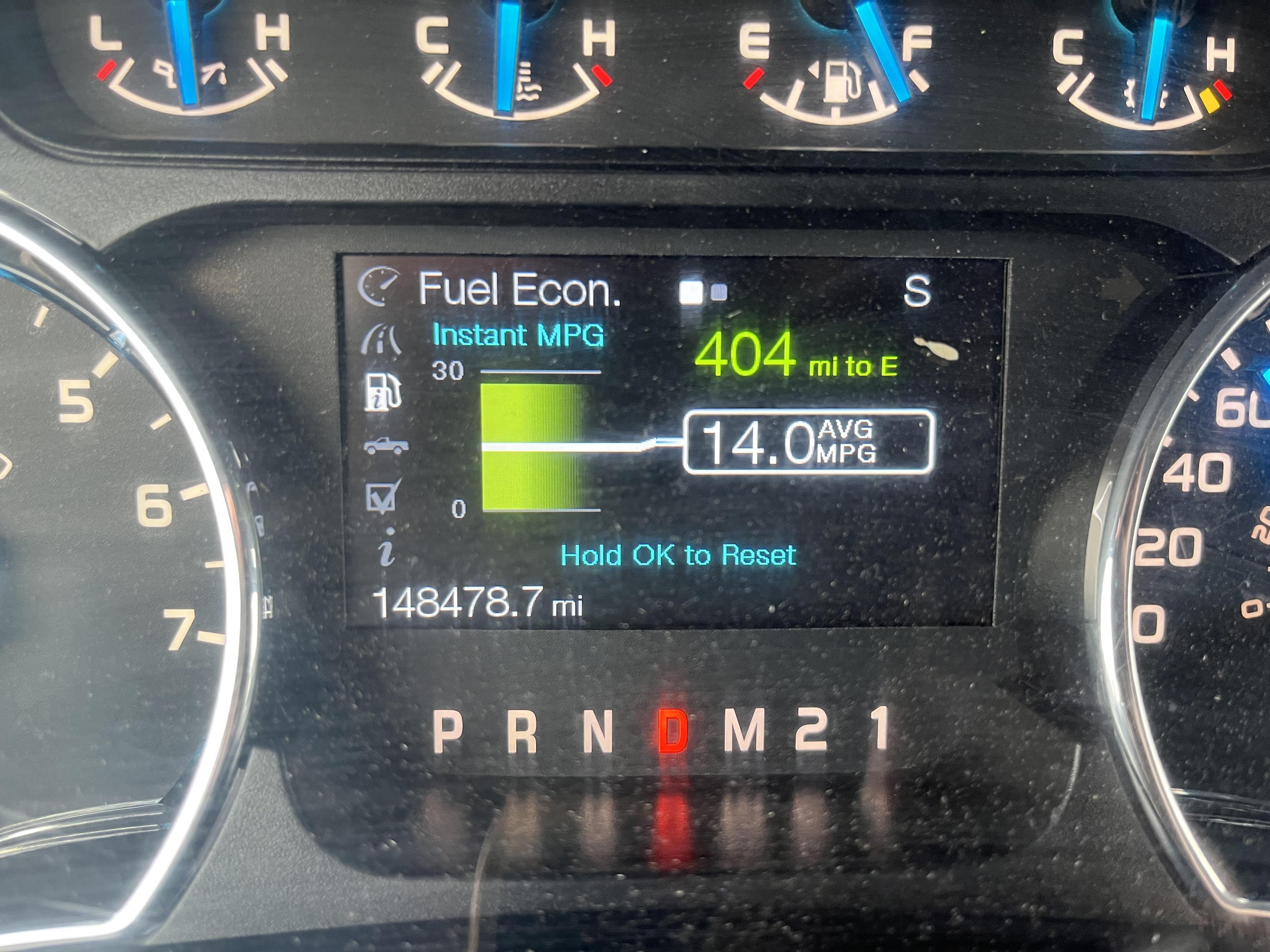
The typical gas mileage for a Ford F-150 falls between 15 and 22 MPG combined depending on engine size, model year, and driving conditions.
What is the real-world gas mileage for Ford F-150 models by year and engine?
Ford F-150 fuel economy varies significantly across engine options and model years.
Owners consistently report numbers lower than EPA estimates once real loads, highway speeds, and maintenance issues enter the picture.
5.0L V8 models
2015-2020 5.0L trucks average 16-18 MPG combined in mixed driving.
Highway runs at 70 mph often settle at 19-21 MPG when the truck is empty and tires are properly inflated.
3.5L EcoBoost models
2015-2020 3.5L EcoBoost trucks reach 17-20 MPG combined when the turbos are healthy.
Many owners see a 2-3 MPG drop after 80,000 miles if carbon buildup or intercooler leaks develop.
| Year Range | Engine | Reported Combined MPG | Common Highway MPG |
|---|---|---|---|
| 2015-2020 | 5.0L V8 | 16-18 | 19-21 |
| 2015-2020 | 3.5L EcoBoost | 17-20 | 20-23 |
| 2021-2024 | 3.5L PowerBoost Hybrid | 22-25 | 24-27 |
Why does my Ford F-150 suddenly lose gas mileage?
Sudden drops in fuel economy almost always trace to a specific component failure rather than normal wear.
Dealerships frequently misdiagnose these as major engine repairs when simpler fixes solve the problem.
Dirty or failing mass air flow sensor
The MAF sensor on 2015-2020 F-150s collects oil residue from the PCV system.
When it drifts, the PCM adds extra fuel and mileage falls 3-5 MPG. Cleaning the sensor with MAF-specific cleaner restores economy in most cases.
Stuck open purge valve
The EVAP purge valve on EcoBoost engines sticks open after 60,000 miles.
Raw fuel vapors enter the intake continuously, richening the mixture and triggering slight misfires that owners feel as reduced throttle response and worse mileage.
Low tire pressure or wrong tire size
Running 3 PSI low across all four tires costs 1-2 MPG.
Many owners install larger all-terrain tires without recalibrating the speedometer, which makes the ECM think the truck is traveling slower than actual speed and alters shift points.
How do I diagnose poor Ford F-150 fuel economy step by step?
Follow this sequence before replacing expensive parts. Each step confirms or rules out a common cause reported on owner forums.
- Scan for pending codes even without a check-engine light using a bidirectional scan tool that reads Ford-specific PIDs.
- Check long-term fuel trims at idle and 2500 RPM. Values over +10% point to vacuum leaks or MAF issues.
- Inspect the air filter housing and intake tract for oil residue that indicates PCV problems.
- Monitor fuel pressure with a gauge on the Schrader valve. Pressure below spec on 5.0L models usually means a weak pump or clogged filter.
- Verify spark plug condition and gap. Fouled plugs on EcoBoost engines cause misfires that the PCM compensates for with extra fuel.
What maintenance items improve F-150 gas mileage the most?
Targeted maintenance yields measurable gains when performed in the correct order. Focus on items that directly affect combustion efficiency.
Replace spark plugs at 60,000 miles
Factory plugs on the 5.0L often last longer than recommended but begin to misfire under load after 60k miles.
Use Motorcraft plugs gapped to 0.030 inches and torque to 15 lb-ft.
Clean the throttle body and MAF
Remove the throttle body and spray with throttle-body cleaner every 40,000 miles.
This restores smooth idle and allows the PCM to trim fuel more accurately.
Update PCM calibration if available
Ford released multiple PCM flashes that improve shift schedules and fuel mapping on 2018-2020 trucks.
Dealers often skip these updates unless asked specifically.
Can driving habits and modifications change F-150 MPG?
Driving style affects mileage more than most owners realize.
Aggressive throttle tip-in and constant 75 mph cruising cost 3-4 MPG on any F-150.
- ✔Use cruise control on flat highways to maintain steady load and keep the transmission in higher gears.
- ✔Remove bed covers or toolboxes when not needed. Added weight and wind resistance reduce economy immediately.
- ✔Switch to 87 octane if the truck does not knock. Premium fuel provides no measurable gain on non-EcoBoost engines.
FAQ
How often should I replace the fuel filter on a 2015-2020 F-150?
The in-tank filter is considered lifetime by Ford, but owners who replace it at 100,000 miles often report a 1 MPG improvement and smoother power delivery.
Does a cold-air intake improve gas mileage on an F-150?
Most aftermarket intakes show zero MPG gain on dyno testing once the engine reaches operating temperature. The factory airbox already provides adequate flow.
Why does my F-150 lose mileage in winter?
Colder air is denser, requiring more fuel for the same volume. Combined with winter fuel blends and block-heater use, expect a 2-3 MPG seasonal drop.
Is the 10-speed transmission better for fuel economy than the 6-speed?
The 10-speed allows earlier upshifts and better lock-up strategy, netting 1-2 MPG in highway driving when the fluid is fresh and the mechatronics are functioning correctly.
Should I disable auto start-stop to save fuel?
Disabling auto start-stop rarely improves overall economy and can increase fuel use in stop-and-go traffic because the engine stays running.
Consistent monitoring of fuel trims and targeted maintenance on the MAF, plugs, and EVAP system restores lost mileage on most F-150s without expensive repairs.
Track your numbers over several tanks after each fix to confirm the improvement.
Leave a Reply