
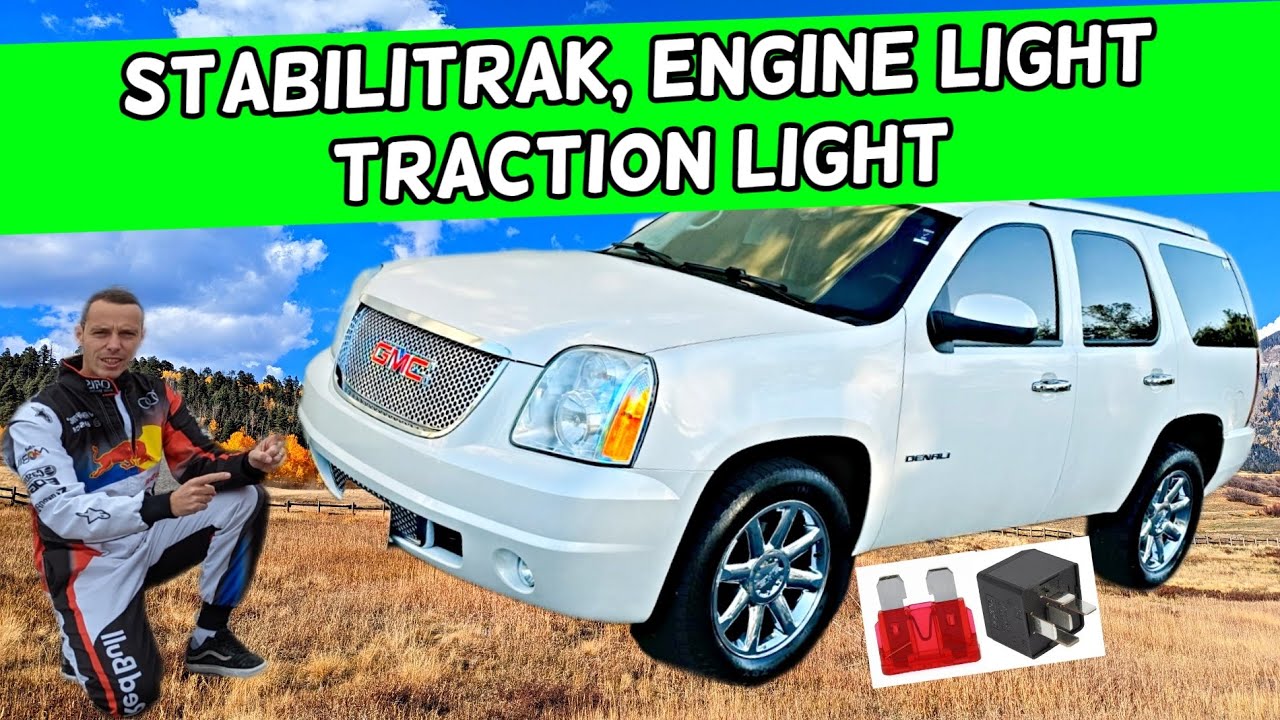
The “Service StabiliTrak” message on a GMC Yukon typically indicates a fault in the vehicle’s stability control system, most commonly caused by a failing wheel speed sensor, a bad brake light switch, a faulty steering angle sensor, or an issue with the Electronic Brake Control Module (EBCM). In many cases, the fix is as simple as replacing a $15–$40 wheel speed sensor, but dealerships often quote $800–$2,000+ for unnecessary module replacements.
What Does “Service StabiliTrak” Mean on a GMC Yukon?
The “Service StabiliTrak” warning means your Yukon’s onboard computer has detected a malfunction in the StabiliTrak electronic stability control system. When this happens, the system is typically disabled, and you may also lose traction control and, in some cases, experience reduced engine power.
StabiliTrak relies on data from multiple sensors — wheel speed sensors, a steering angle sensor, a yaw rate sensor, and a lateral accelerometer — all feeding into the EBCM. If any single sensor sends erratic or missing data, the entire system shuts down as a safety precaution and triggers the warning message.
The critical thing to understand is that this message is a symptom, not a diagnosis. The underlying cause can range from a corroded sensor connector to a failed module. Scanning for diagnostic trouble codes (DTCs) with a capable OBD-II scanner is the only reliable first step.
What Causes the Service StabiliTrak Light on a GMC Yukon?
There are several common root causes, and in my experience, the majority of Yukon StabiliTrak issues trace back to one of the following failures. Each has distinct symptoms and repair costs.
1. Wheel Speed Sensor Failure
This is the single most common cause of StabiliTrak warnings on the Yukon, especially on 2007–2020 models. Each wheel has a speed sensor mounted near the hub or bearing assembly, and these sensors are exposed to road debris, moisture, and salt.
- Symptoms: StabiliTrak light, ABS light, traction control light all come on together. Speedometer may read erratically or drop to zero while driving.
- Common DTCs: C0035, C0040, C0045, C0050 (one code per wheel position)
- DIY Fix: Locate the faulty sensor using the DTC, unplug it, remove the single mounting bolt (usually 10mm), and replace it. Parts cost $15–$50 per sensor. Labor at a shop: $100–$200.
- Pro Tip: Before replacing the sensor, inspect the wiring harness and connector for corrosion or damage. A corroded connector can mimic a bad sensor. Clean it with electrical contact cleaner and dielectric grease first.
2. Brake Light Switch Failure
The brake light switch, mounted above the brake pedal, tells the EBCM when you are braking. When it fails or sends intermittent signals, the stability system loses a critical data point and disables itself.
- Symptoms: Service StabiliTrak message, brake lights may stay on constantly or not work at all, cruise control stops functioning.
- Common DTCs: C0161, C0899, U0121
- DIY Fix: The switch is located under the dash above the brake pedal arm. It twists out of its bracket. Replacement parts cost $10–$25. No special tools needed — just a flathead screwdriver to release the clip.
- Pro Tip: This is one of the cheapest and easiest fixes, yet dealerships frequently overlook it and jump straight to module diagnostics. Always check this first if you also have cruise control issues.
3. Steering Angle Sensor (SAS) Calibration or Failure
The steering angle sensor monitors the position and rate of the steering wheel. If it loses its center calibration — often after a wheel alignment, battery disconnect, or steering component replacement — StabiliTrak will disable itself.
- Symptoms: Service StabiliTrak message appears after an alignment, battery replacement, or steering work. Vehicle may pull or feel unstable in turns.
- Common DTCs: C0710, C0460
- DIY Fix: In many cases, the sensor does not need replacement — it needs recalibration. Turn the steering wheel fully left, then fully right, then back to center with the engine running. Drive straight for 30 seconds. If the light clears, the sensor was just out of calibration. If it persists, the sensor itself may need replacement ($80–$150 part).
4. Electronic Brake Control Module (EBCM) Failure
The EBCM is the brain of the StabiliTrak system. On certain Yukon model years — particularly 2007–2014 — these modules are known to develop internal solder joint failures or water intrusion damage.
- Symptoms: Multiple ABS and stability codes that do not resolve with sensor replacement. Intermittent loss of ABS, traction control, and StabiliTrak simultaneously.
- Common DTCs: C0110, C0161 (persistent), U0073, U0121
- DIY Fix: Module replacement costs $400–$900 for the part alone. However, several companies offer EBCM rebuild services for $150–$300. You remove the module, ship it out, and reinstall the rebuilt unit. No programming required in most cases.
- Pro Tip: Before condemning the EBCM, check the ground points and power supply voltage. A weak battery or corroded ground strap can cause the module to behave erratically and throw misleading codes.
5. Yaw Rate Sensor / Lateral Accelerometer Failure
These sensors, often combined into a single unit mounted under the center console or beneath the driver’s seat, measure the vehicle’s rotational movement and side-to-side G-forces. Failure is less common but does occur on high-mileage units.
- Symptoms: StabiliTrak light with no accompanying ABS light. Vehicle may feel unstable during emergency maneuvers. Codes point to yaw rate or lateral acceleration data errors.
- Common DTCs: C0196, C0710 (if combined with SAS codes)
- DIY Fix: The sensor is typically accessible by removing the center console trim. Part cost ranges from $80–$200. After replacement, a scan tool with SAS reset capability is needed to calibrate the new sensor.
6. Wiring Harness and Connector Issues
On Yukons driven in northern climates or areas with heavy road salt, wiring corrosion is a real and frequently overlooked cause. The wheel speed sensor harnesses run through exposed areas near the wheel wells and are vulnerable to chafing, rodent damage, and connector corrosion.
- Symptoms: Intermittent StabiliTrak warnings that come and go, especially in wet or cold weather. Codes may point to different wheels at different times.
- DIY Fix: Visually inspect each wheel speed sensor connector and harness for green corrosion, broken wires, or loose pins. Clean corroded connectors with electrical contact cleaner and apply dielectric grease. Repair broken wires with solder and heat-shrink tubing — do not use crimp connectors in this application.
GMC Yukon StabiliTrak Problems by Model Year
Different Yukon generations have distinct weak points. Knowing your platform helps narrow down the diagnosis faster.
| Model Years | Platform | Most Common StabiliTrak Cause | Typical Repair Cost |
|---|---|---|---|
| 2007–2014 | GMT900 | Wheel speed sensors, EBCM internal failure, brake light switch | $15–$900 |
| 2015–2020 | GMTK2XX | Steering angle sensor, wheel speed sensors, wiring corrosion | $25–$300 |
| 2021–Present | T1XX | Software calibration issues, steering angle sensor, sensor communication faults | $0–$400 |
2007–2014 GMC Yukon (GMT900 Platform)
This generation is the most documented for StabiliTrak problems. The EBCM on these trucks is mounted in a location that is susceptible to water intrusion, and the wheel speed sensors are known to fail between 80,000 and 120,000 miles. The brake light switch is also a notorious failure point on this generation.
If you own a 2007–2014 Yukon and get the Service StabiliTrak message along with reduced engine power, check the throttle body as well. GM issued a special coverage adjustment (not a full recall) for throttle body issues on some of these trucks that can trigger both a StabiliTrak warning and engine power reduction simultaneously.
2015–2020 GMC Yukon (GMTK2XX Platform)
The newer platform improved EBCM reliability but introduced more sensitivity in the steering angle sensor. Many owners report StabiliTrak warnings appearing after routine maintenance like wheel alignments or tire rotations. The fix is often just a steering angle sensor recalibration, which can sometimes be done without a scan tool using the steering wheel method described above.
2021–Present GMC Yukon (T1XX Platform)
The newest generation uses more software-driven stability control, and some StabiliTrak warnings are triggered by software calibration issues rather than hardware failures. GM has released several TSBs (Technical Service Bulletins) addressing software updates for the body control module and EBCM. If you have a 2021+ Yukon with this warning and no other symptoms, check with your dealer for available software updates before approving any parts replacement.
How to Reset StabiliTrak on a GMC Yukon
After addressing the underlying fault, you may need to clear the codes and reset the system. Here are the methods, from simplest to most thorough.
Method 1: Ignition Cycle Reset
- Turn the engine off and remove the key (or push the start button to fully off).
- Wait 30 seconds.
- Restart the engine and drive normally for 2–3 minutes.
- If the fault has been repaired, the light will stay off. If it returns, the underlying issue is still present.
Method 2: Battery Disconnect Reset
- Disconnect the negative battery terminal.
- Wait 10–15 minutes to allow the capacitors in the modules to fully discharge.
- Reconnect the terminal and start the vehicle.
- Drive straight at 15+ mph for one minute to allow the steering angle sensor to re-center.
Method 3: OBD-II Scanner Clear
- Connect a capable OBD-II scanner (one that reads ABS/BCM modules, not just engine codes).
- Navigate to the ABS or Chassis module and read all stored DTCs.
- Clear the codes and perform any available SAS reset or calibration procedure.
- Test drive and verify the warning does not return.
How Much Does It Cost to Fix Service StabiliTrak on a GMC Yukon?
Repair costs vary dramatically depending on the root cause. Here is a realistic breakdown based on what shops actually charge, not inflated dealership estimates.
| Repair | DIY Cost | Independent Shop | Dealership |
|---|---|---|---|
| Wheel speed sensor replacement | $15–$50 | $100–$250 | $200–$400 |
| Brake light switch replacement | $10–$25 | $75–$150 | $150–$300 |
| Steering angle sensor recalibration | $0 (DIY method) | $50–$100 | $100–$200 |
| Steering angle sensor replacement | $80–$150 | $200–$400 | $400–$700 |
| EBCM replacement (new) | $400–$900 | $600–$1,200 | $1,000–$2,000 |
| EBCM rebuild service | $150–$300 | $300–$500 | N/A (dealers replace, not rebuild) |
| Yaw rate sensor replacement | $80–$200 | $200–$400 | $400–$600 |
Frequently Asked Questions
Is it safe to drive a GMC Yukon with the Service StabiliTrak light on?
You can drive the vehicle, but understand that your stability control and traction control are disabled. In dry, normal driving conditions, this is manageable.
However, in rain, snow, or emergency maneuvers, you lose a critical safety net. Get it diagnosed as soon as possible, and avoid aggressive driving until it is fixed.
Can a bad battery cause the Service StabiliTrak message?
Yes. A weak or failing battery can cause voltage drops that confuse the EBCM and other modules, triggering false StabiliTrak warnings. If your battery is more than 4–5 years old and you are getting intermittent electrical warnings, have the battery and charging system tested before chasing sensor or module faults.
Does the Service StabiliTrak message mean reduced engine power?
Not always, but on certain Yukon model years — particularly 2007–2014 — the system may also trigger a reduced engine power mode as a safety measure. This typically happens when the EBCM communicates a fault to the engine control module (ECM), which then limits throttle output. Fixing the underlying StabiliTrak fault usually resolves the power reduction as well.
Will a wheel alignment fix the StabiliTrak warning?
No, an alignment itself will not fix the warning. However, if the steering angle sensor lost its calibration during the alignment process, recalibrating the sensor after the alignment may clear the message. Always ask the alignment shop to perform an SAS reset as part of the alignment procedure.
Can I disable StabiliTrak permanently on my Yukon?
You can press and hold the traction control button for several seconds to disable StabiliTrak temporarily while driving, but it re-enables every time you restart the vehicle. Permanently disabling it is not recommended and may affect insurance liability in the event of an accident. Fix the root cause instead.
Fix the Root Cause, Not Just the Light
The Service StabiliTrak message on a GMC Yukon is one of the most common — and most commonly misdiagnosed — warnings owners face. Dealerships and many shops default to expensive module replacements when the actual fix is often a $20 sensor or a simple recalibration.
Always start with a proper diagnostic scan, check the cheapest and most common failures first, and do not approve a four-figure repair until the basics have been ruled out. A methodical approach will save you hundreds, if not thousands, of dollars.
Leave a Reply