
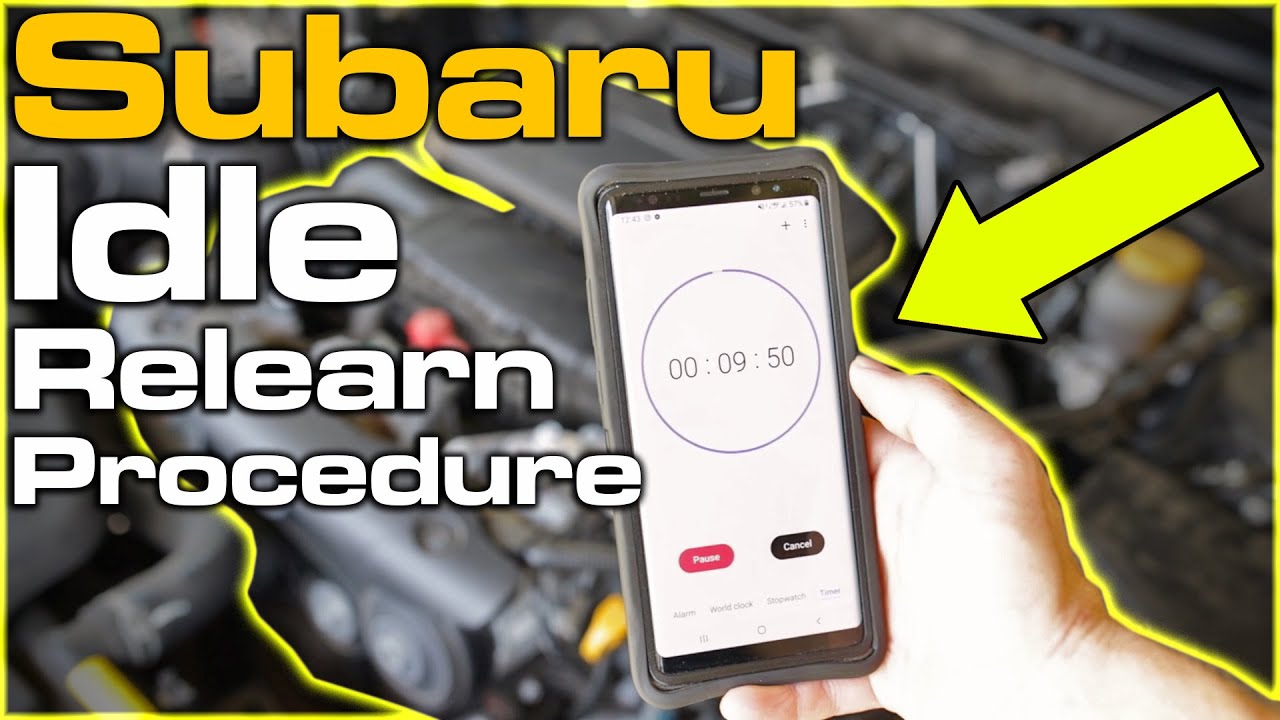
The idle speed relearn procedure is a calibration process where the vehicle’s ECU relearns the optimal idle RPM after battery disconnect, throttle body cleaning, ECU reset, or repair. Symptoms of an unlearned idle include high idle, rough idle, stalling at stops, and fluctuating RPM. Most vehicles require a specific drive cycle or manual reset steps to complete the relearn.
What Happens When the Idle Speed Is Not Relearned?
When the idle speed is not relearned, the ECU runs the engine using default or last-known values that may not match current conditions. This leads to unstable idle, surge between 800 and 1500 RPM, or stalling at stoplights.
Owners commonly notice this right after disconnecting the battery for repairs or after cleaning a throttle body. The car starts fine at first, but the idle either hangs too high or dips dangerously low when coming to a stop.
The root cause is simple. The ECU tracks throttle plate position and idle airflow over time and stores these as learned values. When those values are wiped, the computer must recalibrate before idle quality returns to normal.
When Do You Need an Idle Speed Relearn Procedure?
You need an idle speed relearn after any event that clears stored ECU adaptive values or changes throttle body airflow. The most common triggers are battery replacement, throttle body cleaning or replacement, ECU flash or reprogramming, and repairs involving the intake manifold.
Common Triggers That Require Relearn
- ▶Battery disconnect or replacement – wipes learned idle values on most vehicles.
- ▶Throttle body cleaning – carbon buildup removal changes airflow past the throttle plate.
- ▶ECU reflash or reprogramming – new software expects fresh adaptation values.
- ▶Throttle body replacement – the new unit has different mechanical tolerances.
- ▶Intake manifold gasket replacement – changes vacuum characteristics at idle.
How to Perform an Idle Speed Relearn Procedure
The idle speed relearn procedure varies by manufacturer and model year. Some vehicles relearn automatically within a short drive cycle, while others require specific ignition and pedal sequences to complete calibration.
General Drive Cycle Relearn (Works on Many Vehicles)
- Start the engine and let it reach full operating temperature with all accessories off.
- Turn the engine off and wait at least 60 seconds.
- Restart the engine and idle in Park or Neutral for 5 minutes without touching the accelerator.
- Turn on the AC, headlights, and rear defroster together. Let idle run for another 5 minutes.
- Drive the vehicle at speeds between 35 and 45 mph for at least 10 minutes with steady throttle.
- Return to idle and verify the RPM stabilizes between 650 and 800 RPM.
GM Idle Relearn Procedure
GM vehicles (Chevrolet, GMC, Buick, Cadillac) often require a manual relearn after throttle body work. The ECU must relearn the throttle body’s closed position.
- Turn the ignition to ON without starting. Wait 30 seconds.
- Start the engine and let it idle for 3 minutes with all loads off.
- Turn on AC and headlights for 2 minutes.
- Drive for 15 minutes at mixed speeds to complete adaptation.
Ford Idle Relearn Procedure
Ford vehicles typically relearn within 30 to 60 minutes of normal driving after battery disconnect. However, some older models with IAC valves need a manual KOER (Key On Engine Running) test reset.
- ▶Use an OBD-II scanner to clear throttle body adaptations if the idle stays above 1000 RPM.
- ▶Perform the PATS key cycle if the vehicle has immobilizer-linked idle behavior.
- ▶Allow the vehicle to idle for 15 minutes in Park after clearing codes.
Honda and Acura Idle Relearn Procedure
Honda vehicles respond well to the ECU relearn by disconnecting the battery negative terminal for 15 minutes. After reconnecting, start the engine and let it idle in Park with no accessories for 5 minutes.
Next, turn on the AC and headlights. Let it idle for 5 more minutes. Honda ECUs recalibrate quickly compared to other brands.
Toyota and Lexus Idle Relearn
Toyota electronic throttle bodies usually self-learn within one or two short drive cycles. If the idle stays high after a throttle body cleaning, disconnect the battery for 10 minutes. Then perform a steady idle for 5 minutes followed by light city driving.
Why Does Idle Stay High After Relearn Attempts?
If the idle stays high even after following the correct relearn procedure, there is likely a mechanical or electrical issue preventing adaptation. The most common culprits are vacuum leaks, a faulty IAC valve, a dirty throttle plate that was not cleaned properly, or a malfunctioning throttle position sensor.
1. Vacuum Leak Preventing Stable Idle
A vacuum leak introduces unmetered air into the intake manifold, raising idle RPM above what the throttle plate can control. This is especially common after intake manifold work or when aged rubber hoses crack.
Check all PCV hoses, brake booster lines, and intake gasket sealing surfaces. Use a smoke machine or propane enrichment around the intake to identify leaks.
2. Faulty or Dirty IAC Valve
Vehicles with an idle air control valve (IAC) depend on this component to fine-tune idle speed. If the IAC is carbon-fouled or electrically failing, the relearn cannot stabilize idle RPM.
Remove the IAC valve and clean it with throttle body cleaner. If the problem persists, replace the valve — aftermarket units are available for most makes at a fraction of dealer pricing.
3. Throttle Body Not Cleaned Properly
Owners often clean the throttle body but leave a carbon ridge around the throttle plate edge. This causes inconsistent airflow and the ECU cannot lock in a stable idle value.
Remove the throttle body entirely for a thorough cleaning if the simple spray-and-wipe method does not resolve the issue.
4. Faulty Throttle Position Sensor (TPS)
The TPS tells the ECU where the throttle plate is positioned at idle. If it sends incorrect voltage, the ECU defaults to a safe high idle to prevent stalling.
Test TPS voltage at idle with a multimeter. It should read a steady low value (typically 0.5V to 0.9V on GM and 0.8V to 1.2V on Ford). Any fluctuation or out-of-range reading means the sensor needs replacement.
Model-Specific Idle Relearn Procedures
Below are proven relearn methods for specific popular models that frequently exhibit idle problems after battery or throttle body service.
Nissan Accelerator Pedal Release Method
Nissan vehicles use a specific pedal sequence to reset throttle body adaptation. Turn ignition ON, then fully press and release the accelerator pedal 5 times within 5 seconds. Wait 7 seconds, then hold the pedal fully for 20 seconds until the check engine light blinks.
Can an OBD-II Scanner Help With Idle Relearn?
Yes, a capable OBD-II scanner with bi-directional control can force the ECU to perform throttle body relearn immediately. Basic code readers cannot do this — you need a tool with adaptation reset capability.
Tools like the Autel MX808, Launch X431, or even some mid-range Foxwell scanners can access the throttle body adaptation function. This is especially helpful for European vehicles (BMW, Mercedes, VW) that have complex electronic throttle control systems.
How Long Does Idle Relearn Take on Its Own?
On most modern vehicles, idle relearn completes automatically within 30 to 60 minutes of mixed driving if no mechanical faults exist. If the idle is still unstable after two full drive cycles, you are dealing with a hardware problem — not a calibration problem.
Some owners confuse idle issues with engine idle shutdown behavior. If the engine shuts off unexpectedly at stops, the fix is different and involves disabling engine idle shutdown rather than performing a relearn.
Common Mistakes During Idle Speed Relearn
- ▶Touching the accelerator during idle relearn – this interrupts the calibration and forces the ECU to restart the learning process.
- ▶Running accessories during initial idle – turn off AC, headlights, and defroster for the first phase to establish a baseline.
- ▶Not letting the engine reach operating temperature – cold coolant temperature readings confuse idle adaptation.
- ▶Skipping the battery disconnect step – some vehicles need the stored values fully cleared before relearn begins.
- ▶Ignoring vacuum leaks – no amount of relearn will fix idle caused by unmetered air entering the intake.
FAQ
Will an idle relearn fix a rough idle on cold starts?
Not always. A rough cold start idle is often caused by worn spark plugs, a faulty coolant temperature sensor, or leaking fuel injectors. Idle relearn only fixes calibration-related issues after ECU resets.
Do I need a scanner to relearn idle on a Toyota?
Most Toyota vehicles relearn idle automatically within one or two drive cycles without any scanner. However, if you replaced the electronic throttle body, a scanner reset speeds up the process significantly.
Can I drive my car while idle is relearning?
Yes, and it is actually recommended. Mixed driving at city and highway speeds helps the ECU learn adaptation values faster than stationary idling alone.
Why does my idle drop to 500 RPM and nearly stall after battery reconnection?
This is common on vehicles with IAC valves or drive-by-wire throttle bodies. The ECU defaults to a lower learned idle value and needs a few drive cycles to correct. If it persists beyond 30 minutes of driving, inspect the IAC valve and throttle body.
Final Thoughts on Idle Speed Relearn
The idle speed relearn procedure is straightforward once you understand the specific steps for your vehicle. Most idle problems after battery work or throttle body service resolve within one or two drive cycles when done correctly.
Always rule out vacuum leaks, IAC valve issues, and TPS faults before assuming the problem is purely a calibration issue. A methodical approach saves time and prevents unnecessary parts replacement or expensive dealership diagnostics.
Leave a Reply