
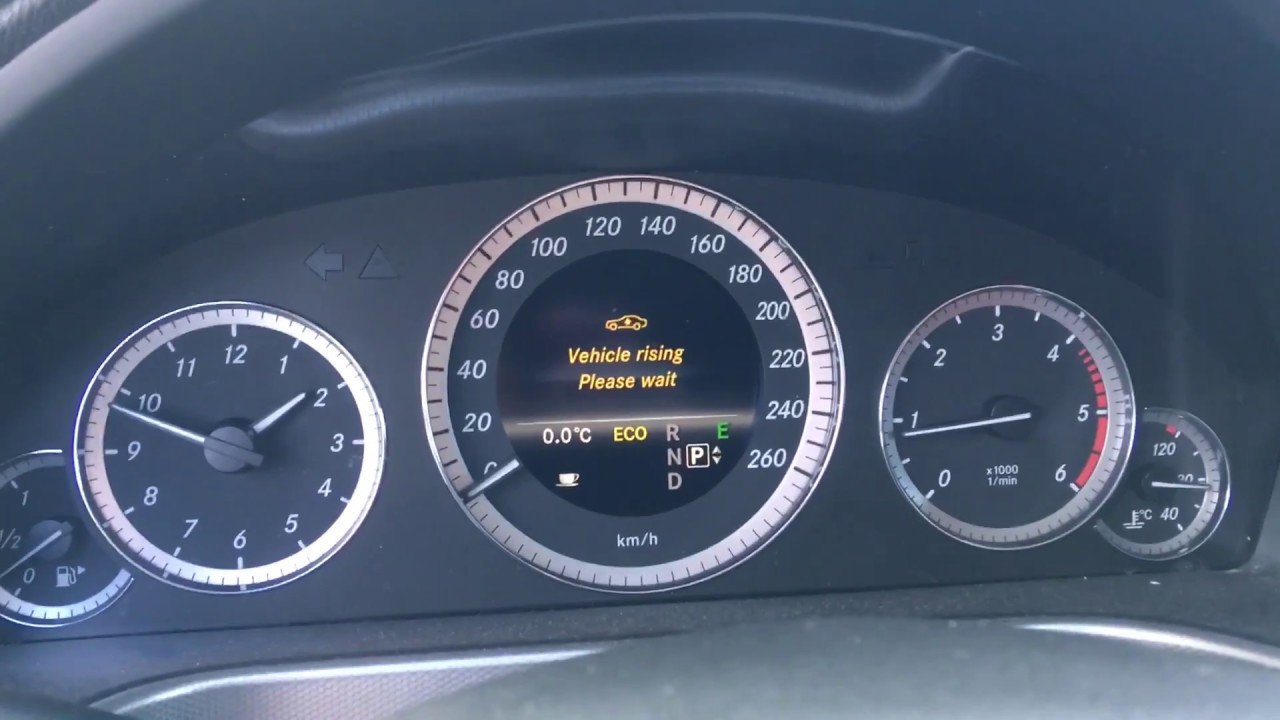
A Mercedes “Vehicle Rising” malfunction occurs when the AIRMATIC or air suspension system fails to raise the vehicle to the correct ride height. This is typically caused by a faulty air compressor, leaking air struts, a defective level sensor, or a blown fuse. The message appears on the dashboard when the system detects the vehicle cannot reach its target height within a set time, usually after 60-90 seconds of attempting to rise.
What Does “Vehicle Rising Please Wait” Mean on a Mercedes?
When your Mercedes displays “Vehicle Rising Please Wait” or “Vehicle Rising Malfunction,” the onboard AIRMATIC control module has detected that the suspension cannot reach the programmed ride height. This warning is a protective measure designed to alert you before driving on a compromised suspension.
In normal operation, the system inflates air struts using a compressor to level the vehicle. When this process takes too long or fails entirely, the error message appears. The system will typically allow you to drive, but it limits speed and locks the suspension at a fixed height to prevent further damage.
The most important thing to understand is that this is not a single-fault warning. It is a symptom that can originate from at least five different root causes, and misdiagnosing it at a dealership can cost you thousands in unnecessary parts.
Common Warning Variations by Model Year
- “Vehicle Rising Please Wait” — Typically on 2003-2012 W211, W220, and W164 models
- “AIRMATIC Visit Workshop” — Common on W221 S-Class and W216 CL-Class
- “Vehicle Rising Malfunction” — Frequently seen on W166 ML-Class and W222 S-Class (2013+)
- “Stop Vehicle Too Low” — Indicates a critical failure where the vehicle has dropped to its bump stops
What Causes the Mercedes Vehicle Rising Malfunction?
The AIRMATIC system has five primary failure points that trigger a rising malfunction: the air compressor, air struts, relay valve block, level sensors, and the control module. Each component fails in a predictable pattern, and experienced technicians can identify the culprit by observing specific symptoms before scanning with a diagnostic tool.
1. Failed or Weak Air Compressor
The air compressor is the heart of the AIRMATIC system, and it is the single most common cause of the rising malfunction. Mercedes uses Wabco or Hitachi compressors depending on the model, and they have a typical lifespan of 80,000 to 120,000 miles.
When the compressor weakens, it cannot generate enough pressure to inflate the struts within the allowed time window. The control module interprets this as a system failure and triggers the warning.
- Symptoms: Vehicle takes excessively long to rise, compressor runs loudly or continuously, rear of the vehicle sits noticeably lower
- Diagnostic tip: Listen for the compressor running under the vehicle. If it sounds labored, rattling, or runs for more than 2 minutes without raising the car, the compressor is failing
- DIY test: With the engine running, raise the vehicle to its highest setting. If the compressor cannot maintain pressure and the car slowly drops, the compressor or its internal piston seal is worn
2. Leaking Air Struts (Air Springs)
Air struts develop leaks at the rubber air bladder over time, especially in climates with extreme heat or road salt exposure. The W220 S-Class and W164 ML-Class are notorious for premature air strut failure, sometimes as early as 60,000 miles.
- Symptoms: One corner of the vehicle drops overnight, hissing sound from the wheel well, vehicle sags on one side when parked
- DIY test: Mix dish soap and water in a spray bottle. Spray the air strut bladder and connections. Bubbles indicate the leak location. Let the vehicle sit overnight and measure the drop height at each wheel arch with a tape measure
3. Faulty Relay Valve Block
The valve block distributes compressed air to each strut. Its internal solenoids or seals can fail, causing air to leak back to the compressor or allowing cross-contamination between struts.
- Symptoms: Vehicle rises unevenly, multiple struts fail to inflate simultaneously, compressor runs but no strut inflates
- Diagnostic tip: If the compressor is confirmed working but none of the struts are receiving air, the valve block is almost always the issue
4. Defective Level Sensors
Each wheel has a ride height sensor that communicates the vehicle’s position to the AIRMATIC module. If a sensor sends incorrect data, the system may believe the vehicle is at the correct height when it is not, or vice versa.
- Symptoms: Vehicle appears level but displays the malfunction, one corner is higher or lower than the rest, warning appears immediately after starting the engine
- Diagnostic tip: Use a Mercedes-compatible scan tool to read live data from each level sensor. Compare the voltage readings at all four corners. A reading that is significantly different from the others indicates a bad sensor or damaged linkage arm
5. AIRMATIC Control Module Failure
While the least common cause, the control module can fail internally due to water intrusion or electrical faults. This is especially true for W220 models where the module is mounted in a location prone to moisture.
How to Diagnose Mercedes Vehicle Rising Malfunction at Home
You can narrow down the root cause without a dealer visit by following a systematic diagnostic process. This approach has been used by independent Mercedes specialists for years and will save you from paying for unnecessary parts.
Step-by-Step Home Diagnostic Process
- Check the fuses first. Locate the AIRMATIC compressor fuse in the engine bay fuse box. On most models, it is a 40A fuse. A blown fuse often means the compressor is drawing too much current due to internal failure
- Listen to the compressor. Start the vehicle and raise it to the highest setting. The compressor should run smoothly for 30-90 seconds and then shut off. If it runs continuously or is silent when it should be running, the compressor is suspect
- Perform the overnight drop test. Park on a level surface, raise the vehicle to the highest setting, and measure the distance from the center of each wheel to the bottom of the fender. Mark the measurements and leave the vehicle overnight. Measure again in the morning. A drop of more than half an inch at any corner indicates a leak at that strut
- Spray test for leaks. Apply soapy water to the air struts, valve block connections, and airline fittings while the compressor is running. Look for bubbling
- Read fault codes. Use an iCarsoft MB II, Autel AP200, or a professional Xentry system to read AIRMATIC-specific fault codes. Codes related to “pressure buildup time exceeded” point to the compressor or valve block. Codes referencing specific corners point to struts or sensors
Mercedes Vehicle Rising Malfunction by Model — Causes and Fixes
Different Mercedes models have unique weak points in their AIRMATIC systems. Knowing your model’s specific failure pattern can dramatically speed up diagnosis.
W220 S-Class (2000-2006)
The W220 is the most failure-prone AIRMATIC model in Mercedes history. The compressor and valve block are known to fail between 70,000 and 100,000 miles. Rear air struts also leak prematurely due to the rubber compound used during this production era.
- Fix: Replace the compressor with an OEM Wabco unit ($300-$500 aftermarket). Replace both rear struts simultaneously if one has failed. Inspect the valve block and replace the relay if cross-contamination is detected
- Common misdiagnosis: Dealerships often replace all four struts when only the rears are leaking, adding $2,000-$3,000 to the repair bill
W221 S-Class (2007-2013)
The W221 improved the AIRMATIC system but introduced issues with the front strut mounts and the compressor relay. The relay overheats and fails, which burns out the compressor motor prematurely.
- Fix: Replace the compressor relay (located in the front SAM module) along with the compressor. Always replace both together to prevent repeat failure
W164 ML-Class (2006-2011)
The W164 suffers from rear air strut leaks and level sensor failures. The level sensor linkage arms corrode and seize, causing incorrect readings.
- Fix: Replace the level sensor and linkage arm assembly. Lubricate the new linkage with marine-grade grease to prevent future corrosion
W166 ML/GLE-Class (2012-2019)
Air compressor failures are common above 80,000 miles. The system also has a tendency to throw false rising malfunction warnings due to software calibration issues in the AIRMATIC module.
- Fix: Before replacing any hardware, perform an AIRMATIC calibration reset using Xentry or Autel. This resolves the issue in approximately 30% of cases without any parts replacement
W222 S-Class (2014-2020)
The W222 uses an improved AIRMATIC system, but the E-ACTIVE BODY CONTROL variant on higher trims has unique issues with the 48V hydraulic pump and individual motor-pump units.
- Fix: For standard AIRMATIC W222 models, compressor and strut failures follow the same pattern as the W221. For E-ACTIVE models, a dealer-level diagnostic is strongly recommended due to system complexity
How Much Does It Cost to Fix Mercedes Vehicle Rising Malfunction?
Repair costs vary significantly depending on the failed component, whether you choose OEM or aftermarket parts, and whether you use a dealer or independent shop.
Independent Mercedes-specialized shops typically charge 40-60% less than dealerships for the same repair using identical or equivalent parts. Always confirm that your independent shop has AIRMATIC-specific diagnostic equipment before authorizing repairs.
Can You Drive with a Mercedes Vehicle Rising Malfunction?
You can drive short distances at low speeds with a rising malfunction warning, but it is not recommended as a long-term practice. The vehicle is locked at a reduced ride height, which affects suspension geometry, tire wear, and handling stability.
If the warning changes to “Stop Vehicle Too Low,” do not drive at all. This indicates the vehicle has dropped to its bump stops, and driving in this condition can damage the wheel wells, fender liners, and exhaust components due to contact with the road surface or suspension components bottoming out.
Risks of Driving on a Compromised AIRMATIC System
- ⚠️ Accelerated and uneven tire wear due to incorrect alignment geometry
- ⚠️ Damaged wheel arch liners and undercarriage components from ground contact
- ⚠️ Increased stress on the compressor, potentially causing a cascading failure of additional components
- ⚠️ Potential MOT/inspection failure due to ride height being outside manufacturer specifications
Frequently Asked Questions About Mercedes Vehicle Rising Malfunction
Why does my Mercedes say “Vehicle Rising” every time I start the engine?
This usually indicates a slow air leak in one or more struts. The system detects the drop that occurred while the vehicle was parked and attempts to re-inflate on startup.
If the compressor can raise the vehicle within the allowed time, the message will clear. If the leak is significant enough to exceed the time limit, the malfunction warning appears.
How long does a Mercedes AIRMATIC compressor last?
An OEM AIRMATIC compressor typically lasts 80,000 to 120,000 miles. However, if air struts are leaking, the compressor runs more frequently, which can cut its lifespan in half. Replacing leaking struts promptly is the single best thing you can do to extend compressor life.
Can I convert my Mercedes AIRMATIC to coil springs?
Yes, conversion kits are available for most AIRMATIC-equipped models. These kits replace the air struts with conventional coil-over shocks and include a module to bypass the AIRMATIC control system.
Conversion typically costs $1,200 to $2,000 for all four corners installed. You lose the adjustable ride height and self-leveling capability, but you eliminate all future AIRMATIC repair costs permanently.
Is the Mercedes AIRMATIC rising malfunction covered under warranty?
Mercedes provides a 4-year/50,000-mile new vehicle warranty. The AIRMATIC system is covered under this warranty.
Extended warranties may also cover the repair, but many third-party extended warranty providers classify air suspension as a “wear item” and exclude it. Always verify coverage before authorizing repairs.
Why does my Mercedes drop on one side overnight but drives fine during the day?
A single-side overnight drop confirms a leak in that specific air strut. During driving, the compressor compensates for the leak continuously, so you do not notice the issue.
When the vehicle is parked and the compressor is off, the strut slowly deflates. The longer you wait, the more pronounced the drop will become as the rubber bladder deteriorates further.
Take Action Before the Problem Gets Worse
The Mercedes vehicle rising malfunction is a progressive issue. A minor air leak or weak compressor will not resolve itself — it will only get worse and eventually cause a cascade of failures across the entire AIRMATIC system.
The smartest approach is to diagnose the specific failed component using the methods described above, source OEM or high-quality aftermarket parts, and either perform the repair yourself or take the vehicle to a qualified independent Mercedes specialist. Acting early can turn a $500 fix into a $300 fix, and waiting too long can turn that same $500 fix into a $3,000 multi-component overhaul.
Leave a Reply