
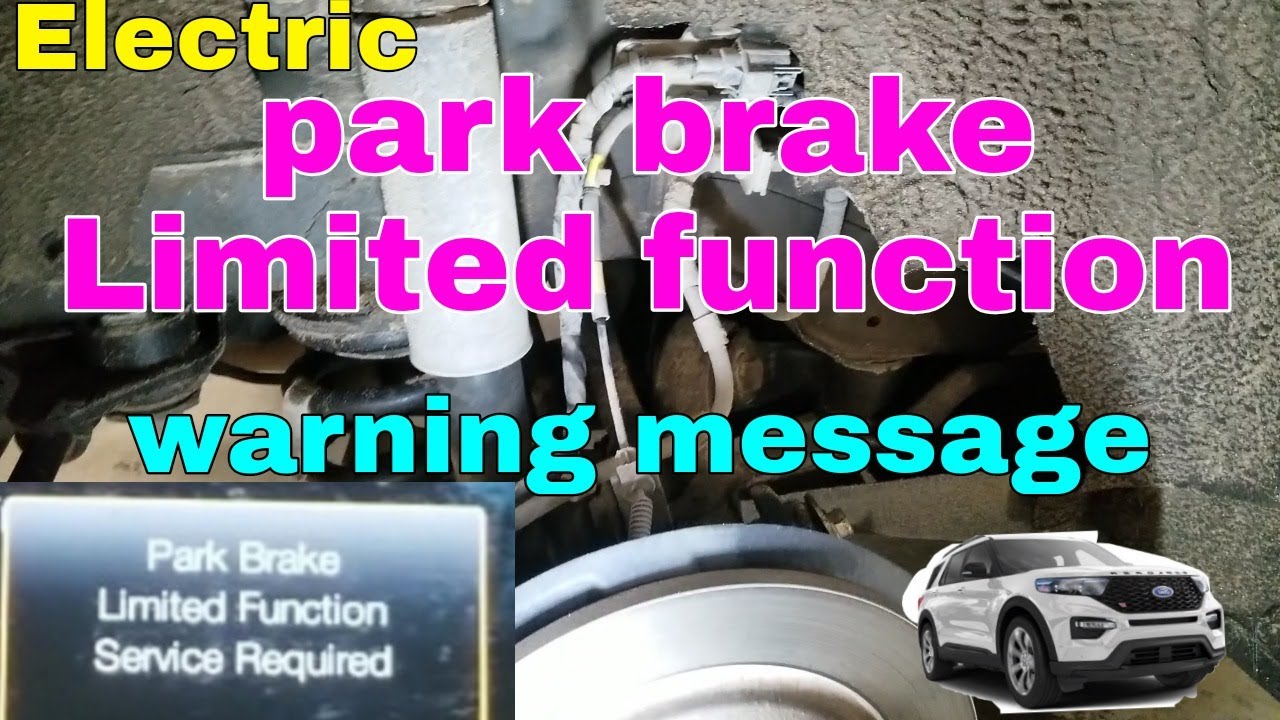
A “Park Brake Limited Function Service Required” message means your vehicle’s electronic parking brake system has detected a fault and can no longer operate at full capacity. Common causes include a failing parking brake actuator motor, corroded wiring connectors, weak battery voltage, or a faulty electronic parking brake control module. The parking brake may still partially work but should not be relied upon until the issue is diagnosed and repaired.
What Does Park Brake Limited Function Service Required Mean?
This warning message appears on the driver information center when the electronic parking brake (EPB) system detects a malfunction that limits its ability to fully engage or disengage the rear parking brake. The system enters a degraded or failsafe mode to prevent damage to the actuator or brake components.
You will most commonly see this message on GM vehicles including Chevrolet Silverado, Tahoe, Suburban, GMC Sierra, Yukon, and Cadillac Escalade models equipped with the electronic parking brake option. It typically appears at startup or when you attempt to set or release the parking brake.
In limited function mode, the parking brake may still apply partial clamping force to the rear rotors, but it cannot guarantee full holding power. This is especially dangerous on hills or when parked on inclines. Do not rely on the parking brake alone until the system is properly repaired.
How the Electronic Parking Brake System Works
Your EPB system uses two electric motor actuators mounted on the rear brake calipers instead of traditional cables and a foot pedal or hand lever. When you press the parking brake switch, a command is sent to the parking brake control module, which activates the motors to clamp the caliper pistons against the rear rotors.
The control module monitors motor current draw, position sensors, and circuit integrity during every apply and release cycle. If any reading falls outside the calibrated threshold, the module sets a diagnostic trouble code and triggers the limited function warning on your dashboard.
What Causes the Park Brake Limited Function Service Required Message?
The most common causes are a failed parking brake actuator motor, corroded or damaged wiring harness connectors at the rear calipers, weak or dying vehicle battery, or internal faults within the electronic parking brake control module. Each cause has distinct symptoms and diagnostic approaches.
1. Failed Parking Brake Actuator Motor
The electric motors inside the rear calipers are the most frequent failure point. These small DC motors are exposed to extreme heat, moisture, road salt, and brake dust. Over time, the internal brushes wear down, the armature corrodes, or the gear mechanism strips.
You may hear a grinding, clicking, or whining noise from the rear of the vehicle when engaging or releasing the parking brake. Sometimes one side works while the other does not, causing an uneven clamping situation that triggers the warning.
- Symptoms: Grinding noise from rear, parking brake only holds on one side, message appears intermittently at first then permanently
- Diagnosis: Use a scan tool to read EPB module codes. Look for codes related to motor current performance or motor position sensor faults. Perform an actuator test to see if each motor responds.
- Fix: Replace the faulty actuator motor. On most GM trucks and SUVs, the actuator is integrated into the rear caliper assembly, meaning you must replace the entire caliper or purchase the actuator motor separately if available for your model year.
2. Corroded Wiring and Connector Damage
The wiring harness connectors that plug into each rear caliper actuator are constantly exposed to water, road debris, salt, and heat cycling. Corrosion builds up on the terminals, increasing resistance and causing communication faults between the control module and the motors.
This is especially common on vehicles driven in northern states or coastal areas where road salt is prevalent. You may notice the warning appears after driving through puddles, in wet weather, or during winter months but disappears in dry conditions.
- Symptoms: Warning comes and goes with weather, visible green or white corrosion on connector pins, intermittent parking brake operation
- Diagnosis: Visually inspect the connectors at both rear calipers. Disconnect them and look for corroded, bent, or pushed-back pins. Measure resistance across the connector terminals; high resistance indicates corrosion.
- Fix: Clean the connector pins with electrical contact cleaner and a small pick. Apply dielectric grease before reconnecting. If pins are badly corroded or the connector housing is cracked, replace the pigtail harness.
3. Weak Battery or Low System Voltage
The electronic parking brake control module requires stable voltage to operate the motors and monitor sensor feedback. When your battery is weak, especially during cold cranking, the module may not receive adequate voltage and will set the limited function warning.
This is a frequently overlooked cause because owners focus on the brake system itself rather than the electrical supply. You might notice the message appears on cold mornings or after the vehicle has been sitting for several days.
- Symptoms: Message on cold starts, message after vehicle sits unused, slow cranking, other electrical warnings present
- Diagnosis: Load test the battery and check charging system output. A healthy battery should maintain above 12.4 volts at rest and above 13.5 volts when running.
- Fix: Replace the battery if it fails the load test. After battery replacement, clear the codes with a scan tool and cycle the parking brake several times to allow the module to relearn.
4. Faulty Electronic Parking Brake Control Module
The control module itself can fail internally due to solder joint cracks, water intrusion, or component degradation. This is less common than actuator or wiring failures but does occur, especially on higher-mileage vehicles.
Module failure typically produces multiple unrelated codes or codes that point to both actuators simultaneously when only one side is actually faulty. If you have already verified the actuators and wiring are good, the module becomes the prime suspect.
- Symptoms: Multiple EPB codes, codes for both sides despite only one actuator being bad, parking brake completely non-functional
- Diagnosis: Verify power and ground at the module connector. Check for communication with the module using a scan tool. If the module responds but generates implausible codes, it is likely internally faulty.
- Fix: Replace the EPB control module. On most GM vehicles, it is located under the center console or behind the rear seat. A replacement module will require programming and calibration with a factory-level scan tool.
5. Park Brake Switch Failure
The dashboard-mounted parking brake switch can develop internal contact issues over time. A worn or sticking switch sends erratic signals to the control module, which interprets them as a system fault.
- Symptoms: Switch feels loose, sticky, or does not click positively; parking brake engages or releases unexpectedly; message appears when pressing the switch
- Diagnosis: Monitor switch status on a scan tool while pressing and releasing the switch. The input should toggle cleanly between on and off without fluctuation.
- Fix: Replace the parking brake switch. On most GM models, the switch pops out of the center console or dashboard panel and plugs into a simple connector. This is usually a straightforward DIY repair.
How to Reset the Park Brake Limited Function Warning
After addressing the root cause, you need to clear the stored diagnostic trouble codes and allow the system to relearn. Simply disconnecting the battery may clear the message temporarily but will not perform a proper module relearn.
Use a professional-grade scan tool or a capable aftermarket tool that supports GM EPB functions. Navigate to the electronic parking brake module, clear all codes, then perform a full apply and release cycle using the scan tool command. Verify the message does not return after multiple cycles.
Can I Drive with the Park Brake Limited Function Warning?
You can drive the vehicle, but do not rely on the parking brake to hold the vehicle on inclines. Use the transmission park position and turn your wheels toward the curb as a secondary safety measure. Get the system diagnosed as soon as possible to avoid a potential rollaway situation.
Model-Specific Repair Notes
| Vehicle | Common Cause | Repair Difficulty |
|---|---|---|
| Chevrolet Silverado 1500 (2019-2024) | Actuator motor failure, corroded connectors | Moderate – caliper replacement or connector repair |
| GMC Sierra 1500 (2019-2024) | Actuator motor failure, weak battery on startup | Moderate |
| Chevrolet Tahoe/Suburban (2021-2024) | Wiring harness corrosion, control module faults | Moderate to difficult – module requires programming |
| Cadillac Escalade (2021-2024) | Module software glitches, actuator failure | Moderate to difficult |
| Chevrolet Equinox (2018-2024) | Switch failure, low battery voltage | Easy to moderate |
How Much Does It Cost to Fix the Park Brake Limited Function Issue?
Repair costs vary widely depending on the root cause. A simple battery replacement or connector cleaning may cost under $200.
Actuator motor or caliper replacement typically runs $400 to $800 per side including parts and labor. Control module replacement with programming can cost $600 to $1,200 at a dealership.
Dealership vs Independent Shop vs DIY
- Dealership: Highest cost but guaranteed access to factory scan tools and programming capability. Necessary for module replacement on newer vehicles.
- Independent Shop: Lower labor rates and many shops now have aftermarket tools capable of EPB service. Confirm they can program replacement modules before authorizing work.
- DIY: Viable for actuator replacement, connector repair, and switch replacement if you have basic mechanical skills and a scan tool capable of commanding the EPB module. You will need to be able to put the system in service mode before removing the rear calipers.
Frequently Asked Questions
Will the parking brake limited function message clear on its own?
Occasionally the message will disappear if it was triggered by a temporary voltage drop or moisture intrusion that dries out. However, the underlying fault codes remain stored and the message will return. Always scan for codes even if the message goes away on its own.
Can I use the parking brake in limited function mode to park on a hill?
It is not recommended. In limited function mode, the system cannot guarantee full clamping force. Always use the transmission park position and turn the front wheels toward the curb as additional protection against rollaway.
Does this warning affect normal braking?
No. The electronic parking brake system is separate from the hydraulic service brake system. Your normal brake pedal function, ABS, and stability control remain fully operational regardless of the parking brake status.
Why does the message come and go in cold weather?
Cold temperatures reduce battery output and increase resistance in corroded connectors. Both conditions can push marginal components past their operating thresholds.
The message clears once the vehicle warms up and voltage stabilizes. This is a strong indicator of a battery or connector issue rather than an actuator problem.
Do I need to replace both rear actuators if only one has failed?
It is not strictly necessary, but it is good practice if both actuators have similar mileage and exposure. If one has failed due to corrosion or wear, the other is likely in similar condition. Replacing both saves labor costs in the long run since the second one often fails within a few months.
Fix It Right the First Time
The park brake limited function service required message is not something to ignore or reset and hope it goes away. The electronic parking brake is a critical safety system, and driving on a hill without full parking brake function is a real rollaway risk.
Start your diagnosis with the basics: battery health, visual connector inspection, and a proper scan tool readout. From there, you can pinpoint the actuator, wiring, switch, or module and make a targeted repair instead of throwing parts at the problem. A methodical approach saves money and gets the job done right.
Leave a Reply