
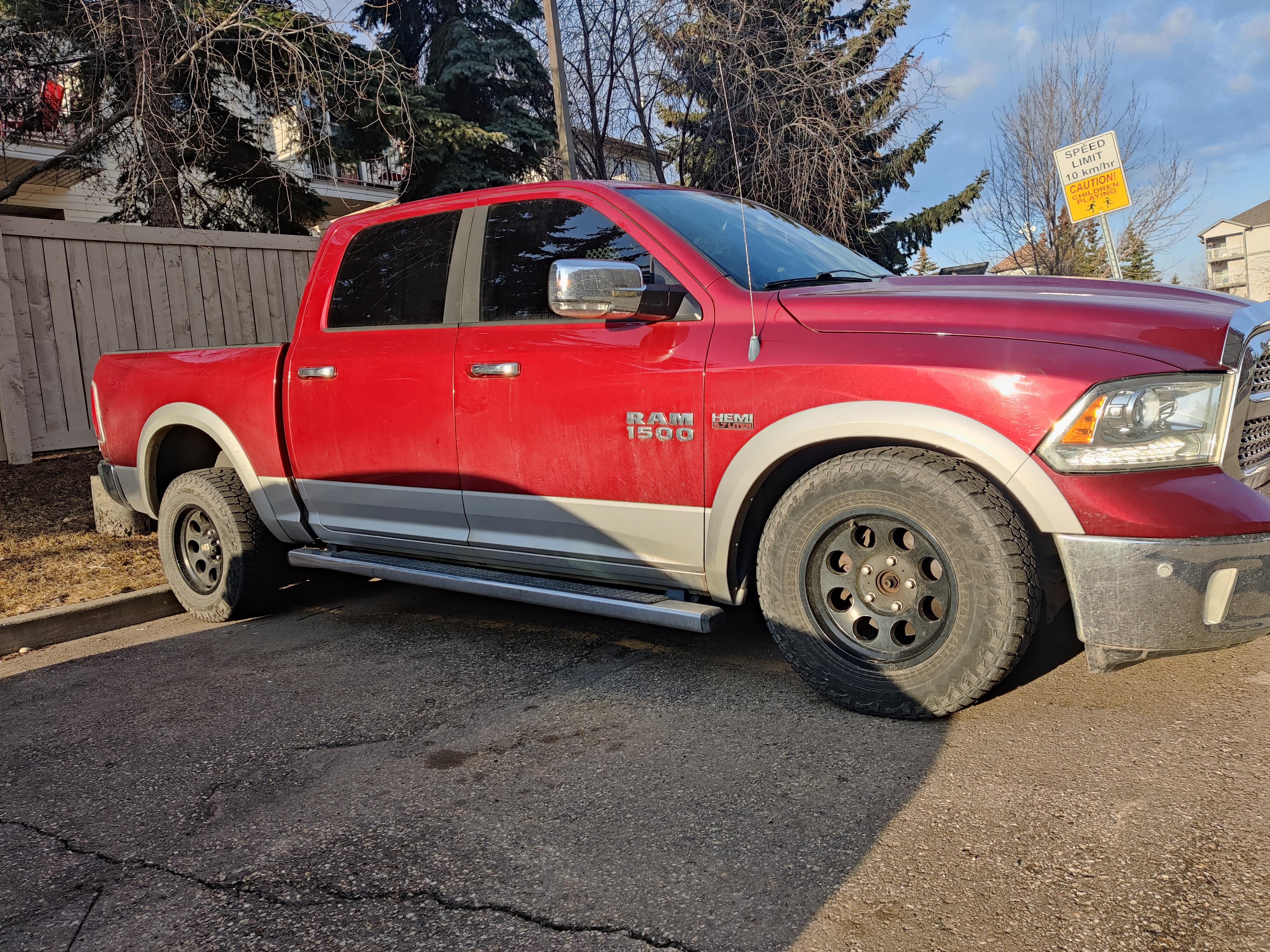
RAM 1500 air suspension problems typically include the rear end sagging overnight, the compressor running constantly or not at all, uneven ride height, dashboard suspension warning lights, and complete system failure. The most common causes are leaking air bags (bellows), a failing compressor, faulty height sensors, and corroded valve block fittings. Most of these issues can be diagnosed at home with a soapy water test, and many can be fixed without dealership pricing.
Why Does My RAM 1500 Rear End Sag Overnight or When Parked?
A sagging rear end on a RAM 1500 equipped with air suspension almost always points to a leaking air spring (air bag). Overnight sag is the number-one complaint owners report, and it typically starts around 60,000 to 90,000 miles.
The air springs on these trucks are rubber bellows that flex thousands of times per mile. Over time, the rubber develops micro-cracts, especially around the bottom piston seal and the upper crimp ring. Cold weather accelerates this dramatically—many owners in northern states first notice sagging in fall or winter.
How to Confirm a Leaking Air Spring at Home
- Fill a spray bottle with warm water and a few drops of dish soap.
- Jack up the rear of the truck and remove the rear wheels for better access.
- Spray the entire air bag, paying close attention to the rubber bellows folds, the top mount seal, and the bottom piston area.
- Turn the ignition on so the compressor inflates the bags.
- Watch for bubbles forming—this is the leak location.
- Check the air line fitting at the top of the bag as well. Fittings loosen from vibration.
Fixing a Leaking Air Spring
If the leak is at the air line fitting, simply push the collet in, pull the line out, trim the end by a quarter inch, and reseat it. This free fix solves roughly 20% of sagging complaints.
If the rubber bellows itself is cracked, the air spring must be replaced. OEM Mopar air springs run $400 to $600 each.
Aftermarket Arnott or Dorman units cost $150 to $300 each and often carry a lifetime warranty. Many owners report aftermarket units outlasting the originals.
Pro tip: Always replace air springs in pairs. If one has failed, the other is not far behind. Replacing both also prevents an uneven ride height that stresses the compressor.
RAM 1500 Air Suspension Compressor Running Constantly or Not Turning On
The air suspension compressor is the heart of the system, and it is the second most common failure point. If it runs non-stop, the system has a leak the compressor is trying to compensate for. If it does not run at all, the compressor motor, relay, or fuse has failed.
Compressor Running Constantly
A compressor that runs every few minutes is working overtime because air is escaping somewhere. Continuing to let it run will burn the motor out.
Diagnose the leak first using the soapy water method described above. Once the leak is fixed, the compressor will cycle normally—roughly once every 12 to 24 hours.
Compressor Not Running at All
- Check the 40-amp compressor fuse in the underhood fuse box. This is the most common and cheapest fix.
- Check the compressor relay, also located in the underhood fuse box. Swap it with an identical relay from another slot to test.
- Listen for the compressor with the ignition on and the rear of the truck parked lower than normal. If silence, the motor windings are likely burned out.
- Test for power at the compressor connector with a multimeter. If 12V is present and the compressor is silent, replace it.
Compressor Replacement Cost Breakdown
| Option | Parts Cost | Labor Cost | Total |
|---|---|---|---|
| Dealership OEM Replacement | $800 – $1,200 | $200 – $400 | $1,000 – $1,600 |
| Independent Shop OEM | $800 – $1,200 | $150 – $250 | $950 – $1,450 |
| Aftermarket (Arnott) + DIY | $350 – $550 | $0 | $350 – $550 |
| Aftermarket (Viair upgrade) + DIY | $250 – $400 | $0 | $250 – $400 |
The compressor sits above the rear axle on the driver side. It is held in by three bolts and two electrical connectors. A competent DIYer can swap it in under an hour with basic hand tools.
RAM 1500 Air Suspension Warning Light On Dashboard
The “Air Suspension — Service Immediately” message or the amber suspension warning light indicates the system has detected a fault. This does not always mean an expensive repair is needed.
Common Triggers for the Warning Light
- Low system voltage: A weak battery or corroded terminals can cause false suspension codes. Fix the electrical issue first and clear codes with an OBD-II scanner capable of reading chassis codes.
- Height sensor failure: Each rear wheel has a height sensor on the control arm. These sensors corrode at the pivot ball joint, causing erratic readings. Replacement sensors cost $40 to $80 each.
- Slow leak detected: The system monitors how often the compressor runs. If it exceeds a threshold, the computer flags a fault before the compressor burns out.
- Temperature fault: The compressor has an internal thermal switch. If it overheats from constant running, it shuts down and triggers the light. Letting the truck sit for 30 minutes sometimes resets this.
How to Clear the Warning Light
- Fix the underlying problem first.
- Use an OBD-II scanner with ABS/chassis module capability (BlueDriver, Autel, or dealer-level tool).
- Navigate to the Air Suspension Control Module.
- Read and record fault codes.
- Clear codes and cycle the ignition.
- Drive the truck for 10 minutes and verify the light stays off.
Disconnecting the battery for 30 minutes will sometimes clear soft codes, but hard codes tied to genuine hardware failures will return immediately.
RAM 1500 Air Suspension Uneven Ride Height — One Side Lower Than the Other
If one corner of the truck sits noticeably lower, the issue is usually isolated to that side’s air spring, height sensor, or airline.
Diagnosing Uneven Ride Height
- Park the truck on level ground and measure from the ground to the fender lip at all four corners. The rear measurements should be within half an inch of each other.
- If one side is low, spray soapy water on that side’s air spring and the airline running from the valve block to the bag.
- Check the height sensor on the low side. Look for a broken mounting tab, a disconnected link rod, or corrosion on the sensor arm.
- Inspect the air line for chafing against the frame or suspension components. The nylon line can rub through over time.
Fixing the Uneven Height
- Leaking air spring: Replace the affected bag (or both as recommended above).
- Damaged air line: Cut out the damaged section and rejoin with a push-to-connect union fitting. The nylon tubing is available at most auto parts stores for under $10.
- Faulty height sensor: Replace the sensor. It is held on by two bolts and one electrical connector. No alignment is needed afterward—the system self-calibrates after a few drive cycles.
- Valve block issue: The valve block distributes air to each spring. Corroded solenoids inside the block can stick, preventing air from reaching one corner. The block sits on the frame rail near the compressor. Replacement blocks are $100 to $200 aftermarket.
RAM 1500 Air Suspension Problems by Model Year
Not all RAM 1500 model years are equal when it comes to air suspension reliability. Here is a year-by-year breakdown of known weak points.
2013–2018 RAM 1500 (DS Body Style)
- Air spring failures are the most common complaint, typically starting at 50,000–80,000 miles.
- The compressor relay and fuse are known failure points. Keep a spare 40A fuse and relay in the glovebox.
- The ride height sensor links corrode badly in salt-belt states.
- These trucks use a Gen-4 system with the compressor mounted above the spare tire area on some trims and above the rear axle on others. Location varies by cab and bed configuration.
2019–Present RAM 1500 (DT Body Style)
- The DT platform uses an updated Gen-5 air suspension system with improved compressor logic and better-sealed air springs.
- Early 2019 models had software calibration issues that caused the truck to sit nose-high. A dealer software flash (TSB available) resolves this.
- Air spring failures still occur but typically later—around 80,000–100,000 miles.
- The valve block on DT models is more integrated and harder to service individually. If one solenoid fails, the entire block often needs replacement.
- Some owners report the system entering “Transport Mode” spontaneously, lowering the truck to its lowest setting. This is usually a height sensor or software issue requiring a dealer-level scan tool to reset.
Should You Convert RAM 1500 Air Suspension to Conventional Coil Springs?
A coil spring conversion kit eliminates the air suspension system entirely and replaces it with traditional steel or progressive-rate coil springs. This is a popular option for owners who are tired of chasing air suspension repairs or who live far from shops that understand the system.
Pros of a Coil Conversion
- No more compressor, air bags, airlines, height sensors, or valve blocks to fail.
- Total conversion kit cost is $300 to $600 (Strutmasters, Arnott, or Rough Country).
- Installation takes 2 to 4 hours with basic tools.
- Ride quality is comparable for daily driving and towing moderate loads.
Cons of a Coil Conversion
- You lose the automatic load-leveling feature when towing or hauling heavy loads.
- You lose the adjustable ride height for off-roading or entry/exit modes.
- The suspension warning light will stay on permanently unless you install a bypass module ($50 to $80).
- Resale value may drop slightly if the next buyer expects factory air suspension.
Frequently Asked Questions About RAM 1500 Air Suspension
How long do RAM 1500 air springs last?
Factory air springs typically last 60,000 to 100,000 miles depending on climate, driving conditions, and load. Trucks in cold or salt-heavy environments tend to see failures earlier. Aftermarket replacements from Arnott often outlast the originals.
Can I drive my RAM 1500 with the air suspension light on?
You can, but the system may be stuck at one ride height and will not adjust for load or road conditions. If the truck is sitting extremely low, driving can damage the bump stops and cause tire rub. Diagnose the issue promptly to avoid secondary damage.
Does RAM warranty cover air suspension repairs?
The factory 3-year/36,000-mile bumper-to-bumper warranty covers air suspension components. The powertrain warranty does not.
Extended Mopar warranties purchased at the time of sale typically cover it. Third-party extended warranties vary—read the fine print for “suspension” exclusions.
Why does my RAM 1500 air suspension only fail in cold weather?
Rubber air springs contract and stiffen in cold temperatures, making existing micro-cracks expand and leak. The compressor also works harder in cold weather because the air is denser and the system needs to build more pressure. If your truck only sags in winter, the air springs are at the end of their life and need replacement before the next cold season.
Is the Arnott air suspension compressor a good replacement for the OEM unit?
Yes. Arnott remanufactures the OEM compressor with upgraded seals and a stronger motor. Most owners report it outlasting the factory unit.
It comes with a two-year warranty and costs roughly half of the Mopar dealer price. Installation is identical to the OEM unit.
Final Word: Don’t Let a Dealer Overquote Your RAM 1500 Air Suspension Repair
Air suspension problems on the RAM 1500 are common, well-documented, and in most cases entirely fixable without a dealership visit. The soapy water test and a basic OBD-II scanner will get you to the root cause faster than any service advisor will.
Whether you choose to repair individual components or convert to coil springs, understanding how the system works puts you in control of the repair and the cost. Keep spare fuses and relays on hand, inspect your air springs annually, and catch small leaks before they burn out your compressor—that single habit will save you the most money over the life of the truck.
Leave a Reply