
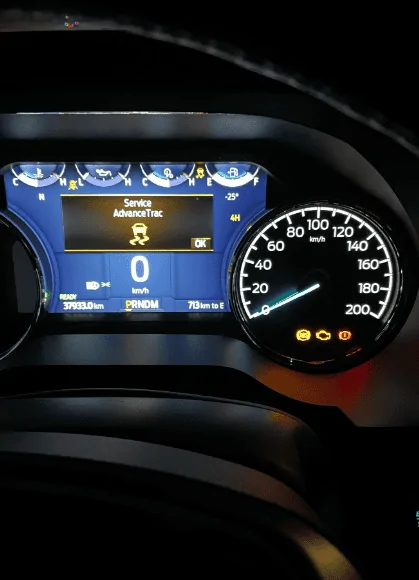
The “Service AdvanceTrac” warning on a Ford F-150 means the AdvanceTrac stability control system has detected a fault and disabled itself. The most common causes are a faulty wheel speed sensor, a bad steering angle sensor, low battery voltage, or a failing yaw rate sensor. In most cases, the fix costs between $50 and $400 depending on the root cause and whether you can diagnose it yourself with an OBD-II scanner.
If you drive a Ford F-150 and that yellow “Service AdvanceTrac” message just lit up your dash, you are not alone. This is one of the most frequently reported electronic warnings across F-150 model years, especially from 2009 through 2024.
The good news is that most causes are straightforward to diagnose and fix. The bad news is that dealerships love to quote $800 to $1,500 for what often turns out to be a $50 sensor or a corroded connector.
I have seen this warning come through on F-150s hundreds of times, and it almost always traces back to a handful of predictable failure points. Below is a complete diagnostic and repair guide based on what actually fails in the real world—not what a service manual says in theory.
What Does Service AdvanceTrac Mean on a Ford F-150?
Service AdvanceTrac is a warning message that tells you Ford’s AdvanceTrac electronic stability control (ESC) system has malfunctioned and has been disabled. When this happens, your traction control, stability control, and sometimes your ABS and trailer sway control also shut down. The truck is still drivable, but you lose critical safety systems that help prevent skidding and rollovers.
AdvanceTrac works by constantly monitoring wheel speeds, steering angle, yaw rate, and lateral acceleration. When any sensor feeding data to the system gives a reading outside expected parameters, the system sets a fault code and disables itself to prevent acting on bad data. The “Service AdvanceTrac” message is the truck’s way of telling you something in that chain is broken.
What Systems Turn Off with Service AdvanceTrac
- ▶ Traction Control (TC) – Prevents wheel spin during acceleration
- ▶ Electronic Stability Control (ESC) – Corrects oversteer and understeer
- ▶ Anti-lock Braking System (ABS) – On some fault combinations, ABS also disables
- ▶ Trailer Sway Control – The system that detects and corrects trailer oscillation
- ▶ Roll Stability Control – Monitors for rollover risk in turns
Is It Safe to Drive with Service AdvanceTrac?
You can drive the truck, but you should do so cautiously and get it diagnosed as soon as possible. Without AdvanceTrac, the truck has no electronic intervention if you hit a slick patch of road, make an emergency swerve, or tow a trailer that starts to sway.
In dry, normal driving conditions, the risk is lower, but in rain, snow, or while towing, driving without stability control is genuinely dangerous.
What Causes the Service AdvanceTrac Light on an F-150?
The most common cause is a faulty wheel speed sensor, followed by a bad steering angle sensor, low or unstable battery voltage, and wiring issues. On higher-mileage trucks, ABS module failures and yaw rate sensor faults are also frequent. Here is a breakdown of every known cause and how to identify each one.
1. Faulty Wheel Speed Sensor
This is the number one cause on every F-150 generation from 2009 to present. Each wheel has a speed sensor that sends real-time RPM data to the ABS and AdvanceTrac modules. When one sensor fails or reads incorrectly, the system cannot determine if the truck is sliding or spinning, so it shuts down entirely.
Common symptoms include the ABS light coming on alongside the Service AdvanceTrac message, and the fault typically correlates with a specific wheel position. You can identify which sensor has failed by scanning for codes—look for codes like C0031, C0034, C0037, or C0040, each corresponding to a specific corner of the truck.
How to Fix It
- Use an OBD-II scanner with ABS capability to pull the specific fault code and identify which wheel sensor is bad.
- Jack up the affected corner and locate the sensor mounted to the wheel hub or knuckle.
- Inspect the wiring harness for damage, corrosion, or broken connectors before replacing the sensor itself.
- If the wiring checks out, remove the single mounting bolt and pull the sensor from the knuckle.
- Install the new sensor, torque the bolt to spec (typically 8-10 ft-lbs), and clear the codes.
Cost: $25 to $80 for the sensor. Dealership quotes $300 to $500 for this job, which is absurd for a 20-minute repair.
2. Steering Angle Sensor (SAS) Failure
The steering angle sensor sits behind the steering wheel and tells the AdvanceTrac module where the driver is pointing the truck. When it drifts out of calibration or fails electrically, the system gets contradictory data and shuts down. This is especially common on 2015 to 2020 F-150s after front-end alignment work, suspension repairs, or steering column work.
Symptoms include the warning appearing after an alignment or suspension job, the steering wheel being slightly off-center when driving straight, or the message coming and going intermittently.
How to Fix It
- First, try recalibrating the SAS. Many scan tools can perform a “steering angle sensor reset” or “centerpoint calibration” without any parts replacement.
- Start the truck, turn the steering wheel fully left, then fully right, then back to center. Some F-150s will self-calibrate with this sequence at speeds below 15 mph.
- If recalibration does not clear the fault, the sensor itself may need replacement, which requires removing the steering wheel and clock spring assembly.
- After replacement, a scan tool calibration is mandatory—the system will not clear on its own.
Cost: $60 to $150 for the sensor. The calibration requires a capable scan tool or a dealer visit, which adds $100 to $200.
3. Low or Unstable Battery Voltage
This one catches people off guard. Ford’s electronic modules are extremely sensitive to voltage.
A weak battery, corroded terminals, or a failing alternator can cause voltage drops that make the ABS and AdvanceTrac modules throw phantom fault codes. If the Service AdvanceTrac message appeared after the truck sat for a few days, after a jump start, or during cold weather, suspect the battery first.
How to Fix It
- Test the battery with a load tester or have it tested at a parts store for free.
- Clean both battery terminals and the ground cable attachment points on the frame and engine block.
- If the battery is more than 3 to 4 years old, replace it regardless of the test result—Ford trucks chew through batteries.
- After replacing or charging the battery, drive the truck for 10 to 15 miles. The system may self-clear once stable voltage is restored.
- If the warning persists, clear the codes with a scan tool and see if they return.
Cost: $0 if it just needs terminal cleaning. $150 to $250 for a new battery.
4. ABS Module or Hydraulic Control Unit Failure
On 2009 to 2014 F-150s in particular, the ABS module internal circuit board develops cold solder joints over time. This causes intermittent communication failures that trigger Service AdvanceTrac along with ABS and traction control warnings. The module may work fine when cold and fail when warm, which makes diagnosis tricky.
How to Fix It
- Scan for communication-related codes such as U0121 (lost communication with ABS module) or C-series codes pointing to the module itself.
- Check the module connector for corrosion or backed-out pins.
- If the connector is clean, the module likely needs replacement or rebuilding. Remanufactured units cost far less than new from Ford.
- After installation, a module programming session with Ford IDS or a comparable tool is required.
Cost: $400 to $900 for parts and programming at a dealer. $200 to $400 for a reman unit installed by an independent shop.
5. Yaw Rate Sensor or Lateral Accelerometer Failure
The yaw rate sensor measures how fast the truck is rotating around its vertical axis. It is part of the AdvanceTrac system’s core input chain.
When it fails, the system has no way to detect a skid or slide. This is less common than wheel speed sensor failure but does happen on trucks with 100,000-plus miles, especially in northern climates where salt and moisture corrode the sensor connectors.
How to Fix It
- Scan for codes in the C1234 to C1280 range or codes specifically pointing to the yaw rate sensor or lateral accelerometer.
- Locate the sensor, which is typically mounted under the center console or beneath the dashboard on the floor pan.
- Inspect the connector for corrosion or water intrusion damage.
- Replace the sensor if the connector is clean, then clear codes and verify the fix.
Cost: $80 to $200 for the sensor. The labor is minimal if the connector is accessible.
Model-Specific Differences Across F-150 Generations
While the core causes are similar, certain model years have known patterns worth calling out.
How to Diagnose Service AdvanceTrac Without a Dealership
You do not need a $200 diagnostic fee to figure out what triggered this warning. Here is a step-by-step process that works for most F-150 owners.
Step 1: Check for Other Warning Lights
If the ABS light, traction control light, or stability control light are also on, the fault is most likely a wheel speed sensor or ABS module. If only Service AdvanceTrac appears, lean toward the steering angle sensor or yaw rate sensor.
Step 2: Scan for Codes
Use an OBD-II scanner that can read ABS and chassis codes. A basic engine-only code reader will not see these faults.
Affordable options include the BlueDriver, FIXD, or any scan tool that supports Ford enhanced diagnostics. Look for codes starting with C (chassis), U (communication), or B (body).
Step 3: Check Battery Health
Before chasing sensors, verify the battery is holding at least 12.4 volts with the engine off and 13.5 to 14.5 volts with the engine running. If either reading is low, fix the battery or charging system first and see if the warning clears on its own.
Step 4: Inspect Visible Wiring
Pop the hood and look at the wheel speed sensor harnesses where they run along the frame and into the engine bay. Look for frayed wires, corroded connectors, or rodent damage. This takes five minutes and can save hours of guesswork.
Step 5: Clear Codes and Drive
After checking the above, clear all codes and drive the truck normally for 20 to 30 miles. If the warning returns, note whether it comes back under the same conditions—turning, braking, highway speed, or at startup. That context helps pinpoint the failing component.
Frequently Asked Questions
Can I turn off Service AdvanceTrac myself?
You can turn off traction control temporarily using the button on the dash, but you cannot clear the Service AdvanceTrac warning without fixing the underlying fault. The truck stores a hard fault code that requires the actual repair and a code clear before the message goes away permanently.
Will a wheel alignment fix the Service AdvanceTrac warning?
An alignment alone will not fix the warning, but if the warning appeared after a bad alignment, the steering angle sensor may need recalibration to match the new steering geometry. Many alignment shops skip this step, which leaves the sensor out of sync and triggers the fault.
How much does it cost to fix Service AdvanceTrac at a dealership?
Dealership repair costs range from $300 for a simple wheel speed sensor to over $1,200 for an ABS module replacement with programming. Diagnostic fees alone run $100 to $180. Independent shops typically charge 30 to 50 percent less for the same repairs.
Can low tire pressure cause Service AdvanceTrac?
Yes, significantly uneven tire pressure or mismatched tire sizes can cause wheel speed differences that confuse the system. If one tire is much lower than the others, the speed sensor on that wheel reads a different RPM, which can trigger a fault. Check and correct tire pressures first—it costs nothing and takes two minutes.
Does Service AdvanceTrac affect towing?
Absolutely. When AdvanceTrac is disabled, trailer sway control is also off.
If you tow a boat, camper, or utility trailer, the truck has no electronic intervention to detect and correct trailer oscillation. This makes towing significantly less safe, especially at highway speeds or in crosswinds.
Fix It Right the First Time
The Service AdvanceTrac warning on an F-150 is annoying, but it is almost always fixable without breaking the bank. Start with the cheapest and most common causes—battery voltage, wheel speed sensors, and tire pressure—before moving to steering angle sensors and ABS modules. A $30 scan tool and 30 minutes of your time can tell you exactly which component failed, saving you from a dealership diagnostic fee and an inflated repair quote.
Do not ignore this warning, especially if you tow, drive in bad weather, or regularly travel at highway speeds. Those safety systems exist for a reason, and getting them back online should be a priority.
Leave a Reply