
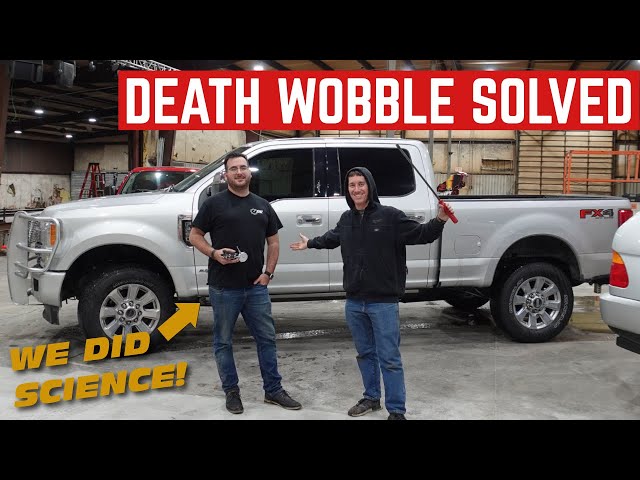
The Ford F350 death wobble is a violent, uncontrollable front-end shaking triggered by hitting a bump or pothole at highway speed. It is caused by worn or loose suspension and steering components—most commonly the track bar (panhard bar), ball joints, tie rod ends, and steering stabilizer—allowing the front axle to oscillate side to side. The fix requires inspecting and replacing the specific worn component(s), not just adding a steering stabilizer as a band-aid.
What causes death wobble on a Ford F350?
Death wobble on an F350 is not caused by a single failed part. It is a chain reaction of accumulated wear, play, and flex in the front suspension and steering geometry. One worn component puts extra stress on the others, and eventually the system reaches a tipping point where a bump input sends the axle into an uncontrolled oscillation.
The solid front axle on the Super Duty uses a track bar to center the axle under the frame. When any joint in the steering or suspension has excessive play, the axle can shift side to side freely. At highway speed, this oscillation feeds on itself and becomes violent enough to shake the entire truck until you slow below roughly 40 mph.
The primary culprits ranked by frequency
- Track bar (panhard bar) ball joint or bushings — This is the number one cause on 2005+ F350s. The frame-side joint wears oval, allowing lateral axle movement.
- Upper and lower ball joints — Especially the lower ball joints, which carry the weight of the truck. Play here lets the wheel toe in and out rapidly.
- Tie rod ends — Worn tie rod ends introduce toe-change under load, amplifying oscillation.
- Steering stabilizer — A failed stabilizer does not cause wobble, but it masks early symptoms. When it finally leaks out, the wobble appears suddenly.
- Alignment specs — Insufficient caster angle reduces the front end’s self-centering tendency and makes it more susceptible to oscillation.
- Lifted trucks with poor geometry — Lifts that do not correct caster or use a dropped track bar bracket introduce angles that promote wobble.
How do you diagnose which part is causing the F350 death wobble?
Put the truck on jack stands with the front wheels off the ground. Grab the tire at 12 and 6 o’clock and rock it to check ball joints.
Grab it at 9 and 3 o’clock to check tie rod ends and the steering gear. Then have someone rock the steering wheel while you watch every joint from underneath.
Step-by-step diagnostic procedure
- Check the track bar: With the engine off and wheels on the ground, have someone turn the steering wheel slightly back and forth. Watch the track bar joints on both ends. Any visible movement at the bushings or ball joint means it needs replacement.
- Check ball joints: Jack up one front corner. Place a pry bar under the tire and lift. Watch the lower ball joint for vertical movement. Any play over 0.060 inches means replacement. Also check the upper ball joint the same way.
- Check tie rod ends: With the wheel still off the ground, grab the tire at 3 and 9 o’clock. Rock it in and out. Any clunking or movement at the tie rod ends means they are worn.
- Inspect the steering stabilizer: Look for oil leakage on the stabilizer body. A leaking stabilizer is dead and needs replacement, but understand this alone rarely fixes wobble.
- Check the pitman arm and idler arm: On trucks with a conventional steering linkage, the pitman arm and idler arm can develop play. Rock the steering wheel and watch for movement at these pivot points.
- Verify alignment specs: Get a printout of your alignment. Caster should be at least 4.5 to 5 degrees positive per side. Low caster is a known contributor, especially on lifted trucks.
How to fix F350 death wobble based on the worn component
You must replace the actual worn part. Do not start by throwing a steering stabilizer at the problem—that is the most common mistake owners and even shops make.
Fix 1: Replace the track bar
On 2005 to 2016 F350s, the OEM track bar uses a ball joint on the frame side that wears out between 60,000 and 100,000 miles. On 2017+ models, Ford revised the design, but it still wears.
Replace with an OEM track bar or a quality aftermarket unit from brands like Moog or Carli. Torque the frame-side bolt to spec and make sure the axle is centered before final tightening.
Fix 2: Replace ball joints
Use Motorcraft or high-quality aftermarket ball joints. The lower ball joints on 2005 to 2010 F350s are notorious for early failure.
On 2011+ trucks with the updated front suspension, the ball joints are improved but still wear. A ball joint press is required—most auto parts stores will rent one for free.
Fix 3: Replace tie rod ends and drag link
On 2005 to 2016 trucks with the older steering linkage, the tie rod ends and drag link ends are individual replaceable units. On 2017+ trucks with the updated steering linkage, consider upgrading to a full Carli or Thuren steering kit if the truck is lifted. Always get an alignment after replacing any steering linkage component.
Fix 4: Steering stabilizer replacement
Replace a leaking stabilizer with a Bilstein or Fox unit. Do not use a dual stabilizer setup as a fix for wobble—it masks the problem and allows the underlying wear to get worse. A single quality stabilizer is sufficient once the root cause is addressed.
Fix 5: Correct alignment and caster
If the truck is lifted, add caster-adjustable radius arms or adjustable track bar brackets to bring caster back into spec. On stock-height trucks, a proper alignment with caster set to at least 5 degrees per side makes a significant difference. Many alignment shops set caster to the minimum spec—insist on the higher end of the range.
Which F350 model years have the worst death wobble problems?
The 2005 to 2010 F350 Super Duty years are the most commonly reported for death wobble. These trucks use a front track bar design with a single ball joint that is prone to early wear, and the ball joints themselves have a shorter service life compared to later models.
Model year breakdown
| Model Years | Common Issues | Recommended Fix |
|---|---|---|
| 2005–2007 (Harley, FX4, Lariat trims most reported) | Track bar ball joint wear, lower ball joint failure, steering stabilizer leak | Replace track bar and ball joints together. Check caster alignment. |
| 2008–2010 | Same track bar issue, early tie rod end wear, idler arm play | Full front-end inspection. Replace all worn joints simultaneously. |
| 2011–2016 | Revised suspension geometry reduces frequency but does not eliminate it. Track bar still wears. Lifted trucks are more susceptible. | Replace track bar, verify alignment caster specs, use OEM or Moog parts. |
| 2017–2019 (updated front end) | New steering linkage design helps, but ball joints and track bar still wear. Wobble less common but still reported, especially on lifted or oversized-tire trucks. | Inspect track bar, ball joints, and steering linkage. Correct alignment for any lift. |
| 2020+ | Improved but not immune. Reports are fewer but still present, particularly on trucks with heavy front-end accessories or off-road use. | Follow standard diagnostic procedure. Address wear early before it cascades. |
Does a steering stabilizer fix F350 death wobble?
No. A steering stabilizer is a shock absorber that dampens minor vibrations and kickback through the steering wheel.
It does not address the worn joints or misaligned geometry that causes death wobble. Replacing the stabilizer alone may temporarily reduce the symptoms, but the wobble will return—often worse—because the underlying wear continues unchecked.
Many dealerships and even some independent shops will recommend a steering stabilizer first because it is a cheap, quick fix that makes the customer feel like something was done. This is a disservice. The correct approach is to diagnose and fix the actual worn component(s).
If a shop recommends only a steering stabilizer without inspecting the track bar, ball joints, and tie rod ends, get a second opinion. You are likely paying for a temporary band-aid that will cost you more in the long run.
How much does it cost to fix F350 death wobble?
The total cost depends on how many components are worn. A single track bar replacement costs between $200 and $400 in parts and one to two hours of labor. A full front-end rebuild including track bar, ball joints, tie rod ends, and steering stabilizer can run $800 to $1,500 at an independent shop, or $1,200 to $2,500 at a dealership.
DIY cost breakdown
- Track bar (OEM or Moog): $80 to $180
- Ball joints (set of 4): $60 to $150
- Tie rod ends (set): $80 to $200
- Steering stabilizer: $40 to $120
- Alignment (after all work): $80 to $130
- Ball joint press rental: Free at most parts stores
Doing it yourself can cut the cost in half or more. The labor is straightforward with basic hand tools, a floor jack, jack stands, and a ball joint press. The most important step most DIYers skip is the alignment afterward—never skip this.
Can you drive an F350 with death wobble?
You can, but you absolutely should not. Death wobble is dangerous because it makes the truck nearly uncontrollable at highway speed.
The only way to stop it is to slow down aggressively, which creates a serious risk of being rear-ended or losing control. If you experience death wobble, reduce speed immediately, pull off the road safely, and do not drive at highway speeds until the problem is diagnosed and repaired.
Continuing to drive with death wobble also accelerates wear on every other steering and suspension component. The violent oscillation puts extreme stress on parts that may have been borderline, pushing them into failure much faster.
Frequently Asked Questions
Is the Ford F350 death wobble covered under warranty?
It depends on your warranty status and the specific failed component. If the truck is under the 5-year/60,000-mile powertrain warranty, steering and suspension components may be covered under the bumper-to-bumper portion if still active.
Some owners have reported getting goodwill repairs from Ford even slightly out of warranty, especially on well-documented cases. Always ask the service manager to check for any applicable technical service bulletins (TSBs) or extended coverage programs.
Will bigger tires cause death wobble on an F350?
Larger and heavier tires amplify existing wear in the front suspension. They do not cause death wobble by themselves, but they increase the load on ball joints, tie rod ends, and the track bar, accelerating wear and lowering the threshold at which wobble appears. If you run oversized tires, inspect your front-end components more frequently and keep alignment specs on the aggressive side for caster.
What is the difference between a shimmy and death wobble on an F350?
A shimmy is a mild vibration felt in the steering wheel, usually between 50 and 65 mph, that goes away with a small steering input or speed change. Death wobble is a violent, full-truck oscillation that feels like the front axle is shaking itself apart.
Shimmy indicates early-stage wear. Death wobble indicates the system has reached a critical failure point and needs immediate attention.
Does a Carli or Thuren suspension kit prevent F350 death wobble?
Quality aftermarket suspension kits like Carli, Thuren, or BDS replace the weak OEM components with stronger joints and correct geometry issues that contribute to wobble. They significantly reduce the risk but do not make the truck immune. Regular inspection and maintenance of all front-end components is still necessary.
Why does my F350 only death wobble on certain roads?
Death wobble requires a trigger input—a bump, pothole, expansion joint, or uneven pavement—to initiate the oscillation. Smooth roads do not provide that trigger.
Roads with consistent surface imperfections at the right frequency and amplitude will reliably cause wobble if the front-end components are worn enough. This is why some owners think the problem is intermittent when it is actually always present, just waiting for the right trigger.
Fix it right the first time
The F350 death wobble is a solvable problem, but only if you resist the temptation to throw parts at it blindly. Start with a thorough inspection of the track bar, ball joints, tie rod ends, and steering stabilizer. Replace every worn component, get a proper alignment with caster set to the higher end of spec, and the wobble will be gone for good.
Do not let any shop sell you just a steering stabilizer and call it fixed. Your safety—and your truck—deserve better than a band-aid.
Leave a Reply