
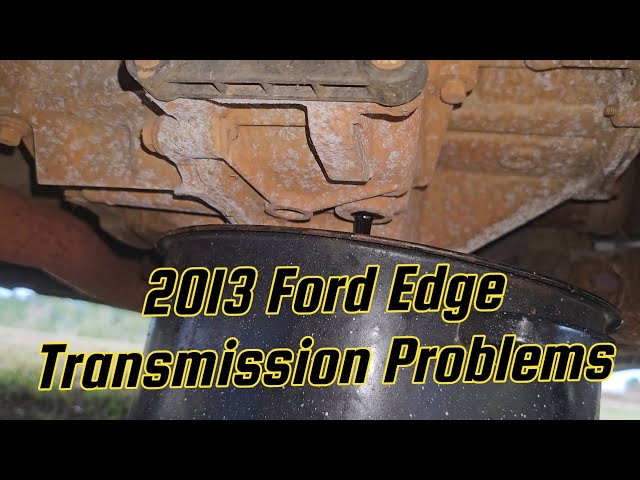
The Ford Edge has well-documented transmission problems across multiple model years, with the 2015–2018 models being the most problematic due to the 6F50/6F35 transmission’s torque converter shudder, valve body failures, and solenoid malfunctions. Owners commonly report harsh shifting, delayed engagement, shuddering at highway speeds, and complete transmission failure between 60,000 and 120,000 miles. Repair costs range from $250 for a solenoid replacement to $5,500+ for a full transmission rebuild or replacement.
What Are the Most Common Ford Edge Transmission Problems?
The Ford Edge suffers from several recurring transmission issues that vary by model year and transmission type. The most frequently reported problems include torque converter shudder, harsh or delayed shifting, slipping gears, transmission fluid leaks, and premature internal component failure.
The severity and type of problem depends heavily on which generation of Edge you own. The 6F50 and 6F35 units found in 2007–2018 models share many of the same failure points. The newer 8F35 8-speed transmission in 2019 and later models introduced a different set of complaints.
2015–2018 Ford Edge (Most Problematic Years)
These model years are widely considered the worst for transmission reliability. The 6F50 transmission in the 2.0L EcoBoost and the 6F35 in other trims are plagued with failures.
- Torque converter shudder – A vibration or shaking felt between 40–60 mph, often mistaken for a tire balance issue
- Harsh downshifts – Violent gear engagement when slowing down, especially from 3rd to 2nd gear
- Delayed forward engagement – A noticeable delay when shifting from Park to Drive, sometimes 2–3 seconds
- Valve body bore wear – Internal valve body passages wear out, causing erratic pressure regulation
- Solenoid body failure – The solenoid pack develops internal leaks, triggering check engine lights and limp mode
2007–2014 Ford Edge (First Generation)
The earlier Edge models used the 6F50 transmission and developed issues as mileage climbed past 80,000 miles. Owners reported gear hunting, slipping under acceleration, and overheating during towing or mountain driving.
- Gear hunting – Transmission constantly shifts between gears on inclines or at steady speeds
- 3rd and 5th gear flare – RPMs spike between gear changes before engagement catches up
- Transmission overheating – No dedicated external cooler on most trims leads to fluid breakdown
- Forward clutch pack failure – Worn clutch plates cause slipping and eventual loss of forward motion
2019–2024 Ford Edge (8F35 8-Speed Transmission)
The newer 8-speed unit brought its own growing pains. Complaints include low-speed shuddering, hesitation during acceleration, and rough 1–2 upshifts when the engine is cold.
- Low-speed shudder – Vibration during light throttle at 15–25 mph, especially in stop-and-go traffic
- Cold start shift quality – Rough shifts during the first few minutes of driving until fluid warms up
- Software calibration issues – Ford has issued multiple TSBs for shift quality through PCM reprogramming
- Adaptive learning problems – The transmission adaptive strategy sometimes learns poor shift patterns
What Causes the Ford Edge Torque Converter Shudder?
Torque converter shudder in the Ford Edge is caused by contaminated or degraded transmission fluid that reduces the friction modifier’s effectiveness inside the converter clutch. When the converter clutch can no longer engage smoothly, it vibrates against the turbine, creating the signature shudder between 40 and 60 mph.
This is the single most common complaint on the 2015–2018 Edge models. Owners often spend hundreds chasing wheel bearings, CV axles, and tire balances before discovering the real source is the torque converter.
How to Confirm It Is Torque Converter Shudder
- Drive at 40–60 mph with light throttle and feel for a rapid vibration that comes and goes
- Lightly tap the brake pedal while maintaining speed – if the shudder disappears momentarily when the converter clutch disengages, it is the torque converter
- Check the transmission fluid – Dark brown or burnt-smelling fluid accelerates friction modifier breakdown
- Scan for codes – P0741 (torque converter clutch solenoid performance) or P1744 (TCC system stuck off) are common
Fixes for Torque Converter Shudder
A complete transmission fluid exchange using Mercon LV or the updated Mercon ULV fluid resolves many early-stage shudder complaints. If the fluid is severely degraded or the converter clutch material is already damaged, the torque converter must be replaced.
- Fluid exchange only (early stage) – $150–$300 at a shop; often fixes the problem if caught early
- Torque converter replacement – $800–$1,500 parts and labor; requires transmission removal
- Updated converter with better friction material – Aftermarket converters with improved clutch linings last longer than OEM replacements
How Much Does a Ford Edge Transmission Replacement Cost?
A full Ford Edge transmission replacement costs between $3,200 and $5,800 depending on whether you choose a rebuilt unit, a remanufactured unit, or a new transmission from Ford. Labor alone runs $800 to $1,500 at most shops since the job requires 8–12 hours.
| Repair Type | Parts Cost | Labor Cost | Total Estimate |
|---|---|---|---|
| Transmission fluid exchange | $30–$80 | $100–$200 | $130–$280 |
| Solenoid body replacement | $250–$450 | $300–$500 | $550–$950 |
| Torque converter replacement | $300–$600 | $500–$900 | $800–$1,500 |
| Valve body replacement | $400–$700 | $400–$600 | $800–$1,300 |
| Rebuilt transmission | $1,800–$2,800 | $800–$1,200 | $2,600–$4,000 |
| Remanufactured transmission | $2,500–$4,000 | $800–$1,500 | $3,300–$5,500 |
Which Ford Edge Years Should You Avoid for Transmission Problems?
The 2015 and 2016 Ford Edge are the worst years for transmission problems based on NHTSA complaints, forum reports, and repair frequency data. The 2017 model improved slightly but still carries significant risk. The 2007 and 2008 models also rank poorly due to age-related failures in the 6F50 transmission.
Worst Ford Edge Model Years Ranked
- 2015 Ford Edge – Highest volume of transmission complaints; torque converter and valve body failures are widespread
- 2016 Ford Edge – Nearly identical failure profile to the 2015; solenoid body failures are especially common
- 2017 Ford Edge – Marginally better but still plagued by shudder and harsh shifting
- 2008 Ford Edge – Age-related failures in the 6F50; overheating and clutch wear are typical
- 2011 Ford Edge – Reports of delayed engagement and gear hunting at highway speeds
Best Ford Edge Years for Reliability
The 2019 and 2020 models generally receive better reliability ratings, though the 8-speed transmission still has some complaints. The 2013 and 2014 models, if well-maintained, tend to offer the best long-term reliability among the first generation.
How to Diagnose Ford Edge Transmission Problems at Home
You can diagnose many Ford Edge transmission problems in your driveway with basic tools and an OBD-II scanner. Identifying the exact symptom pattern helps you avoid unnecessary repairs and overquoted shop bills.
Step 1: Check for Diagnostic Trouble Codes
Connect an OBD-II scanner and read both engine and transmission codes. The Ford Edge stores specific codes for torque converter clutch, solenoid performance, and gear ratio errors that point directly to the failed component.
- P0741 – Torque converter clutch solenoid circuit performance/stuck off
- P0750–P0770 – Shift solenoid A through E circuit malfunctions
- P0730 – Incorrect gear ratio (indicates slipping or internal mechanical failure)
- P1744 – Torque converter clutch system stuck off
- P2700–P2707 – Transmission friction element apply time performance errors
Step 2: Inspect the Transmission Fluid
Pull the transmission dipstick (on models that have one) or check the fill plug. Healthy fluid is translucent red or pink. Dark brown, black, or burnt-smelling fluid indicates internal damage and fluid breakdown.
- Translucent red/pink – Fluid is healthy; problem may be electronic or software-related
- Dark brown – Fluid is degraded; change it and re-evaluate symptoms
- Black with burnt smell – Internal clutch material is disintegrating; expect rebuild
- Metal flakes visible – Hard parts are wearing; transmission needs internal inspection
Step 3: Perform a Stall Test
A stall test helps evaluate the torque converter and clutch packs. With the engine at operating temperature, apply the parking brake, hold the brake pedal firmly, and briefly accelerate to wide open throttle in Drive.
The RPM should reach the specified range (usually 2,200–2,800 for the 6F50). If it goes too high, the clutch packs are slipping. If it goes too low, the converter may be seized or the engine is underperforming.
How to Reset or Reprogram the Ford Edge Transmission
Ford Edge transmissions use adaptive learning algorithms that adjust shift pressure and timing based on driving habits. Over time, the transmission can learn aggressive or sloppy shift patterns that cause harsh shifting, even when nothing is mechanically wrong. Resetting the adaptive learning often resolves shift quality complaints.
Method 1: Battery Disconnect Reset
- Turn off the engine and remove the key
- Disconnect the negative battery terminal
- Wait at least 30 minutes (some technicians recommend overnight)
- Reconnect the battery terminal
- Start the engine and let it idle for 2 minutes without touching the throttle
- Drive the vehicle gently for 15–20 miles, allowing the transmission to relearn shift points under varied conditions
Method 2: Forscan or Ford IDS Reprogramming
For a more thorough reset, use Forscan with a compatible OBD-II adapter to perform a transmission adaptive learning reset through the PCM. This clears all stored adaptation tables and forces the transmission to start learning from scratch. A Ford dealer can also perform this using the IDS diagnostic tool, typically charging one hour of labor ($100–$180).
Method 3: PCM Software Update (TSB-Based)
Ford has released multiple Technical Service Bulletins (TSBs) addressing shift quality on the Edge. These TSBs update the PCM calibration to fix shudder, harsh shifting, and delayed engagement.
Ask your dealer to check for outstanding PCM updates using your VIN. Many of these updates are covered under powertrain warranty or as goodwill repairs.
What Does the Ford Edge Transmission Recall Cover?
As of 2024, Ford has not issued a widespread safety recall specifically for Ford Edge transmission failures. However, Ford has issued several TSBs and extended warranty coverage for certain transmission components on affected model years. NHTSA has received thousands of complaints, but no recall threshold has been met for the transmission as a whole.
- TSB 19-2246 – Addresses shift quality and shudder on 2015–2018 Edge with 6F50/6F35 transmissions
- TSB 20-2100 – PCM reprogramming for harsh or delayed shifts on 2019–2020 Edge with 8F35
- Extended warranty (14M02) – Ford extended torque converter coverage to 10 years/150,000 miles on certain 2015–2016 models after class-action pressure
- Customer satisfaction programs – Some owners have received partial repair cost coverage from Ford even outside warranty; always ask the dealer to check for open programs
DIY Tips: How to Extend Your Ford Edge Transmission Life
Preventing transmission failure in the Ford Edge comes down to fluid maintenance and thermal management. The factory service interval for transmission fluid is often too long, and the lack of an external cooler on most trims causes accelerated fluid breakdown.
- Change transmission fluid every 30,000–40,000 miles instead of the 60,000-mile Ford recommendation; use Mercon LV or the updated fluid spec
- Install an aftermarket transmission cooler – A $50–$100 inline cooler dramatically lowers operating temperatures, especially if you tow or drive in hilly terrain
- Avoid driving habits that heat the fluid – Do not hold the vehicle on hills with the gas pedal; use the brake and avoid heavy throttle from a stop
- Check for leaks regularly – The 6F50 is known for leaking at the case half seam and the cooler line fittings
- Scan for codes proactively – Do not wait for a check engine light; scan every oil change and look for pending transmission codes
Frequently Asked Questions
Can I drive my Ford Edge with a transmission shudder?
Technically yes, but driving with an active shudder accelerates torque converter clutch wear and can eventually send damaged friction material into the valve body, turning a $300 fluid exchange into a $3,000 rebuild. Address it as soon as possible.
Does the Ford Edge have a CVT transmission?
No. All Ford Edge models use a conventional automatic transmission with planetary gear sets. The 2007–2018 models use a 6-speed automatic (6F50 or 6F35), and the 2019 and later models use an 8-speed automatic (8F35).
How long should a Ford Edge transmission last?
With proper maintenance including regular fluid changes every 30,000–40,000 miles, a Ford Edge transmission can last 150,000 to 200,000 miles. Neglected transmissions often fail between 60,000 and 100,000 miles, especially on the 2015–2018 models.
Will Ford cover transmission repairs out of warranty?
Ford occasionally offers goodwill repairs or coverage under customer satisfaction programs for known issues. Call Ford Customer Relationship Center at 1-800-392-3673 with your VIN and repair history. Documented maintenance history and complaint records with NHTSA strengthen your case.
Is it cheaper to rebuild or replace a Ford Edge transmission?
A rebuild is typically $500–$1,000 cheaper than a remanufactured unit but depends on the extent of internal damage. If hard parts like the gear sets or drums are damaged, a remanufactured unit with a warranty is the better value at $3,300–$5,500 installed.
Can a software update fix Ford Edge transmission problems?
In many cases, yes. Ford has released multiple PCM calibration updates that significantly improve shift quality, reduce shudder, and fix delayed engagement. Ask your dealer to check for TSB-related software updates before agreeing to any mechanical repair.
Final Advice for Ford Edge Owners Dealing With Transmission Problems
If you own a 2015–2018 Ford Edge and have not experienced transmission issues yet, start aggressive fluid maintenance now and get any available PCM software updates applied. If you are already experiencing symptoms, begin with a fluid exchange and a scan for codes before agreeing to expensive repairs.
Many Ford Edge transmission problems are caught and fixed for under $300 when diagnosed early, but ignored symptoms escalate quickly into full rebuild territory. Always get a second opinion from an independent transmission specialist before authorizing dealer repairs, and document everything for potential Ford goodwill claims or class-action compensation.
Leave a Reply