
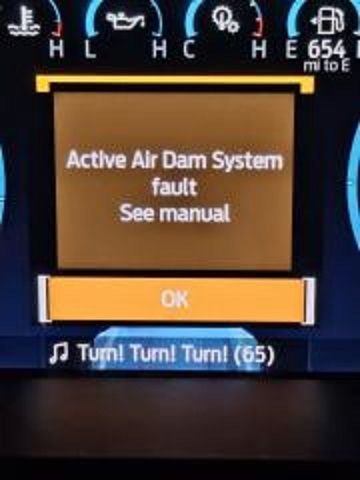
A Ford F-150 Active Air Dam System Fault is a dashboard warning indicating the electronically controlled front air dam cannot deploy or retract properly. The most common causes are physical damage to the air dam panel, ice or debris buildup blocking movement, a failed electric actuator motor, or a wiring/connector issue. Many owners can resolve it with a simple reset, cleaning, or a relatively inexpensive actuator replacement rather than a full dealership overhaul.
What Is the Active Air Dam on a Ford F-150 and What Does It Do?
The active air dam is a motorized panel mounted beneath the front bumper of select Ford F-150 models, starting with the 2021 redesign. It automatically lowers at highway speeds to reduce airflow under the truck, improving aerodynamics and fuel economy by up to one mile per gallon.
When you drive above roughly 40 mph, the system commands an electric actuator to extend the dam downward. When you slow down, stop, or shift into reverse, it retracts to prevent contact with curbs, parking blocks, or rough terrain. The entire cycle takes only a few seconds.
Which F-150 Models Have the Active Air Dam?
- 2021–2024 Ford F-150 – Available on XLT, Lariat, King Ranch, Platinum, and Limited trims equipped with the 3.5L EcoBoost, 5.0L V8, or PowerBoost hybrid powertrains.
- 2024+ Ford F-150 (14th generation refresh) – Carried over with minor updates to the control module software.
- F-150 Raptor – Uses a different front-end design and does not typically include the standard active air dam.
If your truck has the chrome or body-color lower front valance with a visible seam line near the bottom, it almost certainly has this system. You can also check your window sticker or the Ford window sticker lookup tool for the “Active Air Dam” line item.
What Causes the “Active Air Dam System Fault” Warning?
This warning appears when the Body Control Module (BCM) detects the air dam has not reached its commanded position within a set time window. The system monitors current draw on the actuator motor and, on some trims, uses a position sensor to confirm deployment. When something blocks movement or the motor cannot respond, the fault triggers.
Cause 1: Physical Damage from Curbs or Obstacles
This is the number one cause by a wide margin. The air dam hangs lower than most owners realize, and pulling too far into a parking space, scraping a curb, or driving over a speed bump at an angle can crack the panel or bend the mounting brackets. Even a minor impact can shift the dam just enough that the actuator binds up.
Inspect the underside of the front bumper carefully. Look for cracks, missing chunks, or sections that hang at a different angle than the rest. Even hairline fractures near the mounting points can cause the system to fault out.
Cause 2: Ice, Snow, or Debris Buildup
In northern climates, this is extremely common during winter months. Snow packs into the space between the air dam and the bumper fascia, then freezes solid overnight. When the system tries to deploy or retract the next morning, the motor stalls against the ice and the BCM sets a fault code.
Road salt, mud, and gravel can also accumulate over time and create enough resistance to trigger the warning. Owners who regularly drive on gravel roads or through construction zones see this more frequently.
Cause 3: Failed Electric Actuator Motor
The actuator is a small DC motor with a gearbox that drives a linkage to push the dam down or pull it up. Like any motor, it can wear out, especially if it has been fighting against resistance from debris or damage for thousands of cycles. Symptoms of a failing motor include a faint clicking or grinding noise from the front bumper area when the system attempts to cycle, or the dam moving only partway before stopping.
Cause 4: Wiring Harness or Connector Damage
The actuator wiring runs along the underside of the truck, exposed to road spray, rocks, and temperature extremes. Connectors can corrode, pins can back out, and the harness can chafe against sharp edges. Rodent damage is also a real concern, as the soy-based wire insulation Ford uses is attractive to mice and squirrels.
Cause 5: Software Glitch or Calibration Error
Occasionally, a software issue in the BCM or the air dam control module causes a false fault. This is more common after a battery disconnect, a dead battery event, or a module update. The system loses its learned position values and throws a fault until it is recalibrated or reset with a scan tool.
How to Diagnose the Active Air Dam Fault Yourself
Before spending money at a shop, you can narrow down the cause at home with a basic visual inspection and a few simple checks.
- Visual inspection: Get under the front of the truck with a flashlight. Look for cracked, bent, or hanging sections of the air dam. Check that both mounting points are intact and the panel sits evenly.
- Manual movement test: With the truck off, try gently pushing the air dam up and down by hand. It should move smoothly with slight resistance from the actuator. If it feels stuck, gritty, or only moves on one side, you likely have a physical obstruction or a seized actuator.
- Listen for the motor: Turn the ignition on (engine off) and have someone watch under the bumper while you cycle the ignition. You should hear a brief whirring sound as the system runs a self-check. No sound at all points to a dead motor or a wiring problem. A clicking or grinding sound points to a mechanical failure inside the actuator.
- Check for codes: If you have an OBD-II scanner that reads BCM codes, look for DTCs in the B14xx or P06xx range related to the active air dam. A code like B1495 typically indicates an actuator circuit fault.
How to Fix the Ford F-150 Active Air Dam System Fault
The fix depends entirely on the root cause. Here is a breakdown organized by the most common scenarios owners encounter.
Fix 1: Clear Ice and Debris
If the fault appeared during or after a winter storm, park the truck in a heated garage or use a garden hose with warm (not boiling) water to melt packed ice around the air dam. Avoid prying on the panel with a scraper, as the plastic is brittle in cold temperatures and will crack. Once the obstruction is cleared, drive the truck above 40 mph for a few minutes and the system should cycle normally and clear the warning.
Fix 2: Reset the System Without a Scan Tool
For software-related faults, try this sequence:
- Turn the ignition off and open the driver’s door to fully power down the modules.
- Disconnect the negative battery terminal and wait at least 10 minutes.
- Reconnect the battery and start the truck.
- Drive at highway speed for 2–3 minutes to allow the system to re-initialize.
This forces a hard reboot of the BCM and often clears false faults. If the warning returns immediately, the underlying hardware problem still exists.
Fix 3: Replace the Air Dam Actuator
The actuator is the most commonly replaced component. Ford sells it as a standalone part, and aftermarket options are beginning to appear as well.
- OEM part number: NL3Z-17626-A (verify against your specific VIN, as Ford has superseded this number multiple times).
- Typical cost: $80–$150 for the actuator from a Ford dealer or online parts retailer.
- Labor time: 0.5–1.0 hour at a shop. DIY is straightforward with basic hand tools.
Steps to Replace the Actuator
- Raise the front of the truck on jack stands for access.
- Remove the push-pin fasteners securing the lower splash shield.
- Locate the actuator on the driver’s side of the air dam assembly. It is a small black motor with a wiring connector and two mounting bolts.
- Disconnect the electrical connector by pressing the release tab.
- Remove the two 10mm mounting bolts.
- Pull the actuator off the linkage ball stud.
- Install the new actuator in reverse order. Ensure the linkage ball stud seats fully into the socket.
- Reconnect the connector, reinstall the splash shield, and lower the truck.
- Clear any stored DTCs with a scan tool, or perform the battery disconnect reset described above.
Fix 4: Repair or Replace a Damaged Air Dam Panel
If the panel itself is cracked or broken, you have two options. For minor cracks, a plastic welding repair or heavy-duty epoxy can reinforce the area. For major damage, the full air dam assembly needs replacement.
- Full air dam assembly cost: $200–$400 depending on trim level and whether you buy OEM or aftermarket.
- Aftermarket delete option: Some owners choose to remove the active air dam entirely and install a fixed, non-motorized lower valance. This eliminates the fault permanently but sacrifices the small fuel economy gain. You will need a Forscan module edit to disable the fault warning if you go this route.
Fix 5: Wiring Repair
If you find a damaged connector or chafed wire, repair it with solder and heat-shrink tubing rather than crimp connectors, which can corrode in the exposed underbody environment. Wrap the repaired section with abrasion-resistant loom tape. If rodent damage is extensive, consider having the entire harness section replaced by a dealer, as splicing into multiple circuits can introduce new problems.
How Much Does It Cost to Fix the Active Air Dam at a Dealership?
Dealership pricing varies by region, but here is what owners commonly report across forums and owner groups:
| Repair | Parts Cost | Labor Cost | Total Estimate |
|---|---|---|---|
| Actuator replacement only | $80–$150 | $100–$180 | $180–$330 |
| Full air dam assembly replacement | $200–$400 | $150–$250 | $350–$650 |
| Wiring harness repair | $50–$150 | $200–$400 | $250–$550 |
| Software reflash/recalibration | $0 | $100–$150 | $100–$150 |
Many owners report that dealers quote the full air dam assembly replacement even when only the actuator is bad, because it is easier for the tech and more profitable for the service department. Always ask for a detailed diagnosis and push for actuator-only replacement if the panel is physically intact.
Can You Drive with an Active Air Dam System Fault?
Yes, the truck is completely safe to drive with this fault active. The air dam is an aerodynamic aid, not a structural or safety component.
If it is stuck in the retracted position, you will lose a small amount of fuel efficiency at highway speeds. If it is stuck in the deployed position, it is more vulnerable to damage from curbs and obstacles, so be mindful of your ground clearance when parking.
The system is designed to fail safe, meaning it defaults to the retracted position when a fault is detected. You will not experience any drivability issues, warning chimes, or limp mode from this fault alone.
Frequently Asked Questions
Does the Ford F-150 active air dam affect towing or off-road capability?
No. The air dam retracts automatically when you slow down or shift into reverse, so it stays out of the way during low-speed maneuvers.
However, if you frequently off-road in rocky terrain, the deployed dam at highway speed can be vulnerable to kicked-up debris. Some owners who regularly tow long distances appreciate the system because it improves fuel economy by a measurable amount at sustained cruising speeds.
Will the active air dam fault void my Ford warranty?
The fault itself will not void anything. If the failure is caused by an impact (hitting a curb or parking block), Ford may classify it as physical damage rather than a defect, which would not be covered under the bumper-to-bumper warranty. If the actuator fails on its own with no signs of impact, it should be covered under the 3-year/36,000-mile bumper-to-bumper warranty or the 5-year/60,000-mile powertrain warranty if applicable to your plan.
Can I disable the active air dam permanently with Forscan?
Yes. Using Forscan with a compatible OBD-II adapter, you can disable the active air dam module in the BCM configuration.
This prevents the system from attempting to cycle and eliminates the fault warning permanently. The trade-off is a minor loss in highway fuel economy. This is a popular option for owners who have removed the dam for off-road bumper upgrades.
Why does the fault keep coming back after I clear it?
If the warning returns after a reset, the underlying cause has not been addressed. The most common reason for a recurring fault is a partially damaged air dam that binds during movement, a weak actuator motor that stalls under load, or a corroded connector that intermittently loses signal. A proper diagnosis with a scan tool reading live data from the air dam module will pinpoint whether the issue is mechanical or electrical.
Is there a Ford TSB or recall for the active air dam system fault?
As of the latest available information, Ford has issued Technical Service Bulletins (TSBs) related to the active air dam on certain 2021–2023 F-150 models, primarily addressing software calibration updates that reduce false fault triggers. There is no safety recall for this system. Check with your dealer using your VIN to see if any open TSBs apply to your specific truck.
Final Thoughts: Don’t Overpay for a Simple Fix
The active air dam system fault on the Ford F-150 is one of those issues that sounds alarming on the dashboard but is usually straightforward and inexpensive to resolve. Start with a visual inspection, clear any ice or debris, and try a battery reset before heading to the dealer.
If the actuator needs replacement, the part is affordable and the job is DIY-friendly with basic tools. Do not let a dealership convince you to replace the entire assembly unless the panel itself is physically destroyed. A methodical approach to diagnosis will save you hundreds of dollars and get that warning light off your dash for good.
Leave a Reply