
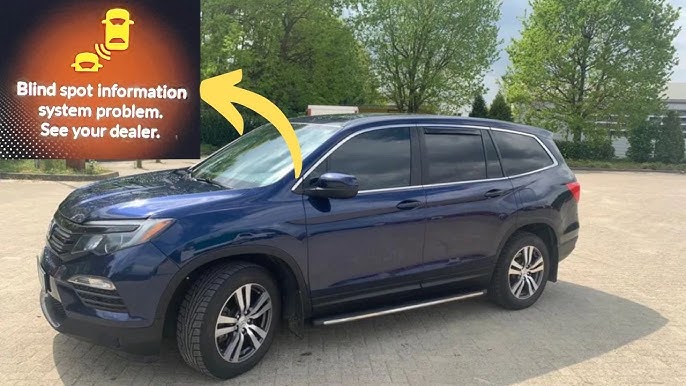
A “Blind Spot Information System Problem” message on your Honda dashboard usually means one or both rear corner radar sensors are malfunctioning, obstructed by dirt, snow, or debris, misaligned after a collision repair, or experiencing an internal electrical fault.
In most cases, cleaning the rear bumper sensor areas, checking for aftermarket bumper accessories, or performing a system reset clears the warning. If the message persists, a dealer scan tool diagnosis is needed to pinpoint the exact sensor failure.
Why Does My Honda Say Blind Spot Information System Problem?
This warning appears when the Body Control Module (BCM) detects a communication failure or abnormal reading from the left or right rear corner radar sensors. These millimeter-wave radar units sit behind the rear bumper cover on both sides and constantly monitor adjacent lanes for approaching vehicles.
When the system cannot trust the sensor data—whether from physical damage, electrical interruption, or environmental blockage—it disables the entire Blind Spot Information System (BSI) and throws the dashboard alert. The system is designed to fail safe rather than give you false confidence.
Most Common Triggers Behind the Warning
- Dirty or obstructed sensor area: Mud, snow, ice, or even thick road grime coating the bumper near the sensors will block radar signals. This is the number one cause in winter months.
- Sensor misalignment: A rear-end collision, even a minor parking lot bump, can shift the radar unit’s angle by just a few millimeters—enough to cause a fault.
- Aftermarket bumper accessories: Bike racks, trailer hitches with wiring, thick bumper guards, or even metallic bumper stickers mounted near the sensor zone can interfere with radar waves.
- Internal sensor failure: The radar module itself can fail due to moisture intrusion, solder joint degradation, or manufacturing defects in certain model years.
- Wiring harness damage: Rodent-chewed wires, corroded connectors, or pinched harnesses from body shop work will interrupt sensor communication.
- Low battery voltage or recent battery disconnect: Voltage drops below 10V or a fresh battery install can cause the system to lose its calibration memory.
How to Reset Honda Blind Spot Information System
For minor glitches, you can often reset the BSI system by turning the vehicle off, waiting 60 seconds, and restarting. If that fails, disconnecting the negative battery terminal for 10 minutes forces a full system reboot and clears soft fault codes.
Step-by-Step Reset Procedure
- Turn the ignition completely off and remove the key or push the start button to power down.
- Wait at least 60 seconds for the system capacitors to discharge.
- Restart the vehicle and drive above 20 mph for 2–3 minutes on a road with clear lane markings.
- If the warning returns, disconnect the negative (black) battery cable using a 10mm wrench.
- Touch the disconnected cable end to the positive terminal for 10 seconds to drain residual power.
- Reconnect the negative terminal, start the car, and drive normally.
Important: After a battery disconnect, you may need to recalibrate your power windows, sunroof, and radio presets. The BSI system itself should self-calibrate within 5–10 minutes of driving.
Honda Blind Spot Sensor Location and How to Clean Them
The BSI radar sensors are mounted inside the rear bumper cover, one on each corner. On most Honda models, they sit approximately 12–18 inches inward from the tail light on both sides, behind the painted bumper skin.
Finding and Cleaning the Sensors
- ▸ Look for small rectangular indentations or slightly raised areas on the inner portions of your rear bumper corners.
- ▸ Do not use a pressure washer directly on these zones. The high-pressure stream can force water past seals into the radar unit.
- ▸ Use a soft microfiber cloth with warm soapy water to gently wipe the sensor area clean.
- ▸ Remove any metallic stickers, magnetic mounts, or adhesive accessories from within 8 inches of the sensor zones.
- ▸ After cleaning, drive for 5 minutes above 20 mph and check if the warning clears.
Honda Blind Spot Information System Problem by Model
Different Honda models have different BSI system configurations, sensor part numbers, and known failure patterns. Here is what you need to know based on your specific vehicle.
Honda CR-V (2017–2024)
The CR-V uses two rear corner radar sensors (part numbers 36801-TLA-A04 and 36806-TLA-A04, though these vary by generation). This is the most commonly reported model for BSI faults because of its popularity and the sensor placement being more exposed to road spray.
Rear bumper removal and sensor replacement requires removing the rear wheel well liners and bumper clips—expect 1–2 hours of shop labor.
Honda Pilot (2016–2024)
Pilot models, especially 2016–2022, have a known issue where the sensor bracket itself can corrode and lose alignment. Honda issued a Technical Service Bulletin (TSB) for certain production ranges.
Check with your dealer using TSB 20-071 or related numbers covering your model year.
Honda Accord (2018–2024)
The Accord’s BSI system is generally more reliable, but owners report phantom warnings during heavy rain or after automatic car washes. The sensors are positioned slightly lower on the bumper, making them more prone to splash contamination.
Honda HR-V and Passport
Both models share similar sensor hardware with the CR-V. Passport owners should be especially cautious with trailer hitch installations—any hitch receiver mounted within 10 inches of the sensor will trigger persistent faults.
How Much Does It Cost to Fix Honda Blind Spot Sensor?
Repair costs vary significantly depending on whether you need a simple cleaning, a sensor replacement, or a full calibration.
Money-Saving Tips for BSI Repairs
- ✔ Always try cleaning the sensor area and performing a reset before paying for diagnostics.
- ✔ Genuine Honda sensors from online OEM parts dealers are 20–40% cheaper than dealership parts counters.
- ✔ If only one sensor is bad, confirm the fault code at an auto parts store with a free scan before ordering the correct side.
- ✔ Aftermarket BSI sensors are available but many owners report compatibility issues—OEM is the safer bet.
- ✔ If your vehicle is still under the 3-year/36,000-mile warranty, BSI system repairs are fully covered.
Will a Honda Blind Spot Problem Affect Other Safety Systems?
In most cases, a BSI fault only disables the blind spot monitoring, cross-traffic alert, and lane change assist features. Your forward collision warning, lane keeping assist, adaptive cruise control, and automatic emergency braking operate on separate forward-facing sensors and cameras, so they remain fully functional.
However, on newer Honda models (2023+) with integrated sensor networks, a persistent BSI fault can occasionally trigger cascading warnings across the Honda Sensing suite. If you see multiple safety system warnings appear simultaneously with the BSI fault, get a full dealer-level diagnostic scan immediately.
Frequently Asked Questions
Can I drive with the blind spot information system problem warning?
Yes, the vehicle is completely safe to drive. The BSI system is a driver-assist feature, not a critical safety system.
Your mirrors and shoulder checks still work perfectly. The warning simply means the electronic blind spot monitoring is temporarily unavailable.
Does the Honda BSI system need calibration after a windshield replacement?
No, the BSI radar sensors are independent of the windshield-mounted camera. However, if the shop disconnected your battery during the windshield replacement, the system may need a short drive cycle to recalibrate itself.
Why does my blind spot warning only come on in cold weather?
Moisture condensation inside the radar sensor housing is a known cold-weather issue. As temperatures drop, small amounts of trapped moisture can temporarily interfere with radar signal transmission. The warning typically clears once the bumper warms up from engine heat or sunlight exposure.
Can tinted tail lights or smoked bumper covers cause BSI problems?
Tail light tinting will not affect the BSI radar sensors since they use millimeter-wave radar, not optical cameras. However, if the tinting film or smoked cover extends over the bumper sensor area and contains metallic particles, it can block radar signals and trigger faults.
How do I know which side sensor is bad on my Honda?
The most reliable method is to scan the vehicle with an OBD-II scanner that reads Honda body codes. The fault code will specify left sensor (36801-xxx) or right sensor (36806-xxx). Without a scanner, note which side the BSI indicator fails to illuminate when a vehicle passes on that side during a test drive.
Final Takeaway: Diagnose Before You Replace
The Honda Blind Spot Information System is a solid piece of engineering, but it has clear weak points—sensor exposure to the elements, sensitivity to bumper modifications, and occasional bracket corrosion on certain model years.
Before spending hundreds at a dealership, always start with the simplest fix: clean the sensor area, perform a battery-reset reboot, and drive for 10 minutes. If the warning persists, get a proper fault code read to identify the exact failing component so you only pay for the repair you actually need.
Leave a Reply