
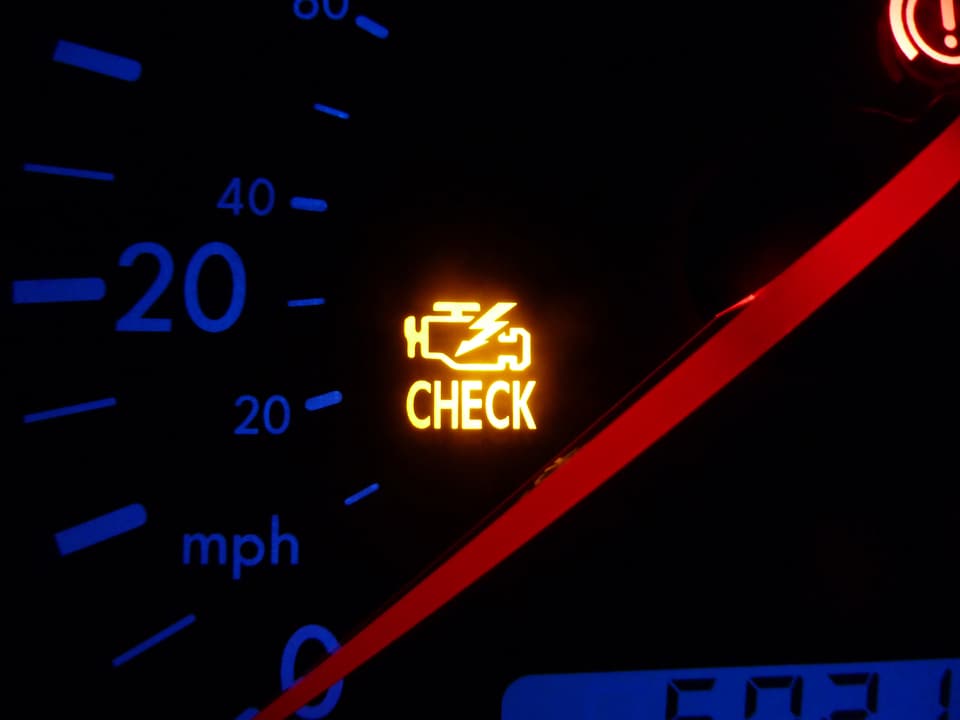
A flashing check engine light on a Jeep means the engine is actively misfiring and raw fuel is being dumped into the exhaust system. This is a critical warning that can destroy your catalytic converter within minutes.
You must reduce speed immediately, avoid heavy acceleration, and diagnose the issue as soon as possible—typically caused by failed ignition coils, worn spark plugs, clogged fuel injectors, or a damaged catalytic converter.
What Does a Flashing Check Engine Light Mean on a Jeep?
A flashing check engine light indicates an active engine misfire that is severe enough to cause immediate damage to your catalytic converter. Unlike a solid check engine light, which signals a stored fault code that can wait for diagnosis, a flashing light is an urgent call to action.
When a cylinder misfires, unburned fuel exits the combustion chamber and enters the hot catalytic converter. This fuel ignites inside the converter, causing temperatures to spike well above 1,600°F.
Within minutes, the converter substrate can melt, warp, or crack—turning a $30 coil pack repair into a $2,000+ exhaust overhaul.
On Jeep vehicles, the PCM (Powertrain Control Module) triggers the flashing CEL when the misfire rate is high enough to risk catalyst damage. The module also stores a specific diagnostic trouble code, most commonly in the P0300-P0312 range, pinpointing which cylinder is misfiring.
- Solid check engine light — Stored fault, not immediately dangerous, schedule repair soon
- Flashing check engine light — Active misfire, stop driving aggressively, diagnose immediately
- Flashing CEL with rough idle or shaking — Severe misfire, pull over safely and tow if necessary
Why Is My Jeep Check Engine Light Flashing and Shaking?
If your Jeep is shaking or vibrating while the check engine light flashes, you are experiencing a multiple-cylinder misfire or a severe single-cylinder misfire. The shaking is the direct result of uneven power delivery from the engine, meaning one or more cylinders are not contributing their share of combustion force.
Jeep owners commonly report this symptom on the 3.6L Pentastar V6 and the older 4.0L inline-six engines. The vibration is usually most noticeable at idle and low RPM, and it often disappears or lessens at highway speeds, which tricks some owners into thinking the problem is minor.
It is not.
What Causes the Shaking Along With the Flashing Light
- Dead ignition coil on one or more cylinders — The most common culprit on Pentastar engines. When a coil fails, that cylinder produces zero or near-zero power, causing a noticeable imbalance.
- Fouled or worn spark plugs — Old plugs cannot ignite the air-fuel mixture efficiently, leading to incomplete combustion and rough running.
- Cracked or leaking intake manifold — Vacuum leaks lean out the mixture, causing intermittent misfires that get worse under load.
- Clogged fuel injector — A partially blocked injector delivers insufficient fuel to one cylinder, creating a lean misfire.
If the shaking is severe and the CEL is flashing, do not continue driving at highway speeds. Pull over, let the engine cool, and either limp to the nearest shop at low speed or have the vehicle towed.
Every mile you drive in this condition accelerates catalytic converter damage.
Can I Drive My Jeep With a Flashing Check Engine Light?
No, you should not drive normally with a flashing check engine light. While you can technically limp the vehicle short distances at low speeds and low RPM, extended driving will almost certainly damage the catalytic converter and potentially the engine itself.
If you must move the vehicle—say, from the highway shoulder to the next exit—keep your speed under 35 mph, avoid hills, do not accelerate hard, and turn off the air conditioning to reduce engine load. Get the vehicle diagnosed the same day if possible.
I ignored the flashing CEL on my 2016 Grand Cherokee for two weeks because it would come and go. By the time I brought it in, the catalytic converter on bank one was completely melted.
What would have been a $22 ignition coil cost me $1,800 in exhaust repairs. Don’t be like me.
Common Causes of a Flashing Check Engine Light on Jeep Vehicles
After diagnosing hundreds of Jeeps with misfire-related CEL issues, the causes almost always fall into a handful of categories. Here are the real-world causes ranked by frequency, based on what actually fails—not what a textbook says could fail.
1. Ignition Coil Failure (Most Common)
The 3.6L Pentastar V6 uses coil-on-plug ignition, and these coils are notorious for failing without warning. A coil can test fine at idle and die under load, which is why some owners only see the flashing CEL during highway acceleration.
DIY Fix: Use an OBD-II scanner to identify the misfiring cylinder (P0301-P0306). Swap the suspected coil with a known good cylinder.
If the misfire follows the coil, replace it. A new OEM Mopar coil costs $25-$45 per unit, or $15-$25 for quality aftermarket brands like Delphi or Standard Motor Products.
- Remove the engine cover and locate the coil pack on top of each cylinder
- Disconnect the electrical connector by pressing the release tab
- Remove the 10mm bolt holding the coil in place
- Pull the coil straight up and swap with another cylinder
- Clear codes with your scanner and test drive under load
2. Worn or Fouled Spark Plugs
Jeep recommends spark plug replacement at 30,000-mile intervals on the Pentastar engine, but many owners push them to 60,000 or beyond. Worn plugs develop wide electrode gaps that require more voltage to fire, and the ignition coil may not keep up—especially under heavy throttle.
DIY Fix: Replace all six (or eight, on Hemi engines) spark plugs at once. Use the OEM-spec NGK or Champion plugs.
The gap should be pre-set to 0.043 inches for the 3.6L Pentastar. Do not use platinum plugs in engines designed for iridium, as the heat range mismatch causes fouling.
3. Fuel Injector Problems
Clogged or electrically failed fuel injectors cause lean misfires that trigger P0300 (random misfire) or cylinder-specific codes. This is more common on high-mileage Jeeps (100,000+ miles) and vehicles that run cheap fuel or skip fuel system maintenance.
DIY Fix: First, try a quality fuel system cleaner like Chevron Techron or Gumout Regane. Run two full tanks with the additive.
If the misfire persists, have the injectors professionally cleaned or replaced. On the 3.6L Pentastar, injector replacement requires removing the intake manifold, which is a 2-3 hour job for a home mechanic.
4. Catalytic Converter Degradation
On some Jeeps—especially 2011-2015 Grand Cherokees and Wranglers—the catalytic converter itself begins to deteriorate internally. The substrate breaks apart and creates exhaust restriction, which causes backpressure-induced misfires. You may also notice a sulfur or rotten egg smell and reduced power.
DIY Fix: Check for converter restriction using an exhaust backpressure gauge. Normal reading is under 3 PSI at idle and under 8 PSI at 2,500 RPM.
If readings exceed these values, the converter needs replacement. Aftermarket converters cost $150-$400, while OEM Mopar units run $600-$1,200 depending on model.
5. Vacuum Leaks and PCV System Failures
Cracked vacuum hoses, a leaking intake manifold gasket, or a failed PCV valve can introduce unmetered air into the engine. The PCM compensates by adding fuel, but if the leak is large enough, it cannot keep up and a misfire results. This is especially common in cold climates where rubber components crack from temperature cycling.
How to Diagnose a Flashing Check Engine Light on a Jeep at Home
You do not need a $5,000 shop scanner to diagnose most flashing CEL issues on a Jeep. A basic $30-$80 OBD-II scanner with live data capability will get you 90% of the way there.
Step-by-Step Diagnostic Process
- Read the codes — Plug in your OBD-II scanner and read all stored and pending codes. Look for P0300 through P0312 (misfire codes) and note which cylinder is flagged.
- Check freeze frame data — The freeze frame shows you the exact conditions (RPM, load, temperature) when the misfire occurred. If it happens only under heavy load, suspect coils or plugs first.
- Swap test the ignition coil — Move the coil from the misfiring cylinder to a known good one. Clear codes and drive. If the misfire moves, the coil is bad.
- Inspect the spark plugs — Pull the plugs from the misfiring cylinder and look for fouling, cracked porcelain, or excessive electrode wear. Compare to the other cylinders.
- Check fuel trim data — Look at long-term fuel trim (LTFT). If it is above +10%, you likely have a vacuum leak or weak fuel delivery. If below -10%, the system is running rich.
- Perform a compression test — If coils, plugs, and injectors all check out, the misfire may be mechanical. Low compression points to a worn valve, head gasket failure, or damaged piston rings.
Model-Specific Solutions for Jeep Check Engine Light Flashing
Jeep Wrangler (3.6L Pentastar, 2012-2023)
The Wrangler is the most commonly reported Jeep model for flashing CEL issues. The number one cause is ignition coil failure, often on cylinders 2 and 5. The Pentastar engine also has a known issue with the left cylinder head on early production models (2012-2013) where valve seat recession causes chronic misfires that no coil or plug swap can fix.
- Replace coils and plugs together as a set for preventive maintenance every 60,000 miles
- If misfire persists after coil and plug replacement, perform a leak-down test to check valve sealing
- On 2012-2013 models, check if the cylinder head was replaced under TSB 09-002-14
Jeep Grand Cherokee (3.6L and 5.7L Hemi, 2011-2022)
The 5.7L Hemi Grand Cherokee has a unique issue: the Multi-Displacement System (MDS) deactivates four of eight cylinders during light-load cruising. When the deactivated cylinders reactivate, worn lifters or failing solenoids can cause momentary misfires that trigger a flashing CEL. This is distinct from the Pentastar coil issues.
- On Hemi models with MDS misfires, listen for a ticking noise at idle—this indicates lifter wear
- Disable MDS with a tuner if the lifters are failing and you need to delay full repair
- Catalytic converter failure is more common on 2014-2016 Grand Cherokees; check for codes P0420 and P0430 alongside misfire codes
Jeep Compass and Renegade (2.4L Tigershark, 2015-2021)
The 2.4L Tigershark engine in the Compass and Renegade has a well-documented oil consumption problem that leads to spark plug fouling. As the engine burns oil, carbon deposits build on the plugs and eventually cause misfires. Many owners report the flashing CEL appearing between 40,000 and 80,000 miles.
- Check oil level frequently—these engines can consume 1 quart per 1,000 miles
- Replace spark plugs every 30,000 miles if oil consumption is present
- If the engine is consuming excessive oil, have the piston rings inspected; some units were covered under an extended warranty or class action settlement
How Much Does It Cost to Fix a Flashing Check Engine Light on a Jeep?
Costs vary dramatically depending on the root cause. Here is a realistic breakdown based on typical repair shop pricing and DIY costs.
Frequently Asked Questions About Jeep Check Engine Light Flashing
Why does my Jeep check engine light flash only when accelerating?
This typically indicates an ignition coil that is breaking down under load. At idle and light throttle, the coil has enough voltage to fire the plug, but under high demand, it cannot keep up. Swap the suspected coil to another cylinder and see if the misfire follows it.
Will a flashing check engine light damage my Jeep engine?
The engine itself is rarely damaged by a misfire in the short term. The primary risk is to the catalytic converter, which can overheat and melt within minutes of sustained misfiring. However, prolonged misfires can also wash down cylinder walls with raw fuel, diluting engine oil and accelerating internal wear.
Can bad gas cause a flashing check engine light on a Jeep?
Yes, contaminated or low-octane fuel can cause misfires, especially on engines with high compression ratios. If you suspect bad fuel, drain the tank and refill with fresh premium fuel from a reputable station. Add a fuel system cleaner and clear the codes.
If the misfire returns, the fuel is not the cause.
Why does my Jeep check engine light flash and then stop?
Intermittent flashing usually means the misfire is occasional, not constant. This is common with ignition coils that are beginning to fail—they misfire under specific conditions like cold starts, high humidity, or heavy acceleration, then return to normal. The coil will eventually fail completely, so replace it during the intermittent phase to avoid converter damage.
Is a flashing check engine light covered under Jeep warranty?
If your Jeep is under the 5-year/60,000-mile powertrain warranty and the misfire is caused by a covered component (coil, plug, injector, or internal engine failure), yes. Catalytic converters are covered under the federal emissions warranty for 8 years or 80,000 miles. Dealerships sometimes deny coverage by blaming wear items, so push back with documentation if the vehicle is within warranty mileage.
Do I need to reset the check engine light after fixing the misfire?
Yes, you should clear the codes with an OBD-II scanner after the repair. The light may also turn off on its own after several successful drive cycles with no misfires detected, but clearing it immediately lets you verify that the fix actually worked by confirming the code does not return.
Final Takeaway: Act Fast and Diagnose Smart
A flashing check engine light on your Jeep is not a suggestion—it is a warning that something is actively failing in your engine’s combustion process. The most expensive mistake Jeep owners make is ignoring the flash or driving on it for days or weeks.
Diagnose the misfire immediately, start with the cheapest components first (coils and plugs), and always verify the fix with a test drive under load and a clean code scan. In the vast majority of cases, this is a repair you can handle in your own driveway for under $100 in parts.
Leave a Reply