
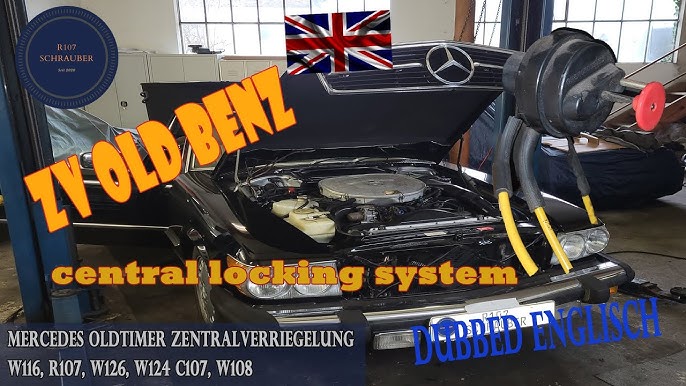
The Mercedes central locking system usually fails due to a faulty PSE (Pneumatic System Equipment) pump, a bad door lock actuator, a failed Signal Acquisition Module (SAM), or a weak key fob battery. Start your diagnosis by checking the key fob battery first, then listen for the PSE pump running when you press lock/unlock. If the pump runs but doors don’t respond, the actuators or vacuum lines are the likely culprit.
Why Is My Mercedes Central Locking Not Working?
The central locking system on a Mercedes relies on several electronic and mechanical components communicating in sync. When one link in that chain fails, the entire system can appear dead or behave erratically. In most cases I have diagnosed, the failure traces back to one of five areas: the PSE pump, the door lock actuators, the key fob, the SAM module, or the wiring harness.
What makes Mercedes systems tricky compared to other brands is that they use a combination of vacuum-operated and electronically-actuated locking depending on the model year and chassis. The W203, W210, W220, and older models rely heavily on vacuum-based PSE pumps.
Newer W204, W212, W205, and beyond shifted to electronic actuators controlled through the CAN bus network. Knowing which system your car uses is the first step in accurate diagnosis.
Quick Diagnostic Checklist
- Does the key fob LED light up when you press a button? If not, replace the battery first.
- Can you hear the PSE pump running under the rear seat or in the trunk when you press lock/unlock?
- Do any individual doors lock or unlock while others do not?
- Does the dashboard central locking switch work even when the key fob does not?
- Are there any warning lights or messages on the instrument cluster?
How to Fix a Mercedes PSE Pump Failure
The PSE pump is the heart of the central locking system on vacuum-based Mercedes models. It creates the vacuum pressure needed to lock and unlock the doors, trunk, and fuel flap.
When it fails, nothing in the system responds. The pump is typically located under the rear seat on the driver’s side or in the trunk area behind the left panel.
Symptoms of a Bad PSE Pump
- No response from any door when pressing the key fob or interior switch.
- A faint humming or clicking noise from under the rear seat with no door action.
- Intermittent operation where some doors work and others do not.
- Trunk and fuel flap also fail to operate alongside the doors.
How to Diagnose and Replace the PSE Pump
- Remove the rear seat cushion by pulling up on the front edge clips.
- Locate the PSE pump unit, which has multiple vacuum lines running to it.
- Disconnect the electrical connector and test for 12V power at the plug with a multimeter when the lock button is pressed.
- If power is present but the pump does not run, the pump motor has failed internally.
- Remove the vacuum lines one by one and label them so you do not mix them up during reassembly.
- Unbolt the pump bracket and install the replacement unit.
- Reconnect all vacuum lines and the electrical connector, then test every door, the trunk, and the fuel flap.
Many PSE pumps fail because water intrusion corrodes the motor brushes. Check the drain area around the pump housing for moisture and seal any leaks before installing the new unit, or the same failure will repeat within months.
Mercedes Door Lock Actuator Failure Symptoms and Fix
When only one or two doors stop responding while the rest of the system works normally, the individual door lock actuator is almost always the problem. The actuator is a small motor inside the door that physically moves the lock mechanism. These motors wear out over time, especially on high-mileage W203, W211, and W220 models.
How to Confirm a Bad Actuator
- Remove the door panel and disconnect the actuator connector.
- Apply 12V directly to the actuator motor terminals. If it does not move, it is dead.
- Check the wiring from the actuator back to the SAM connector for continuity and damage.
Actuator Replacement by Model
Mercedes Key Fob Not Working With Central Locking
A dead or failing key fob is the most overlooked cause of central locking problems. Before tearing into door panels or replacing modules, always test the key fob itself. The infrared or radio frequency signal from the fob must reach the antenna module in the car to trigger the locking system.
Steps to Test and Fix Key Fob Issues
- Replace the key fob battery with a fresh CR2025 or CR2032, depending on your key type.
- Hold the fob close to the infrared receiver on the driver’s door handle and press the button. If it works up close but not from a distance, the fob signal is weak.
- Try your spare key fob. If the spare works, the primary fob needs replacement or reprogramming.
- On older models, re-sync the fob by inserting it into the ignition, turning to position two, and pressing the lock button for five seconds.
SAM Module Failure Causing Central Locking Problems
The Signal Acquisition Module acts as the communication hub between the key fob, the door switches, and the locking actuators. When the SAM fails or develops internal faults, it can cause the entire central locking system to go dead or behave unpredictably. Water leaking through the cabin filter housing on W203 and W211 models is a notorious cause of SAM corrosion.
Signs the SAM Is the Problem
- Multiple unrelated electrical issues alongside central locking failure, such as turn signals, wipers, or interior lighting acting up.
- Diagnostic scan tools show communication errors with the SAM module.
- Visible corrosion or water stains on the SAM connector when inspected.
What to Do About a Bad SAM
Remove the SAM module from its housing, usually located in the passenger footwell or under the hood near the fuse box. Inspect the connector pins for green corrosion.
Clean the pins with electrical contact cleaner and a small brush. If corrosion is severe, the SAM must be replaced and coded to the vehicle using a Mercedes-compatible diagnostic tool like Xentry or iCarsoft MB.
Wiring Harness Damage in Mercedes Central Locking
The wiring that runs from the body to each door passes through a rubber boot at the door hinge area. Over years of opening and closing, these wires fatigue and break inside the insulation where you cannot see the damage. This is extremely common on the driver’s door because it gets the most use.
How to Find and Repair Broken Door Wires
- Pull back the rubber boot between the door and the body at the hinge area.
- Flex each wire individually. A broken wire will feel soft or separate when bent.
- Strip back the insulation on both sides of the break, solder a repair wire, and insulate with heat shrink tubing.
- Secure the repaired harness with zip ties to reduce future stress on the solder joints.
Frequently Asked Questions
Can a weak car battery cause Mercedes central locking to stop working?
Yes. A weak or dying car battery can cause insufficient voltage to reach the SAM and PSE pump, resulting in non-responsive central locking. If your central locking started acting up alongside slow cranking or dim lights, have the battery and alternator tested before replacing any locking components.
Why do my Mercedes doors lock but will not unlock?
This usually points to a partially failing actuator or a vacuum leak on the unlock side of the PSE system. The lock and unlock circuits sometimes use different diaphragms or valve positions inside the pump, so one direction can fail independently of the other.
How much does it cost to fix Mercedes central locking at a dealership?
Dealerships typically quote between 400 and 1200 dollars depending on the root cause, with PSE pump replacement on the higher end. Independent Mercedes specialists often charge 30 to 50 percent less for the same repair using OEM or quality aftermarket parts.
Is it safe to drive with a malfunctioning central locking system?
Yes, the vehicle remains safe to drive. However, you may not be able to lock all doors simultaneously, which is a security concern. Use the manual key blade inside the fob to lock the driver’s door as a temporary measure until the repair is completed.
Will a Mercedes central locking fault clear on its own?
No. Unlike some engine management codes that can self-clear, central locking faults are almost always caused by a physical component failure that requires actual repair. Waiting will not fix the problem, and in the case of water intrusion issues, the damage will only get worse over time.
Take Control of Your Mercedes Central Locking Repair
Do not let a dealership scare you into a full system replacement when only one component has failed. Start with the simplest checks like the key fob battery and work your way through the system methodically.
Most Mercedes central locking repairs are straightforward once you identify the exact failure point, and many can be done in your own garage with basic tools and a multimeter. Save yourself the diagnostic fee and the markup by understanding exactly how the system works before you hand over your keys to anyone else.
Leave a Reply