
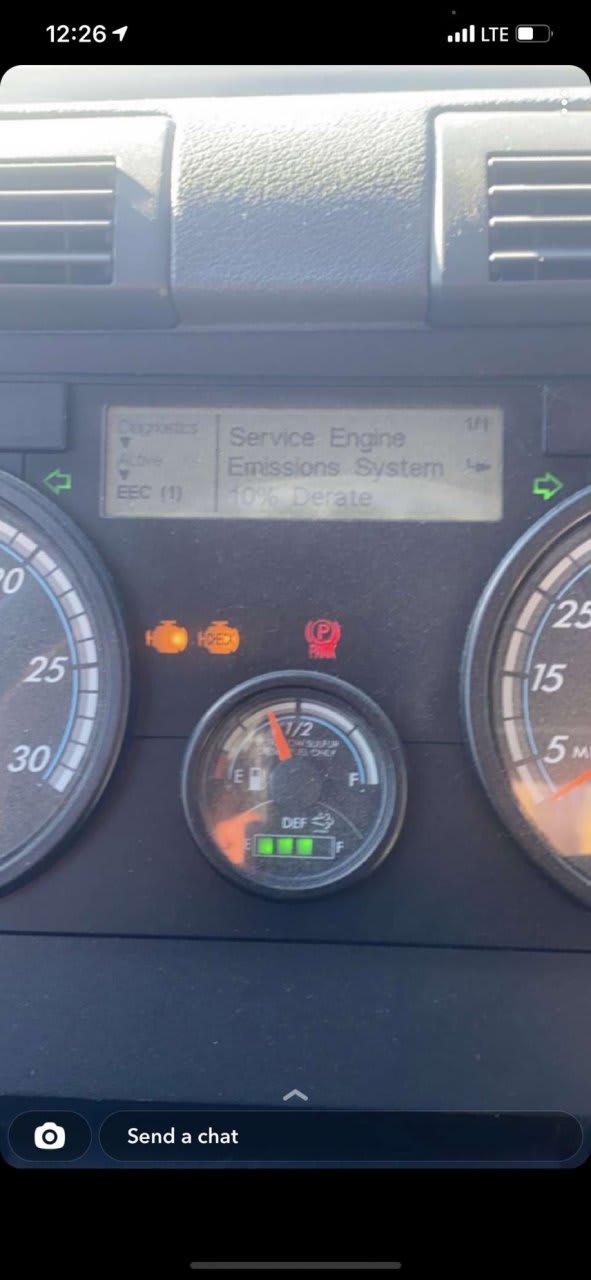
If your diesel truck is showing “Service Emissions System” with a 25% derate, the most common causes are DEF quality issues, a failing NOx sensor, a clogged DEF injector, or SCR catalyst degradation. Start by checking your DEF concentration with a refractometer—if it reads below 32.5%, drain and refill with fresh DEF before spending money on parts.
What Does “Service Emissions System 25 Derate” Mean on a Diesel Truck?
This warning means your truck’s ECM has detected a fault in the emissions system and has intentionally reduced engine power to approximately 25% of its normal output. You will feel a massive loss of acceleration, and towing becomes nearly impossible.
The derate is a federally mandated failsafe. It is designed to force you into repairing the emissions system instead of ignoring it. Most trucks give you a countdown—a certain number of key cycles or miles—before the derate locks in permanently.
This message is most commonly reported on GM Duramax L5P and LML engines, Ford 6.7L Powerstroke, and Ram Cummins 6.7L trucks. However, the diagnostic approach and root causes differ slightly by manufacturer.
Which Trucks Are Most Affected?
- 2017–2024 GM Silverado/Sierra 2500/3500 (L5P Duramax) – Most frequently reported. The DEF system on these trucks is notoriously sensitive to DEF quality and sensor calibration.
- 2011–2016 GM Silverado/Sierra (LML Duramax) – Common NOx sensor failures trigger the derate.
- 2011–2024 Ford F-250/F-350 (6.7L Powerstroke) – DEF injector crystallization and SCR catalyst faults are the usual suspects.
- 2013–2024 Ram 2500/3500 (Cummins 6.7L) – Often tied to DEF heater failures and NOx sensor drift.
What Causes the 25% Derate in the Emissions System?
There are multiple failure points in the emissions system that can trigger this derate. In my experience diagnosing these trucks, the fault almost always traces back to one of six areas. Do not throw parts at it—read the codes first, then work through these causes in order.
1. DEF Quality or Concentration Problem
This is the single most overlooked cause. DEF (Diesel Exhaust Fluid) degrades over time, especially if stored in heat or direct sunlight. Old or contaminated DEF has a concentration below the required 32.5% urea, and the ECM will flag it.
- Buy a DEF refractometer (under $30) and test your fluid. It should read 32.5% ±0.5.
- If it reads below 32%, drain the DEF tank completely and refill with fresh, name-brand DEF (Blue Peak, Peak Blue DEF, or OEM branded fluid).
- Never buy DEF that has been sitting on a store shelf in direct sunlight or extreme heat.
- DEF has a shelf life of about 12 months when stored properly at temperatures below 86°F.
2. NOx Sensor Failure (Upstream or Downstream)
NOx sensors measure nitrogen oxide levels before and after the SCR catalyst. When they fail or drift out of calibration, the ECM cannot verify that the emissions system is working correctly and triggers the derate.
On the L5P Duramax, the downstream NOx sensor (Sensor 2) fails far more often than the upstream. On Ford 6.7 trucks, both sensors are known failure points after 80,000–120,000 miles.
- Pull diagnostic codes with an OBD-II scanner that reads manufacturer-specific codes (not just generic P-codes).
- Look for P2201, P2202, P2213, P2214, P229E, or P2BAD depending on your truck.
- Compare NOx sensor readings at idle. The downstream sensor should read significantly lower than the upstream. If both read nearly the same, the downstream sensor is likely faulty.
- Dealerships typically charge $800–$1,200 per sensor installed. Aftermarket sensors run $150–$350 and are a viable option if you can do the install yourself.
3. DEF Injector Crystallization or Clogging
The DEF injector (also called the dosing module or reductant injector) sprays DEF into the exhaust stream upstream of the SCR catalyst. Over time, urea crystals build up on the injector tip and inside the nozzle, restricting or blocking flow.
- Remove the DEF injector and inspect the tip. White crystalline buildup is the telltale sign.
- Soak the tip in hot distilled water for 30 minutes and use a soft brush to remove deposits. Do not use a wire brush or pick—you will damage the spray pattern.
- If cleaning does not restore flow, replace the injector. On the L5P, the part is around $150–$250.
- After replacement or cleaning, perform a DEF dosing test with a scan tool to verify proper spray volume and pattern.
4. SCR Catalyst Degradation
The SCR (Selective Catalytic Reduction) catalyst converts NOx into harmless nitrogen and water using DEF. If the catalyst substrate is contaminated with coolant, oil, or excessive soot, it loses efficiency.
This is a less common cause but is often the first thing dealerships blame because it is the most expensive to replace ($2,500–$4,500 for the part alone).
- Before replacing the SCR, verify that NOx conversion efficiency is below threshold using a scan tool that reads live SCR data.
- Check for upstream causes—coolant leaks into the exhaust (head gasket, EGR cooler), oil consumption, or repeated DPF regen failures that dump excessive fuel into the exhaust.
- Some independent shops can perform an SCR efficiency reset after cleaning, which may buy you time if the catalyst is only partially degraded.
5. DPF (Diesel Particulate Filter) Issues
A clogged or failing DPF can indirectly trigger the 25% derate. When the DPF cannot regenerate properly, soot loading increases, exhaust backpressure rises, and the entire aftertreatment system is affected.
- Check soot loading percentage with a scan tool. Anything above 80% requires a forced regen or professional cleaning.
- If the DPF will not complete a forced regen, it may need professional baking and ash cleaning ($300–$600 at a diesel specialty shop).
- Watch for cracked DPF substrate—this often happens after multiple failed regen attempts where excessive fuel is injected.
6. DEF Heater or Supply Line Failure
In cold climates, the DEF heater keeps the fluid from freezing (DEF freezes at 12°F / -11°C). If the heater fails, the ECM cannot inject DEF, and the derate kicks in.
- Check for codes related to the DEF heater circuit (P205B, P205C, or P205D on GM trucks).
- Inspect the DEF supply line for ice blockages if you are in freezing temperatures.
- On Ram Cummins trucks, the DEF tank heater assembly is a common failure item and costs $200–$400 for the part.
How to Diagnose the 25 Derate Step by Step
Follow this diagnostic sequence before spending money on parts. I have seen owners replace $2,000 worth of sensors when the problem was $20 worth of bad DEF.
- Read all codes. Use a quality scan tool—Foxwell NT510 Elite, Autel MaxiCOM, or dealer-level tool. Generic code readers miss manufacturer-specific emissions codes.
- Check DEF quality. Use a refractometer. Replace if below 32%.
- Inspect the DEF injector. Remove, clean, or replace if crystallized.
- Test NOx sensor readings. Compare upstream vs. downstream at idle and at 2,000 RPM.
- Check SCR conversion efficiency. A healthy SCR should show 90%+ NOx conversion.
- Inspect DPF soot loading. Force a regen if above 80%. Clean or replace if regen fails.
- Check DEF heater and supply lines. Especially in cold-weather climates.
| Cause | Likelihood | DIY Fix? | Est. Cost |
|---|---|---|---|
| Bad DEF quality | Very High | Yes | $15–$30 |
| NOx sensor failure | High | Moderate | $150–$1,200 |
| DEF injector clogged | High | Yes | $0–$250 |
| SCR catalyst degraded | Moderate | No (shop needed) | $2,500–$4,500 |
| DPF clogged | Moderate | Moderate | $300–$1,500 |
| DEF heater failure | Low–Moderate | Moderate | $200–$500 |
How Dealerships and Shops Overquote This Repair
Dealerships frequently quote $3,000–$6,000 for emissions derate repairs because they default to replacing the SCR catalyst and both NOx sensors as a package. This is the “shotgun approach”—throw everything at it and hope it works.
In reality, more than half of the 25 derate cases I have seen resolve with a DEF drain-and-refill, a cleaned injector, or a single sensor replacement. Always get a second opinion from a diesel-specialty independent shop if the dealer quote seems excessive.
Pro Tip: Ask the shop or dealer to show you the live SCR efficiency data and NOx sensor readings before authorizing any major repair. If they cannot show you the data, they are guessing.
How to Clear the 25% Derate After Repair
After fixing the root cause, the derate does not always clear immediately. Here is what to do:
- Clear all codes with a scan tool. Do not just disconnect the battery—this does not clear emissions-related codes on modern diesels.
- Drive the truck through a complete drive cycle. This includes city driving, highway driving, and at least one complete DPF regen cycle.
- Monitor SCR efficiency. The ECM needs to see consistent NOx conversion above the threshold for multiple drive cycles before it removes the derate.
- If the derate persists, the ECM may need a software reflash at the dealer. Some L5P trucks have updated calibration files that adjust the derate thresholds.
FAQ
Can I drive my truck with the 25% derate?
Technically yes, but it is not recommended. The truck has almost no passing power, struggles on hills, and towing is dangerous. More importantly, continued driving with an unresolved emissions fault can cause additional damage to the SCR catalyst and DPF, turning a $300 repair into a $3,000 one.
Will deleting the emissions system fix the 25 derate permanently?
Deleting the emissions system eliminates the derate but is a federal violation under the Clean Air Act. It is illegal to tamper with or remove emissions equipment on any vehicle driven on public roads. Fines can reach $4,500 per violation for individuals and significantly more for shops that perform the work.
How long do I have before the derate becomes permanent?
Most trucks give you a countdown—typically 100 to 200 miles or a set number of key cycles (usually 5–7). Once the countdown expires, the truck drops to a crawl speed (5 mph on some models). Fix it before the countdown ends.
Does the dealer warranty cover the 25 derate repair?
If your truck is under the federal emissions warranty (8 years/80,000 miles for major emissions components), many of these repairs are covered. The SCR catalyst, NOx sensors, DEF injector, and DPF often fall under this extended warranty. Always check your warranty status before paying out of pocket.
Why does my truck keep going into derate even after I fixed it?
Recurring derates usually mean either the root cause was not fully addressed, or there is a secondary fault that was masked. Common examples include a cleaned DEF injector that still has restricted internal passages, or a NOx sensor that tests good at idle but fails under load. Run a complete SCR system test with a professional scan tool to catch intermittent faults.
Final Word: Fix It Right the First Time
The 25% emissions derate is frustrating, but it is almost always fixable without a four-figure repair bill if you diagnose it correctly. Start with the cheapest and most common causes—DEF quality and the injector—before moving to sensors and catalysts.
Read the codes, verify with live data, and do not let anyone pressure you into a full aftertreatment replacement without showing you proof that it is needed. Your truck and your wallet will thank you.
Leave a Reply