
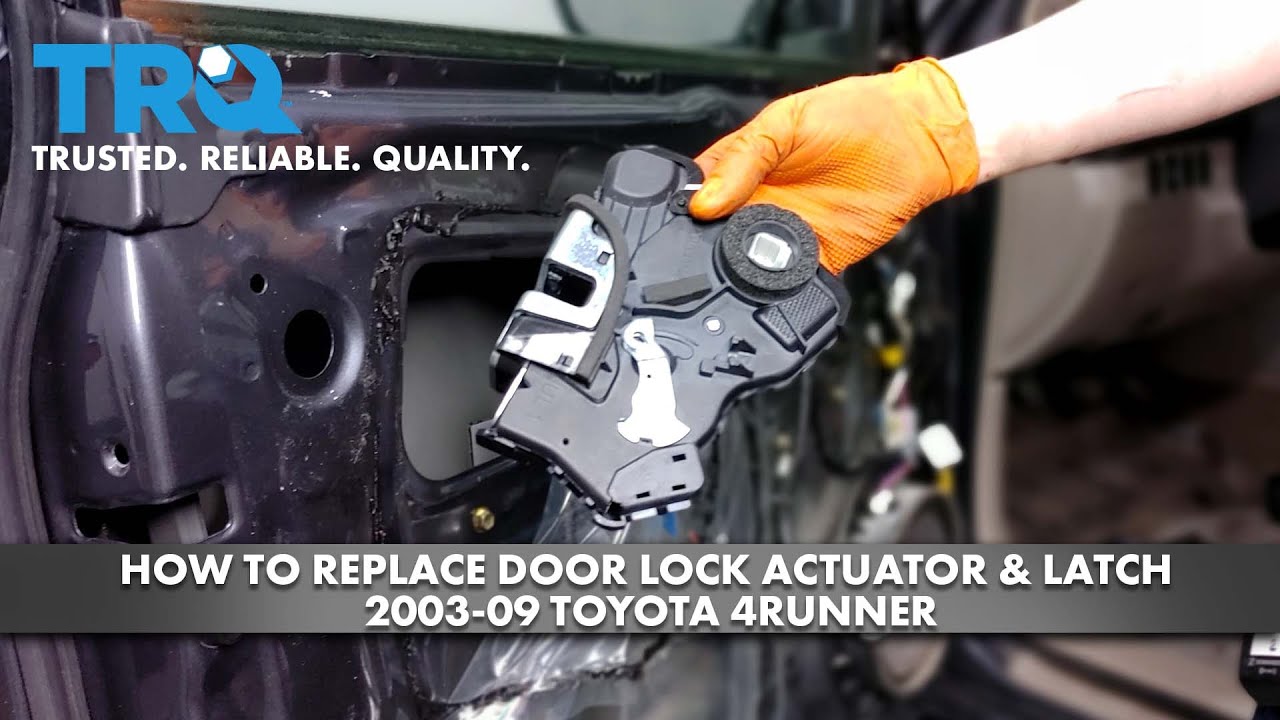
The most common Toyota 4Runner door lock problem is a failed door lock actuator, especially on 4th generation (2003-2009) and 5th generation (2010-2024) models. Symptoms include locks that won’t unlock with the key fob, locks that cycle erratically, or a single door that stops responding to the central locking system. Replacing the actuator typically costs $40-$80 for the part if you DIY, versus $250-$400 at a dealership.
If your 4Runner is acting up with door locks, you are far from alone. This is one of the most widely reported electrical complaints across nearly every generation of the Toyota 4Runner. After working through hundreds of these complaints across forums, dealership tech reports, and owner feedback, the pattern is clear: most of these failures are predictable, diagnosable at home, and fixable without a trip to the dealer.
Why Do Toyota 4Runner Door Lock Actuators Fail So Often?
Toyota 4Runner door lock actuators fail because the small internal electric motor wears out over time, the nylon gears inside strip, and the grease inside dries up and creates resistance. This is a known weakness across the 4th gen (2003-2009) and 5th gen (2010-2024) models and is not related to how you use your locks.
The actuator is a small motorized unit embedded inside each door. It receives an electrical signal from the body control module (BCM) and physically moves the lock rod up or down. Over years of use, the internal motor brushes wear, the commutator gets dirty, and the small plastic gears crack or strip.
Symptoms of a Failing Door Lock Actuator
- One door does not lock or unlock with the key fob or the interior switch while all other doors work fine.
- The lock moves slowly or labors, making a weak clicking or grinding noise before it finally locks.
- The lock cycles repeatedly on its own, locking and unlocking without you pressing anything.
- The lock works intermittently, sometimes responding and sometimes staying dead, often temperature-dependent.
- A buzzing or whirring sound comes from inside the door when you press lock or unlock.
How to Confirm It Is the Actuator and Not Something Else
Before you spend money on parts, you need to rule out other causes. Here is the diagnostic sequence that actually works:
- Test the driver’s master switch. If the master switch on the driver’s door panel does not control a specific door lock, but the individual door switch does, your master switch is the problem, not the actuator.
- Swap the suspect actuator with a known good door. If the problem follows the actuator, the actuator is bad. If the problem stays at the same door position, you likely have a wiring issue.
- Check for voltage at the actuator connector. Use a multimeter at the actuator plug. If you get 12V when pressing lock/unlock, the actuator is bad. If you get nothing, trace the wiring back.
- Listen for the relay click. Press lock and listen near the fuse box under the dash. If you hear the relay click but the door does not respond, the signal path is intact and the actuator is the failure point.
Which Toyota 4Runner Years Have the Worst Door Lock Problems?
The 4th generation 4Runner (2003-2009) has the highest volume of door lock complaints, followed closely by the 5th generation (2010-2024). The 3rd generation (1996-2002) has fewer actuator failures but is more prone to relay and wiring issues.
4th Generation (2003-2009) – The Worst Offender
This generation uses a combined actuator and latch assembly, meaning you cannot just replace the small motor. Toyota designed it as a single unit, which makes the OEM replacement expensive. Many owners on forums report multiple doors failing within the same 2-3 year window, starting around 80,000-120,000 miles.
The rear hatch lock actuator on the 4th gen is especially problematic. It tends to fail before the side doors, and when it does, you lose access to the rear cargo area unless you use the manual key cylinder, which many owners forget exists.
5th Generation (2010-2024) – Smarter System, Same Weak Motor
The 5th gen 4Runner moved to a smart key system with push-button start on most trims. The door lock actuators still use the same basic internal motor design, and they still fail. However, this generation added a new wrinkle: the smart key antenna system can mimic actuator failure symptoms.
If your 5th gen 4Runner door locks work with the interior switch but not with the key fob, do not assume the actuator is bad. The issue could be the smart key antenna in the door handle or a weak fob battery. Test the fob battery first and try holding the fob directly against the door handle.
3rd Generation (1996-2002) – Relay and Wiring Problems
The 3rd gen uses separate actuators that are more durable, but the door lock relay under the dash is a known weak point. When this relay fails, all four doors stop responding to the central lock simultaneously. The fix is a $15-$30 relay replacement from any auto parts store.
Comparison Table: 4Runner Door Lock Problems by Generation
| Generation | Years | Most Common Issue | Average Failure Mileage | DIY Part Cost |
|---|---|---|---|---|
| 3rd Gen | 1996-2002 | Door lock relay failure | 100,000-150,000 | $15-$30 (relay) |
| 4th Gen | 2003-2009 | Actuator motor failure (all doors) | 80,000-120,000 | $40-$80 per door |
| 5th Gen | 2010-2024 | Actuator failure + smart key antenna | 90,000-130,000 | $50-$90 per door |
How to Replace a Toyota 4Runner Door Lock Actuator at Home
You can replace a 4Runner door lock actuator in your driveway with basic hand tools in about 45-90 minutes per door. You will need a Phillips screwdriver, a 10mm socket, a trim removal tool, and a replacement actuator.
Tools and Parts You Need
- Replacement door lock actuator (OEM part number varies by door position and year)
- Phillips screwdriver set
- 10mm socket and ratchet
- Plastic trim removal tools
- Painter’s tape (to protect the door panel)
- Electrical contact cleaner (optional but recommended)
Step-by-Step Process for 4th and 5th Gen 4Runners
- Disconnect the negative battery terminal. This prevents accidental airbag triggers and electrical shorts while you work inside the door.
- Remove the door panel. Pop the trim pieces around the interior door handle and armrest. Remove the screws hidden underneath. Use the trim tool to release the plastic clips around the perimeter. Lift the panel up and off.
- Peel back the vapor barrier. This is the plastic sheet glued to the inside of the door. Carefully pull it back without tearing it. You will need to reseal it later.
- Disconnect the actuator wiring harness. Locate the connector near the door latch area. Press the release tab and unplug it.
- Remove the door latch assembly. The actuator is built into the latch on most 4Runners. Remove the three 10mm bolts holding the latch to the door. You may need to disconnect the lock rod clips first.
- Transfer the rods and clips. If your new actuator does not come with the lock rods attached, transfer them from the old unit. Pay attention to the clip orientation.
- Install the new assembly. Bolt it back in, reconnect the harness, and reconnect the battery to test before reassembling everything.
- Reassemble. Reattach the vapor barrier with fresh tape or adhesive, then snap the door panel back on.
Can a Bad Door Lock Relay Cause All 4Runner Door Locks to Stop Working?
Yes. If all four door locks and the rear hatch lock stop responding at the same time, the door lock relay is the most likely cause, especially on 3rd generation 4Runners. A single failed actuator will only affect one door.
The door lock relay is typically located in the fuse box under the driver’s side dashboard. On the 3rd gen, it is a small cube-style relay.
You can test it by swapping it with an identical relay from another slot in the fuse box, such as the horn relay. If the locks start working and the horn stops, the relay is confirmed bad.
How to Find and Replace the Door Lock Relay
- Open the fuse box cover under the driver’s dash and look at the diagram printed on the inside of the cover.
- Locate the relay labeled “DOOR LOCK” or check your owner’s manual for the exact position.
- Pull the relay straight out. It may be tight, so rock it gently side to side.
- Push the new relay into the same slot until it clicks.
- Test all door locks with the key fob and interior switch.
Why Does My 4Runner Door Lock Work With the Key but Not the Remote?
If your 4Runner door lock works with the physical key in the cylinder but not with the remote or interior switch, the problem is usually electrical, not mechanical. This points to a failed actuator motor, a bad relay, or a wiring break in the door jamb harness.
Check the Door Jamb Wiring Harness
This is one of the most overlooked causes of 4Runner door lock problems. The wiring that runs from the body into each door passes through a rubber boot in the door jamb. Over years of opening and closing the door, these wires flex and eventually break internally, even though the insulation looks fine from the outside.
- Pull back the rubber boot on the door jamb of the affected door.
- Flex each wire gently while someone operates the lock switch. If the lock responds when you move a specific wire, you have found a broken conductor.
- Repair by splicing in a new section of wire with solder and heat shrink. Do not just twist and tape. That will fail again within months.
Check the Key Fob Battery and Programming
On 5th gen 4Runners with smart key systems, a weak fob battery will cause the remote lock to fail while the interior switch still works. Replace the CR2016 or CR2032 battery in the fob first. If that does not fix it, try reprogramming the fob using the ignition cycle method described in your owner’s manual.
How Much Does It Cost to Fix 4Runner Door Lock Problems?
DIY repair of a Toyota 4Runner door lock actuator costs between $40 and $90 per door for the part. A dealership will charge $250-$400 per door including labor. An independent shop typically charges $150-$250 per door.
Cost Comparison Table
| Repair Type | DIY Cost | Independent Shop | Dealership |
|---|---|---|---|
| Single actuator replacement | $40-$90 | $150-$250 | $250-$400 |
| Door lock relay replacement | $15-$30 | $60-$100 | $100-$150 |
| Door jamb wiring repair | $5-$15 | $80-$150 | $150-$250 |
| Master door lock switch | $50-$120 | $150-$250 | $250-$400 |
| All four doors + tailgate actuators | $200-$450 | $600-$1,000 | $1,200-$1,800 |
Aftermarket actuators are available for as low as $15-$25 per door on sites like RockAuto and Amazon. Many owners report that aftermarket units work just fine and last several years.
However, OEM Toyota actuators tend to have a longer lifespan and a more precise fit. The choice depends on your budget and how long you plan to keep the truck.
Frequently Asked Questions About Toyota 4Runner Door Lock Problems
Will a failing door lock actuator drain my 4Runner battery?
Yes, it can. When an actuator motor gets stuck or the internal circuit stays energized, it draws continuous power even when the truck is off.
If you notice your 4Runner battery dying overnight and you have door lock issues, pull the door lock fuse temporarily to confirm. If the battery stops draining, the actuator is parasitically drawing current and needs replacement.
Can I drive my 4Runner with a broken door lock actuator?
You can drive safely with a broken actuator, but the affected door will not lock with the central system. You can still lock it manually with the key from outside or by pushing the interior lock button by hand. Just be aware that the alarm system may not arm correctly if a door is not registering as locked.
Is the 4Runner tailgate lock actuator the same as the door actuators?
No. The rear hatch or tailgate lock actuator is a different part number and is not interchangeable with the side door actuators. On 4th gen 4Runners, the tailgate actuator is a particularly common failure point and tends to go out before the side doors do.
Why do my 4Runner door locks click but not actually lock?
This happens when the actuator motor has enough power to move the internal mechanism but not enough to fully engage the lock rod. It is a classic sign of a motor that is on its last legs.
The internal brushes are worn and the motor can no longer generate enough torque. Replace the actuator soon because it will stop working entirely within weeks.
Does the Toyota 4Runner have a door lock recall?
Toyota has not issued a widespread recall specifically for 4Runner door lock actuators. There have been Technical Service Bulletins (TSBs) related to door lock and smart key system behavior on certain model years, but these typically address software issues in the body control module rather than the physical actuators. Check with your local dealer using your VIN to see if any open TSBs apply to your specific truck.
Can cold weather cause 4Runner door locks to stop working?
Cold weather makes a weak actuator fail faster. The grease inside the latch assembly thickens in cold temperatures, adding resistance to an already struggling motor.
If your locks work fine in summer but fail or slow down in winter, the actuator is failing and the cold is just exposing the weakness. It will fail in warm weather eventually too.
Fix Your 4Runner Door Locks Once and Move On
Toyota 4Runner door lock problems are annoying but not complicated. The actuator is the number one culprit across nearly every generation, and replacing it is one of the most straightforward DIY repairs you can do on this truck.
Diagnose properly before buying parts, do not let a dealership talk you into replacing the entire door latch assembly if only the actuator motor is available separately for your year, and do not ignore wiring issues in the door jamb. Fix the root cause, not just the symptom, and your locks will work like new for another 100,000 miles.
Leave a Reply