
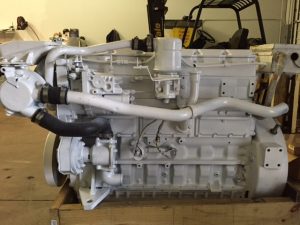
The Caterpillar 3208 is a 10.4-liter V8 diesel engine with bore and stroke of 4.5 by 5.0 inches, compression ratios from 16.5:1 to 17.5:1, and factory horsepower ratings spanning 150 to 375 depending on the application and turbo setup.
What are the exact displacement, bore, stroke, and compression specs for a 3208 Cat engine?
The 3208 displaces exactly 636 cubic inches or 10.4 liters as a 90-degree V8. Bore measures 4.5 inches and stroke measures 5.0 inches across all production versions.
Compression ratio starts at 16.5:1 on naturally aspirated models. It rises to 17.5:1 on later turbocharged versions used in marine and industrial ratings.
These dimensions remained consistent from the engine’s introduction in the mid-1970s through the final production runs in the early 2000s. Owners can confirm displacement by measuring cylinder bore with a dial bore gauge and verifying stroke via the crankshaft throw.
Aftermarket rebuild kits list the same 4.5 by 5.0 specification. Any deviation usually indicates a prior sleeving job or non-standard repair.
Block and crankshaft material details
The block uses a one-piece cast-iron construction with siamesed cylinders that limit overboring to 0.060 inches maximum. The crankshaft is forged steel with five main bearings.
The rear seal commonly leaks after 300,000 miles when the rope seal dries out. Replacement cranks must match the 5.0-inch stroke exactly or piston-to-valve clearance will be lost.
Which horsepower and torque ratings were offered on the 3208 Caterpillar engine?
Factory ratings ranged from 150 horsepower at 2,200 rpm in early truck versions up to 375 horsepower at 2,800 rpm in later marine configurations. Torque output typically fell between 480 and 950 lb-ft depending on the fuel setting and turbocharger.
Most on-highway truck engines carried 210- to 250-horsepower ratings. These units generally produced between 650 to 750 lb-ft of torque.
Dealerships often misquote ratings because they read the wrong data plate. The engine serial number prefix determines the original rating.
An 02Z prefix usually indicates a 225-horsepower truck engine while 75Z prefixes cover higher-output industrial versions. Always cross-reference the serial number against Caterpillar’s service information before ordering parts.
Rating variations by application
- ➤ Truck and bus versions: Stayed between 150-300 horsepower with mechanical governors.
- ➤ Marine versions: Reached 375 horsepower with aftercoolers and different injector timing.
- ➤ Agricultural and genset units: Often used 210-horsepower settings with continuous-duty fuel stops.
How does the 3208 Cat engine fuel system and injection pump work?
The engine uses a Caterpillar sleeve-metering fuel pump driven off the front gear train. Fuel delivery is controlled by a mechanical governor that senses engine speed through flyweights.
Injectors are pencil-type with a 0.009-inch orifice on most truck ratings. Marine versions use larger 0.011-inch tips for increased fuel flow.
Timing advance occurs through a centrifugal mechanism inside the pump. When the advance mechanism sticks, owners notice hard starting and smoke at idle.
Rebuilding the pump requires setting the fuel rack to the exact millimeter specification stamped on the data plate. This is usually between 8.2 and 9.5 mm depending on horsepower.
Common fuel system service steps
- Inspect the rack: Remove the fuel shutoff solenoid and check for free movement.
- Check transfer pump: Verify output pressure at the pump inlet; it should read 20-30 psi at cranking speed.
- Verify injectors: Check injector pop pressure at 2,800 psi on a test bench before reinstallation.
- Adjust high-idle: Reset the high-idle screw only after confirming the rack travel matches the original rating.
What are the real-world oil capacity, coolant capacity, and maintenance intervals for the 3208?
| Specification | Capacity / Interval |
|---|---|
| Oil Capacity (Dry) | 22 Quarts (Truck) / 28 Quarts (Marine) |
| Coolant Capacity | 32 Quarts (Average) |
| Oil Change Interval | 250 – 300 Hours |
Caterpillar originally recommended 250-hour oil changes. Many fleets extended this to 300 hours with synthetic 15W-40 when operating temperatures stayed below 210 degrees Fahrenheit.
The oil cooler is a common failure point. Restricted cores raise oil temperature and accelerate bearing wear.
Independent shops frequently overlook the cooler during service. They often mistakenly blame the turbo for issues caused by high oil temperatures.
Which common OEM weaknesses appear repeatedly on 3208 engines in the field?
The front crankshaft seal leaks on nearly every engine past 250,000 miles. This occurs because the original rope seal hardens over time.
Cylinder head gaskets fail when the block deck is not resurfaced during overhaul. This is especially prevalent on 300-plus horsepower ratings.
The aftercooler on marine engines corrodes from the inside when raw water treatment is neglected. This leads to coolant contamination in the oil.
Dealerships often recommend full engine replacement when only the sleeve metering pump needs calibration. Independent shops familiar with the platform can usually restore original power for less than half the cost.
How do owners verify correct 3208 Cat engine specifications on their own unit?
Locate the engine data plate on the valve cover or front timing cover. Record the serial number prefix and arrange number, then compare against Caterpillar’s published rating charts.
Measure valve lash at 0.015 inches intake and 0.025 inches exhaust on a warm engine. This confirms the cylinder head matches the published specification.
Finally, check the fuel pump data plate for the rack setting to confirm horsepower output. These checks prevent ordering the wrong parts and avoid common misdiagnosis.
FAQ
Can the 3208 Cat engine be converted from naturally aspirated to turbocharged?
Yes, but the conversion requires a different cylinder head casting, upgraded injectors, and a recalibrated fuel pump to avoid detonation. The block itself accepts the turbo manifold without modification on most serial numbers.
What is the typical lifespan of a 3208 engine before overhaul?
Well-maintained units reach 400,000 to 500,000 miles in trucking service. Marine applications often require overhaul between 8,000 and 12,000 hours when raw-water cooling is properly treated.
Are aftermarket performance parts available for the 3208?
Limited aftermarket support exists. Most upgrades involve larger injectors and pump recalibration rather than bolt-on turbos, because the siamesed cylinder design limits boost levels before cracking occurs.
Does the 3208 require special tools for injection timing?
A Caterpillar timing fixture and dial indicator are required to set the pump accurately. Generic timing lights will not produce the correct fuel delivery curve.
Accurate specifications allow owners to diagnose power loss, order correct parts, and avoid costly misdiagnosis at both dealerships and independent shops. Verifying bore, stroke, fuel settings, and serial number data on every service interval keeps the engine operating at its designed output for the longest possible service life.
Leave a Reply