
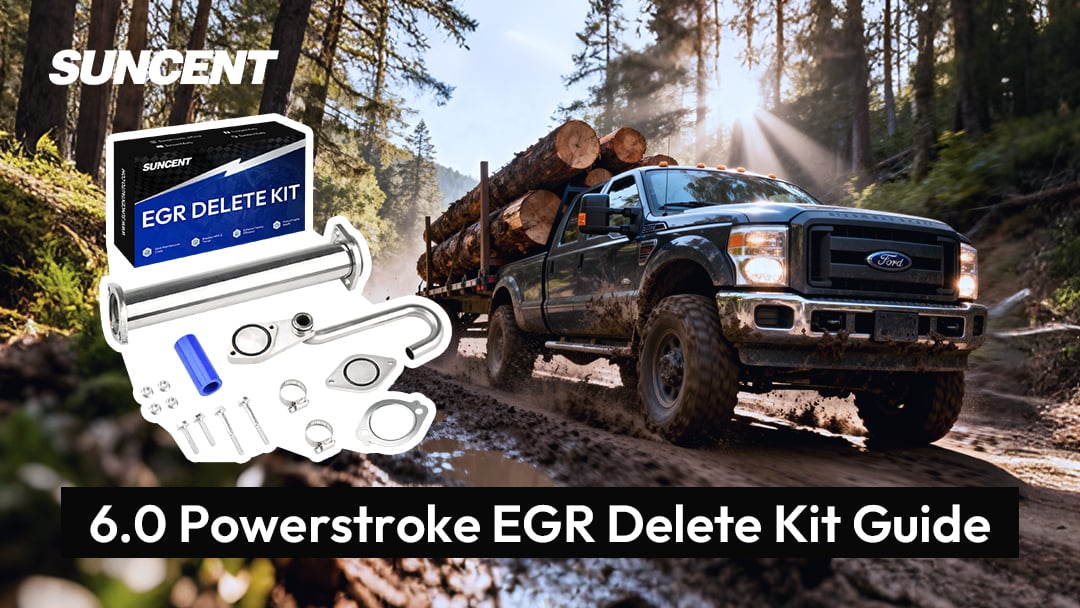
A 6.0 Powerstroke EGR delete removes the exhaust gas recirculation (EGR) valve and cooler from the engine, eliminating a system that is one of the most notorious failure points on the 6.0L Ford Powerstroke diesel. The delete prevents coolant contamination, reduces soot buildup in the intake, lowers engine temperatures, and significantly improves long-term reliability. It typically requires an EGR delete kit, a coolant bypass hose, and an ECM tuner or custom tune to prevent check engine lights and limp mode.
What Is a 6.0 Powerstroke EGR Delete and Why Do Owners Do It?
The EGR system on the 6.0 Powerstroke routes a portion of exhaust gases back into the intake manifold to lower combustion temperatures and reduce NOx emissions. On paper, it is an emissions compliance device. In practice, it is the single most problematic system on this engine.
The factory EGR cooler is a small heat exchanger mounted on top of the engine. Over time, it cracks internally, allowing coolant to leak into the exhaust stream or into the cylinders.
When this happens, you get white smoke from the tailpipe, coolant loss with no visible external leak, hydrolocking risk, and head gasket failure. Most 6.0 owners who have dealt with a catastrophic EGR cooler failure wish they had deleted it sooner.
- Eliminates the EGR cooler failure point — the number one cause of coolant loss and head gasket issues on this engine
- Reduces soot recirculation — keeps the intake manifold, turbo vanes, and intercooler cleaner
- Lowers coolant and oil temperatures — the engine no longer ingests hot exhaust gas into the intake
- Improves throttle response and power — cleaner airflow means more efficient combustion
- Reduces long-term maintenance costs — no more repeated EGR valve replacements or cooler replacements
Is an EGR Delete Legal on the 6.0 Powerstroke?
Federally, removing any emissions equipment violates the Clean Air Act. The EGR system is considered an emissions control device, and tampering with it is technically illegal under federal law regardless of your state’s inspection requirements.
However, enforcement varies drastically by state and county. Many states with no emissions testing or no visual inspections will never flag a deleted EGR.
States like California, Colorado, and New York with strict emissions testing may fail your vehicle or refuse registration. Know your local laws before proceeding.
- No-emissions states: Most Southern, Midwestern, and rural states do not test diesel trucks, making the risk of legal consequences practically zero for daily drivers
- Strict-emissions states: California, New York, and a handful of others may visually inspect and require functional EGR for registration
- Resale consideration: A deleted truck may be harder to sell to buyers in strict-emissions states, but in truck-heavy markets, it is often preferred
What Are the Symptoms of a Failing 6.0 Powerstroke EGR Cooler?
A cracked EGR cooler is not a subtle failure. It announces itself with specific symptoms that experienced 6.0 owners learn to recognize immediately. The problem is that many shops misdiagnose these symptoms as head gasket failures and charge thousands more than necessary.
Early Warning Signs
- White smoke from the exhaust on startup or under load — this is coolant being burned in the combustion chamber after leaking through the cracked cooler
- Slow or persistent coolant loss with no visible external leak — the coolant is entering the exhaust or cylinders internally
- Rough idle or misfires on startup — pooled coolant in a cylinder after the truck sits overnight causes a brief misfire until it clears
- Sweet smell from the exhaust — the telltale odor of burned ethylene glycol coolant
- Coolant overflow tank bubbling or puking — exhaust pressure pushes back through the crack into the cooling system
Advanced Failure Signs
- Hydrolocking — enough coolant pools in a cylinder to prevent the piston from completing its stroke; this can bend a connecting rod and destroy the engine
- Oil cooler failure cascade — the EGR cooler and oil cooler share coolant passages; when one fails, the other often follows
- Head gasket failure — repeated thermal cycling from coolant intrusion weakens the head gaskets and eventually causes combustion gas intrusion into the cooling system
What Parts Do You Need for a 6.0 Powerstroke EGR Delete?
You cannot simply remove the EGR cooler and cap the lines. The 6.0 requires specific parts and, critically, an ECM tune to compensate for the removed hardware. Running the truck without a tune after deleting the EGR will trigger codes and potentially put the engine into limp mode.
Essential Parts List
- EGR delete kit — includes the intake elbow replacement, block-off plates, and coolant bypass fittings. Sinister Diesel, Bulletproof Diesel, and H&S Motorsports make the most commonly used kits.
- Coolant bypass hose or fitting — the EGR cooler had coolant flowing through it; you need to reroute that flow with a bypass or block-off
- ECM tuner or custom tune — a programmer from SCT, HP Tuners, or a custom-tuned file from a diesel performance shop to disable EGR-related codes and adjust fueling tables
- New intake gaskets — you will be removing the intake manifold; always use fresh gaskets to prevent boost leaks
- Coolant and fresh oil — if the cooler was actively leaking, you need to flush and refill both systems
How Much Does a 6.0 Powerstroke EGR Delete Cost?
Cost varies significantly depending on whether you do the work yourself or pay a shop. The 6.0 is notoriously labor-intensive for EGR work because of tight engine bay packaging.
Do not let a shop quote you a full head gasket job when the root cause is the EGR cooler. Verify the cooler is cracked first by pressure testing the cooling system and checking for exhaust gases in the coolant using a block tester kit.
Step-by-Step 6.0 Powerstroke EGR Delete Overview
This is a moderately advanced DIY job. If you are comfortable with removing intake components and have basic diesel engine knowledge, you can complete it in a weekend. Plan for 5 to 8 hours depending on your experience.
- Disconnect the batteries and drain the coolant — open the radiator petcock and remove the degas bottle cap to speed draining
- Remove the intake manifold and turbo inlet — you need clear access to the EGR cooler and oil cooler area on top of the engine
- Remove the EGR valve and EGR cooler — unbolt the cooler from the intake and exhaust sides; some kits require you to also remove the EGR cooler adapter plate
- Install the block-off plates and coolant bypass — follow your specific kit instructions; torque all bolts to spec
- Reinstall the intake manifold with new gaskets — ensure all mating surfaces are clean and free of old gasket material
- Flush the cooling system if coolant contamination occurred — run distilled water through the system, drain, and repeat before filling with fresh ELC coolant
- Load the ECM tune — this disables EGR-related diagnostic codes and adjusts fuel mapping to account for the removed recirculation
- Start the engine, bleed the cooling system, and check for leaks — the 6.0 is notorious for trapping air in the cooling system; run the heater on high and squeeze hoses to burp air pockets
Common Mistakes When Deleting the 6.0 Powerstroke EGR
Skipping the Tune
Running a deleted EGR without a tune is the most common mistake. The PCM will throw P0401 and related codes, and in some cases, it will enter limp mode. Get the tune loaded before you drive the truck.
Not Replacing the Oil Cooler at the Same Time
The EGR cooler and oil cooler share coolant passages and fail together. If your EGR cooler cracked, your oil cooler is likely compromised too. Bulletproof Diesel’s upgraded oil cooler is the gold standard replacement.
Ignoring Coolant Type
After a delete, switch to a proper ELC (Extended Life Coolant) and maintain it. The factory Ford Gold coolant is one reason the coolers clog and fail prematurely due to silicate dropout.
Using Cheap Delete Kits
Budget kits with poor gaskets or poorly machined block-off plates will cause boost leaks and coolant leaks. Spend the extra money on a reputable brand.
Frequently Asked Questions
Will an EGR delete void my 6.0 Powerstroke warranty?
If your truck is still under any warranty, yes, an EGR delete will void coverage on the engine and related components. Most 6.0 Powerstrokes are well past warranty at this point, so this is rarely a concern for current owners.
Can I pass emissions with a deleted EGR on my 6.0 Powerstroke?
In states with tailpipe-only diesel testing, the truck may still pass because the EGR primarily affects NOx at combustion temperatures, and diesel emissions tests often focus on opacity. In states with visual inspections or OBD-based tests, a deleted EGR will likely fail.
Do I need to delete the EGR and do head studs at the same time?
Not necessarily, but many owners do both simultaneously because the labor overlaps significantly. If you are already tearing into the engine for the EGR delete, adding ARP head studs and fresh head gaskets adds value and prevents the most expensive future failure on the 6.0.
Will my 6.0 Powerstroke run better after an EGR delete?
Yes. Owners consistently report lower coolant and oil temperatures, reduced smoke on startup, smoother idle, and improved throttle response. The engine breathes cleaner air without exhaust gas dilution in the intake charge.
The Bottom Line on the 6.0 Powerstroke EGR Delete
If you own a 6.0 Powerstroke, the EGR system is a ticking time bomb. Deleting it is one of the single most impactful reliability upgrades you can make to this engine.
Pair it with an oil cooler upgrade, a proper coolant flush, and an ECM tune, and you eliminate the three most common catastrophic failure modes on the 6.0 platform. Do the job right once, and you will spend far less over the life of the truck than chasing repeated EGR cooler and oil cooler replacements.
Leave a Reply