
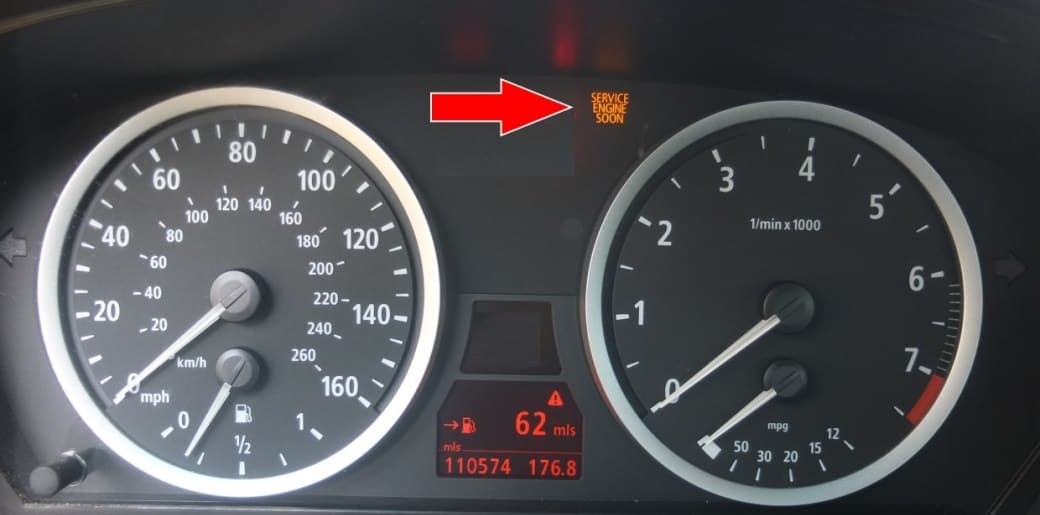
The “Service Engine Soon” light on a BMW means the engine control module (DME/DDE) has detected a fault in the engine, emissions, or drivetrain system. Unlike a maintenance reminder, this light is triggered by a stored diagnostic trouble code (DTC) and requires code scanning to identify the exact problem. Common causes include a failing VANOS solenoid, faulty mass airflow sensor, vacuum leaks, or catalytic converter degradation.
What Does the Service Engine Soon Light Mean on a BMW?
The Service Engine Soon (SES) light is BMW’s version of the check engine light. When this amber or yellow light illuminates on your instrument cluster, it signals that the onboard diagnostics system (OBD-II) has registered a fault code related to engine performance or emissions.
On most BMW models produced after 1996, the SES light serves the same function as the generic “Check Engine” light mandated by federal emissions standards. BMW simply labels it differently in the cluster.
The DME (Digital Motor Electronics) or DDE (Digital Diesel Electronics) continuously monitors dozens of sensors and actuators. When a reading falls outside the calibrated range for a set number of drive cycles, the light turns on.
SES Light vs. Maintenance Required Indicator
Do not confuse the Service Engine Soon light with BMW’s Service Vehicle indicator or the condition-based service (CBS) reminders. The CBS system tracks oil changes, brake pad wear, and inspections with separate icons. The SES light specifically points to an emissions or engine performance fault that requires diagnostic scanning.
What the Light Looks Like
Depending on your BMW model year and generation, the SES light appears as either a text message reading “Service Engine Soon” on the iDrive screen or as a small engine-shaped icon on the analog or digital gauge cluster. On F-chassis and G-chassis models, it may appear under the vehicle status menu in iDrive.
Is It Safe to Drive with the Service Engine Soon Light On?
It depends on how the car is running. If the light is steady and the engine sounds, feels, and accelerates normally, you can typically drive short distances to a shop or home. If the light is flashing or the car is misfiring, shaking, losing power, or producing unusual smells, stop driving immediately.
A flashing SES light almost always indicates an active misfire. Driving with a misfire sends raw, unburnt fuel into the catalytic converter, which can overheat and destroy the catalyst substrate within minutes. Replacing a BMW catalytic converter costs between $1,200 and $3,500 depending on the model, so ignoring a flashing light can turn a $200 coil pack job into a four-figure repair.
When You Can Keep Driving
- ✓The light is steady (not flashing) and the engine idles smoothly
- ✓There is no noticeable loss of power or rough running
- ✓No unusual smells such as raw fuel or burning
- ✓No overheating or abnormal temperature gauge readings
When You Must Stop Driving
- ✗The light is flashing repeatedly
- ✗The engine is shaking, stumbling, or surging at idle
- ✗You hear knocking, pinging, or loud exhaust noise
- ✗There is a strong fuel smell from the exhaust
- ✗The temperature gauge is climbing past normal range
Most Common Causes of the BMW Service Engine Soon Light
After diagnosing hundreds of BMWs, certain failure patterns appear again and again. The majority of SES lights on BMWs trace back to a handful of predictable component failures. Here are the most frequently seen causes, ranked by how often they show up in real-world diagnostics.
1. Ignition Coil and Spark Plug Failure
This is the single most common cause of the SES light on gasoline BMWs, especially the N54, N55, N20, and B58 engines. A failing ignition coil causes a misfire, which triggers codes like P0300 through P0306. The coil packs on BMWs are a known weak point, and they often fail without warning.
🔧 DIY Fix: Swap the suspected coil with a cylinder that is not misfiring. If the misfire follows the coil, replace it.
Always replace spark plugs at the same time if they are due. BMW coil packs typically cost $25 to $60 each, and a full set of six NGK or Bosch plugs runs $40 to $80.
2. VANOS Solenoid Failure
The VANOS system controls variable valve timing on BMW engines. When the solenoid sticks or fails, you may experience rough idle, sluggish acceleration, poor fuel economy, and codes like P1520, P1523, or 2A87. This is extremely common on N52, N54, and N55 engines.
🔧 DIY Fix: The intake and exhaust VANOS solenoids sit on the front of the engine and are accessible with basic tools. Remove the single bolt, pull the solenoid, clean it with brake cleaner, and reinstall.
If cleaning does not resolve the issue, replace the solenoid. OEM replacements cost around $80 to $150 each.
3. Mass Airflow (MAF) Sensor Failure
A dirty or failing MAF sensor sends incorrect air readings to the DME, resulting in a lean or rich condition. Symptoms include hesitation during acceleration, rough idle, and codes P0171, P0174, or P1083. Many shops will immediately recommend replacing the sensor without checking for vacuum leaks first, which is a mistake.
🔧 DIY Fix: Before replacing the MAF, remove it and clean the sensing element with dedicated MAF sensor cleaner spray. Do not use carb cleaner or brake cleaner, as these can damage the sensor.
If cleaning does not help after two attempts, replace the sensor. A genuine Bosch MAF costs $100 to $200.
4. Vacuum Leaks
Vacuum leaks are the most misdiagnosed issue on BMWs. Cracked vacuum lines, torn intake boots, and failed crankcase ventilation (CCV) valves or valve cover gaskets allow unmetered air into the engine. This triggers lean codes and can mimic MAF sensor failure.
On N52 and N54 engines, the rubber intake boot between the throttle body and DISA valve is notorious for developing hidden cracks.
🔧 DIY Fix: Perform a smoke test or spray carb cleaner around vacuum connections while the engine is idling. If the idle changes, you found the leak.
Common leak points include the valve cover gasket, oil filter housing gasket, intake manifold gaskets, and the CCV system. Replacing a valve cover gasket on an N52 typically costs $150 to $300 in parts and takes about two hours.
5. Oxygen Sensor Failure
BMW oxygen sensors (pre-cat and post-cat) degrade over time. A failing upstream O2 sensor causes poor fuel trim and performance issues.
A failing downstream sensor triggers catalytic converter efficiency codes like P0420 or P0430. Many shops quote a catalytic converter replacement when only the O2 sensor needs replacing.
🔧 DIY Fix: Scan the codes and identify which sensor is flagged. Upstream sensors are AFR (air-fuel ratio) sensors on most modern BMWs and cost $80 to $170.
Downstream sensors are conventional O2 sensors and cost $40 to $80. Use a 22mm O2 sensor socket and some penetrating oil for removal.
6. Thermostat and Coolant System Faults
BMW uses electronically controlled thermostats that tend to fail in the open position, causing the engine to run too cool. The DME detects this and sets codes like P0128. While this does not cause immediate drivability issues, it hurts fuel economy and emissions.
On N20 and N26 engines, the thermostat is a common failure point under 80,000 miles.
🔧 DIY Fix: Replace the thermostat and bleed the cooling system using BMW’s bleed procedure. The thermostat housing on most inline-six BMWs is accessible from the front of the engine.
Parts cost $60 to $120. Make sure to use BMW-approved coolant and follow the vacuum fill method to avoid air pockets.
7. Catalytic Converter Degradation
Over time, catalytic converters lose efficiency, especially if the engine has been running rich or misfiring. Codes P0420 and P0430 indicate the catalyst is below efficiency threshold. Before accepting a $2,000-plus converter replacement quote, rule out O2 sensor issues and exhaust leaks upstream of the converter.
🔧 DIY Fix: Try a catalytic converter cleaner additive and ensure the O2 sensors are functioning correctly. If the converter is genuinely degraded, consider an aftermarket direct-fit converter as a more affordable alternative to the OEM unit. Aftermarket converters for common BMW models run $200 to $600.
How to Read and Reset the Service Engine Soon Light on a BMW
You need an OBD-II scanner to read the fault codes behind the SES light. A basic $20 code reader will pull generic P-codes, but a BMW-specific scanner provides manufacturer codes and module-level data that are far more useful for accurate diagnosis.
Tools You Can Use at Home
- Budget Option: ELM327 Bluetooth OBD-II adapter paired with the BimmerLink or Torque Pro app on your phone. Total cost under $30.
- Mid-Range: Foxwell NT510 or NT530 with BMW software. Reads all modules, performs service resets, and costs around $80 to $130.
- Professional Grade: Autel MaxiCOM MK808 or Launch X431. Full bidirectional control, coding, and advanced diagnostics. Costs $300 to $600.
- BMW Factory Tool: ISTA+ running on a laptop with an ICOM or K+DCAN cable. This is what the dealer uses and provides the most comprehensive diagnostics.
How to Reset the Light
Fix the underlying problem first. Clearing codes without repairing the fault will cause the light to return within a few drive cycles.
Once the repair is complete, use your scanner to clear the stored and pending codes. The light should turn off immediately. On some models, you may need to complete two to three full drive cycles for the readiness monitors to set before passing emissions inspection.
BMW Service Engine Soon Light by Model: What Fails Most Often
How Dealerships and Shops Misdiagnose the SES Light
Dealerships and many independent shops rely heavily on code-based diagnosis without performing hands-on verification. This leads to unnecessary part replacements and inflated repair bills. Here are the most common misdiagnosis traps.
Misdiagnosing O2 Sensor Codes as Catalytic Converter Failure
A P0420 code does not automatically mean your catalytic converter is bad. In many cases, a degraded downstream O2 sensor or a small exhaust leak upstream of the converter is the real culprit. Always replace and retest the O2 sensors before approving a converter replacement.
Replacing the MAF Sensor Without Checking for Vacuum Leaks
Lean codes like P0171 and P0174 often lead shops to replace the MAF sensor. In reality, vacuum leaks from the valve cover gasket, oil filter housing gasket, or cracked intake boots are far more common causes. A $5 can of carb cleaner or a $50 smoke test can save you $200 on an unnecessary MAF replacement.
Quoting Timing Chain Replacement When the VANOS System Is the Issue
On N20 and N26 engines, timing chain stretch is a real concern. However, some shops quote a $3,000-plus timing chain job when VANOS solenoid replacement or a simple oil service would resolve the issue. Always get a second opinion and verify chain stretch with ISTA+ or a timing tool before authorizing the repair.
Frequently Asked Questions
Can a loose gas cap trigger the BMW Service Engine Soon light?
Yes. A loose, damaged, or missing gas cap can cause an evaporative emissions (EVAP) leak, which triggers the SES light with codes like P0442 or P0456.
Tighten the cap, clear the code, and see if it returns. If the light comes back, inspect the cap seal for cracks or replace the cap entirely for around $15 to $30.
How many miles can I drive with the Service Engine Soon light on?
If the light is steady and the car runs normally, there is no immediate mileage limit, but you should diagnose it within a few days. If the light is flashing, do not drive more than a few miles. Extended driving with an active misfire risks damaging the catalytic converter.
Does the Service Engine Soon light pass state inspection?
No. In most states with emissions testing, an illuminated SES light is an automatic fail. You must repair the fault, clear the codes, and complete the OBD-II drive cycle monitors before the inspection computer will pass the vehicle.
Why does my Service Engine Soon light come on and then turn off?
This means the DME detected a fault during one drive cycle but did not see it recur during subsequent cycles. The code will remain stored as a pending code. This often happens with intermittent misfires or borderline sensor readings.
Scan the codes even if the light turns off, as the pending code can help you catch a problem early.
Can low oil cause the Service Engine Soon light on a BMW?
Indirectly, yes. Low oil pressure or extremely low oil levels can affect the VANOS system, which operates on oil pressure. This can trigger VANOS-related fault codes and the SES light.
Check your oil level regularly, as BMW engines are known to consume oil between service intervals, especially the N52, N54, and N63 engines.
Is the BMW Service Engine Soon light different from the EML light?
Yes. The SES light relates to engine and emissions faults.
The EML (Elektronische Motorleistungsregelung) light indicates a problem with the electronic throttle control or drive-by-wire system. If both lights are on simultaneously, the issue is likely more severe and requires immediate diagnosis.
Final Word: Diagnose Before You Replace
The BMW Service Engine Soon light is not something to panic about, but it is also not something to ignore or blindly throw parts at. The most expensive mistake BMW owners make is authorizing repairs based on a single code without verifying the root cause.
Invest in a decent scanner, learn to read freeze frame data, and always confirm a diagnosis with a physical inspection before spending money. Your wallet will thank you.
Leave a Reply