
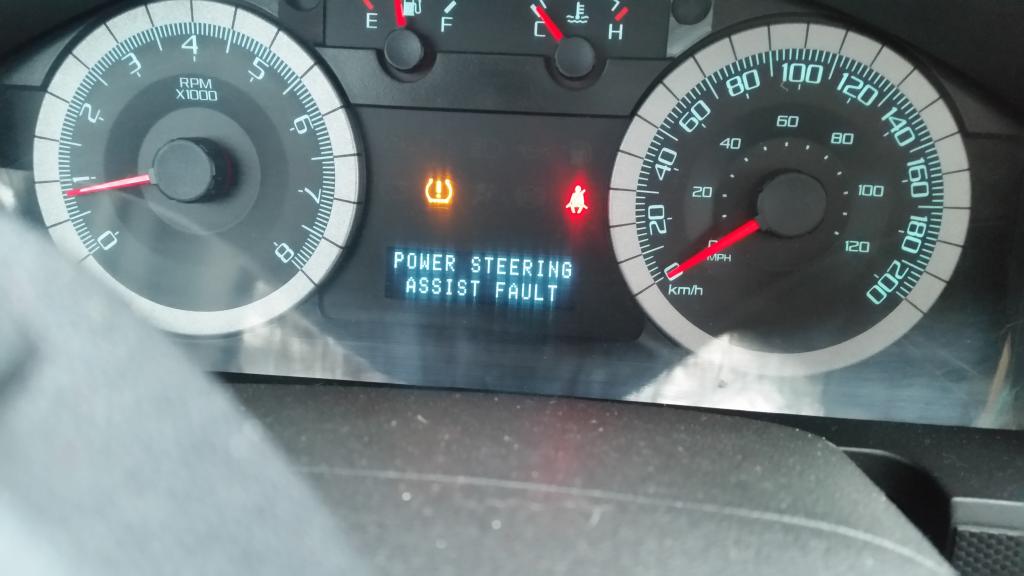
The Ford Escape “Power Steering Assist Fault” message means your electric power steering (EPS) system has detected a malfunction in the steering gear, torque sensor, wiring, or control module. In most cases on 2013–2019 Escapes, the fault is caused by a failing steering gear assembly, corroded connectors at the steering rack, or a weak battery dropping below 12V under load. A full steering rack replacement at a dealership can cost $1,200–$2,500, but many cases are resolved with a connector cleaning, battery replacement, or a software recalibration for under $200.
What Causes the Ford Escape Power Steering Assist Fault to Come On?
The Power Steering Assist Fault message triggers when the Power Steering Control Module (PSCM) detects an internal error, a communication failure, or an out-of-range signal from one of the steering system sensors. Unlike older hydraulic systems, the Ford Escape uses a fully electric rack-and-pinion steering gear with no power steering fluid to leak. When something goes wrong, the system disables power assist entirely, making the wheel extremely heavy—especially at low speeds and during parking.
There are five primary causes that account for the vast majority of these faults:
- Steering Gear (Rack) Failure – The electric motor or internal gears wear out, producing a grinding noise before the fault appears.
- Torque Sensor Failure – The sensor inside the steering column sends incorrect driver-input data to the PSCM.
- Corroded or Damaged Wiring/Connectors – Road salt, moisture, and heat cycling degrade the connectors at the steering rack.
- Low Battery Voltage – The EPS system is extremely sensitive to voltage. A battery dipping below 11.8V under load can trigger false faults.
- Power Steering Control Module (PSCM) Failure – Less common, but the module itself can fail internally or lose its software calibration.
If your warning appeared right after a cold start on a freezing morning, always check battery voltage first. A weak battery is the number-one false trigger for this fault on Ford Escapes.
How to Tell If It Is a Real Failure or a False Trigger
Disconnect the negative battery terminal for 15 minutes, then reconnect and start the engine. Turn the steering wheel lock to lock three times with the engine running.
If the fault clears and does not return after 50 miles of driving, it was likely a voltage-related false trigger. If it returns immediately or within a few drive cycles, you are dealing with a hardware failure.
Which Ford Escape Model Years Are Most Affected?
The 2013, 2014, 2015, and 2016 Ford Escape have the highest reported failure rates for the power steering assist fault. Ford issued multiple Technical Service Bulletins (TSBs) and Safety Recall 14S05 for the 2013–2014 Escape, addressing steering gear software and hardware defects. The 2017–2019 models still experience the issue but at a noticeably lower frequency.
| Model Year | Common Cause | Warranty/Recall Coverage | Average Repair Cost (No Coverage) |
|---|---|---|---|
| 2013–2014 | Steering gear assembly, software calibration | Recall 14S05 (check VIN on NHTSA.gov) | $800–$1,800 |
| 2015–2016 | Steering gear, connector corrosion, torque sensor | TSB 16-0087 (limited coverage) | $1,000–$2,200 |
| 2017–2019 | Torque sensor, low battery, PSCM software | Extended warranty may apply (80K miles in some cases) | $600–$1,800 |
| 2020+ | Occasional software glitches, wiring | Standard bumper-to-bumper or powertrain warranty | $200–$800 |
Before paying for any repair, always run your VIN through the NHTSA recalls lookup tool and contact your Ford dealer. Even if the original recall window has passed, Ford has sometimes extended goodwill coverage for known defects.
How to Diagnose the Ford Escape Power Steering Assist Fault at Home
You do not need a $5,000 scan tool to narrow down the problem. A basic OBD-II scanner, a multimeter, and a visual inspection will eliminate the most common causes before you spend money at a shop.
Step 1: Check Battery Voltage and Charging System
- With the engine off, measure battery voltage at the terminals. It should read 12.4V or higher.
- Start the engine and measure again. You need 13.8V–14.7V at idle to confirm the alternator is charging.
- Load-test the battery. Many auto parts stores will do this for free. If the battery is older than 3–4 years, replace it regardless of the test result.
- Clear the fault codes with your scanner and drive for a full day. If the fault does not return, the battery was the root cause.
Step 2: Scan for Diagnostic Trouble Codes (DTCs)
Connect an OBD-II scanner that can read Ford-specific modules. The PSCM stores codes in the U3000, U0131, U0100, and C-series ranges. The most telling codes are:
- U3000:49 – Control module internal electronic failure (steering gear replacement likely needed)
- U0131 – Lost communication with PSCM (check wiring and connectors first)
- C102D – Torque sensor signal fault (sensor or clock spring issue)
- C1B00 – Steering assist motor circuit fault (motor or gear failure)
Step 3: Inspect the Steering Rack Connectors
Jack up the front of the vehicle and locate the two large electrical connectors on the steering gear assembly, usually near the firewall on the driver’s side. Unplug them and look for green corrosion, bent pins, or melted plastic. This is extremely common in northern climates where road salt is used.
Step 4: Perform a Steering Angle Sensor Reset
If you recently had an alignment done, replaced a wheel, or disconnected the battery, the steering angle sensor may need recalibration. With the engine running on flat ground, slowly turn the wheel from full left lock to full right lock and back to center, holding for 5 seconds at each stop. This basic reset can clear some faults.
Ford Escape Power Steering Assist Fault Fixes by Cause
Fix 1: Clean or Replace Corroded Connectors
This is the cheapest and most overlooked repair. After unplugging the connectors at the steering gear, spray both sides with electrical contact cleaner.
Use a small pick to gently straighten any bent pins. Apply dielectric grease before reconnecting. Many owners report this fix lasting over 60,000 additional miles.
Fix 2: Replace the Battery
If your battery tests weak or is over three years old, replace it with a high-quality AGM battery rated at 760 CCA or higher. The Ford Escape’s EPS system draws significant amperage at startup, and a marginal battery that passes a basic voltage test can still cause intermittent faults under load.
Fix 3: Replace the Steering Gear Assembly
When the steering gear itself has failed—usually confirmed by the U3000:49 code, a grinding noise, or total loss of assist—the entire rack assembly must be replaced. Ford sells the part for approximately $700–$1,100 depending on the model year.
Labor adds 2.5–4 hours. After installation, the new gear requires PSCM programming with a Ford IDS or Forscan tool with a J2534 adapter.
Fix 4: Replace the Torque Sensor or Clock Spring
If the C102D code is present and the steering wheel controls or horn also malfunction, the clock spring assembly behind the steering wheel is likely the culprit. The clock spring contains the torque sensor on some model years. Replacement parts cost $80–$250, and the job takes 1–2 hours for someone comfortable removing an airbag.
Fix 5: Reprogram the PSCM
In some cases, the control module software becomes corrupted, especially after a jump-start or battery disconnect. A Ford dealer or a skilled independent shop with Forscan and a J2534 pass-through device can reflash the PSCM to the latest calibration file. This costs $75–$150 and takes about 30 minutes.
Can You Drive a Ford Escape With a Power Steering Assist Fault?
You can physically drive the vehicle, but the steering will be extremely heavy—nearly impossible to turn at parking lot speeds for most drivers. At highway speeds, the wheel is manageable but requires noticeably more effort, especially in emergency maneuvers.
Do not ignore this fault. Even if the car is drivable, you have lost a critical safety system. The effort required to steer in an emergency situation—like avoiding a pedestrian or a sudden obstacle—may exceed what you can physically apply to the wheel.
If you must drive the vehicle to a shop, keep speeds low, avoid highways, and use routes with minimal turns. Be prepared to use both hands and significant force at every intersection.
How Much Does It Cost to Fix the Power Steering Assist Fault on a Ford Escape?
| Repair | Parts Cost | Labor Cost | Total Estimated Cost |
|---|---|---|---|
| Battery replacement | $150–$250 | $0 (DIY) | $150–$250 |
| Connector cleaning | $10 (contact cleaner + grease) | $0 (DIY) | $10–$20 |
| PSCM software reflash | $0 (software only) | $75–$150 (shop time) | $75–$150 |
| Torque sensor / clock spring | $80–$250 | $150–$300 | $230–$550 |
| Steering gear replacement | $700–$1,100 | $300–$600 | $1,000–$1,700 |
Frequently Asked Questions
Does the Ford Escape have hydraulic power steering?
No. All Ford Escape models from 2013 onward use a fully electric power steering (EPS) system.
There is no power steering pump, no reservoir, and no fluid to check or change. The assist motor is integrated directly into the steering gear assembly.
Will a wheel alignment fix the power steering assist fault?
No. An alignment adjusts the wheel angles and does not affect the electric power steering system. However, if an alignment was recently performed and the steering angle sensor was disturbed, a sensor recalibration may be needed after the alignment to clear the fault.
Can Forscan reset the Ford Escape power steering fault?
Yes. Forscan, paired with a compatible ELM327 or J2534 adapter, can read PSCM codes, perform module resets, and reflash the steering control module. It is the most cost-effective diagnostic tool for Ford owners and is widely recommended in owner forums.
Is the power steering assist fault covered under Ford’s extended warranty?
Some 2013–2016 Escapes have an extended coverage program for the steering gear that goes up to 10 years or 150,000 miles, depending on the specific TSB and your VIN. Contact a Ford dealer with your VIN to check eligibility. Even if you are outside the window, asking for a goodwill repair—especially if you have service history with Ford—sometimes gets partial coverage.
Why does my power steering fault come and go?
Intermittent faults usually point to a corroded connector, a weak battery, or a torque sensor that is beginning to fail. The connector issue is the most common intermittent cause because moisture and temperature changes affect the connection quality. Inspect and clean the steering rack connectors before replacing any major components.
Final Advice From the Shop Floor
Before authorizing a $1,500 steering rack replacement, always start with battery testing and connector inspection. These two steps alone resolve roughly 30–40% of power steering assist faults on the Ford Escape and cost almost nothing to perform.
If the steering gear does need replacing, ask your shop to use a Motorcraft or OEM-remanufactured unit rather than a discount aftermarket rack—many budget replacements fail within 12–18 months and you will be right back where you started. Invest in a Forscan setup, and you will save yourself hundreds in diagnostic fees on this vehicle and any future Ford you own.
Leave a Reply