
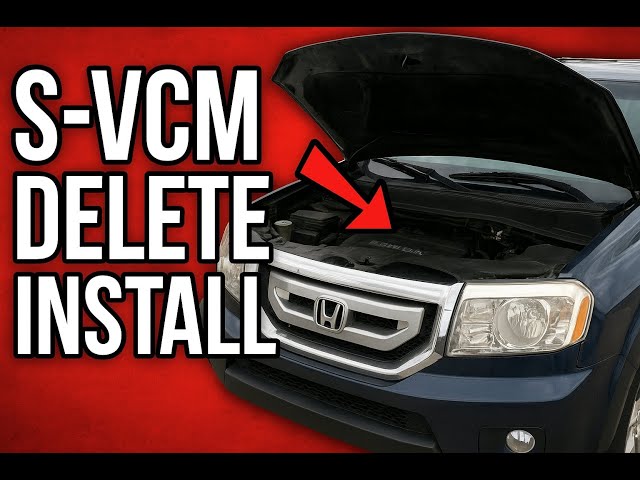
To disable VCM (Variable Cylinder Management) on a Honda Pilot, you can install an aftermarket VCM disabler device such as the S-VCM Controller or VCMuzzler II. These devices plug into the Engine Coolant Temperature (ECT) sensor and trick the ECU into thinking the engine hasn’t reached operating temperature, preventing VCM from activating. This is the safest, most reversible, and most popular method—no tuning or ECU reflash required.
What Is VCM on a Honda Pilot and Why Do Owners Want to Disable It?
VCM (Variable Cylinder Management) is Honda’s cylinder deactivation technology that shuts down 2 or 3 of the 6 cylinders during light-load driving to save fuel. Owners disable it because it causes excessive oil consumption, premature engine mount failure, vibration, carbon buildup, and transmission shudder.
Honda introduced VCM on the Pilot starting with the 2006 second-generation models equipped with the 3.5L V6 J35 engine. The system works by closing the intake and exhaust valves on select cylinders using a hydraulic spool valve assembly controlled by the ECU. When active, the engine essentially runs on 4 or 3 cylinders instead of 6.
In theory, this saves fuel. In practice, it has become one of the most complained-about features on any Honda product. The problems are so widespread that Honda has issued multiple Technical Service Bulletins (TSBs) and even extended warranties on certain components.
Which Honda Pilot Model Years Have VCM?
- 2006–2008 Pilot (Gen 2): VCM-I — deactivates rear bank (3 cylinders). Most problematic generation.
- 2009–2015 Pilot (Gen 2–3): VCM-II — deactivates 2 or 3 cylinders depending on load. Still heavily problematic.
- 2016–2022 Pilot (Gen 3): VCM-II continues with the 3.5L V6. Honda made incremental improvements but the core complaints remain.
- 2023+ Pilot (Gen 4): Uses a new 3.5L V6 with VCM but paired with a 10-speed automatic. Early reports suggest fewer issues, but time will tell.
What Problems Does VCM Cause on the Honda Pilot?
VCM causes excessive oil consumption, engine vibration, failed motor mounts, transmission torque converter shudder, fouled spark plugs, carbon buildup on intake valves, and premature catalytic converter degradation. These issues typically appear between 40,000 and 100,000 miles.
1. Excessive Oil Consumption
This is the number one complaint. When cylinders deactivate, the piston rings never fully seat on those cylinders.
Oil seeps past the rings, burns in the combustion chamber, and gets consumed. Owners routinely report burning 1 quart every 1,000–2,000 miles—far beyond Honda’s “acceptable” spec of 1 quart per 3,000 miles.
Left unchecked, this leads to oil-fouled spark plugs, clogged catalytic converters, and in extreme cases, engine seizure from oil starvation.
2. Engine Vibration and Failed Motor Mounts
When the engine transitions between 6-cylinder and 3- or 4-cylinder mode, it creates a harmonic imbalance. The active engine mounts—which use hydraulic fluid to dampen vibration—work overtime to compensate.
Over time, the mounts crack and leak fluid. Replacing all four mounts at a dealership can cost $1,200–$2,500.
3. Transmission Torque Converter Shudder
VCM creates constant load changes on the torque converter. The lock-up clutch cycles aggressively, which causes a shudder or vibration felt between 35–65 mph. Many owners mistake this for a failing transmission, but the root cause is VCM-induced stress.
4. Carbon Buildup and Spark Plug Fouling
Deactivated cylinders don’t burn fuel efficiently when they reactivate. Incomplete combustion leads to carbon deposits on intake valves and fouled spark plugs. This causes misfires, rough idle, and check engine lights—often misdiagnosed as ignition system failure.
How to Disable VCM on a Honda Pilot: All Methods Explained
There are four main methods to disable VCM: aftermarket VCM disabler devices, ECU tuning/retuning, replacing the ECU with a non-VCM unit, and mechanical deletion. The disabler device is the easiest, cheapest, and most reversible option.
Method 1: Aftermarket VCM Disabler Device (Recommended)
These small electronic devices tap into the Engine Coolant Temperature (ECT) sensor circuit. The ECU only activates VCM once the engine coolant reaches full operating temperature (around 170°F+). The disabler sends a modified resistance signal to the ECU so it never thinks the engine is fully warmed up.
Popular devices:
- S-VCM Controller: The most popular option. Plugs inline with the ECT sensor. Adjustable. No CEL. Fully reversible. Around $80–$100.
- VCMuzzler II: Similar concept with a fixed resistor value. Simpler but less adjustable. Around $50–$70.
- VCM Tuner II: A more advanced unit with temperature-compensating resistance. Works well in extreme climates. Around $90–$120.
Installation steps:
- Locate the ECT sensor on the engine block or thermostat housing (location varies by model year).
- Disconnect the ECT sensor connector.
- Plug the VCM disabler inline between the sensor and the wiring harness connector.
- Secure the device away from heat sources using the included zip ties.
- Start the engine and verify no check engine light appears.
- Drive normally and confirm the engine stays in full 6-cylinder mode.
Method 2: ECU Retune or Reflash
A performance tuner or Honda specialist can reflash the ECU to permanently disable VCM software. This is a true software-level disable.
However, it voids any remaining powertrain warranty and is not reversible without another reflash. Cost ranges from $300–$600 depending on the tuner and model year.
This method is more common on older Pilots (2006–2015) where warranty is no longer a concern. Shops that specialize in Honda tuning or Hondata systems can perform this work.
Method 3: ECU Swap to Non-VCM Unit
Some owners of 2006–2008 Pilots have sourced ECU units from Honda vehicles of the same era that did not have VCM. This requires matching the correct part number, immobilizer programming, and potentially rewiring. It is complex and not recommended unless you have deep Honda electrical experience.
Method 4: Mechanical VCM Delete (Advanced)
This involves physically modifying or replacing the VCM spool valve assembly and associated oil control solenoids. Some aftermarket kits exist for the J-series engine, but this is an engine-out or top-end-off procedure.
It costs $500–$1,500 in parts alone and requires specialized knowledge. This approach is typically only used by builders or those doing engine rebuilds anyway.
Model-Year-Specific VCM Disable Guide for Honda Pilot
The disabler device method works across all VCM-equipped Pilots, but ECT sensor locations and connector types differ by generation. Here is what you need to know for each era.
2006–2008 Honda Pilot (VCM-I)
- ECT Sensor Location: Rear of the engine block, driver side near the firewall.
- Connector Type: 2-pin weatherpack connector.
- Notes: VCM-I is the most aggressive version. Disabling it yields the most dramatic improvement in oil consumption and vibration.
2009–2015 Honda Pilot (VCM-II)
- ECT Sensor Location: Thermostat housing area, front of engine.
- Connector Type: 2-pin connector, slightly different keying from Gen 2.
- Notes: VCM-II is less aggressive but still causes the same long-term problems. These are the most commonly reported Pilots on forums for oil consumption complaints.
2016–2022 Honda Pilot (VCM-II, Gen 3)
- ECT Sensor Location: Thermostat housing, accessible from above.
- Connector Type: Updated 2-pin connector. Verify disabler device compatibility before purchasing.
- Notes: Honda improved piston ring design in later 2019+ models, reducing but not eliminating oil consumption. Many owners still disable VCM as a preventive measure.
Will Disabling VCM Affect Fuel Economy?
Most owners report a fuel economy loss of 1–3 MPG after disabling VCM. On a Pilot averaging 22 MPG, you might drop to 19–21 MPG in mixed driving. The trade-off is worth it to avoid $2,000+ in engine mount and oil-related repairs.
Here is a realistic breakdown of the trade-off:
When you factor in the cost of extra oil, premature repairs, and the frustration of recurring check engine lights, disabling VCM almost always saves money over the life of the vehicle.
Can the Dealership Disable VCM for Me?
No, Honda dealerships cannot and will not disable VCM. It is federally mandated emissions equipment, and disabling it technically violates the Clean Air Act. Dealerships will only address VCM-related symptoms under warranty or TSB—not remove the system.
However, Honda has acknowledged VCM issues through several TSBs. If your Pilot is consuming oil excessively, bring it to the dealer and request documentation. Having an oil consumption test on record helps if you later need warranty engine work or a goodwill repair.
Some independent shops will install a VCM disabler for you if you supply the device, typically charging 0.5–1 hour of labor ($60–$150). But the installation is genuinely simple enough for anyone comfortable with popping a hood.
Frequently Asked Questions
Does disabling VCM throw a check engine light?
Quality VCM disabler devices like the S-VCM Controller and VCMuzzler II are designed to prevent a check engine light. They maintain the correct resistance range so the ECU does not detect a sensor fault. Cheap knockoff devices may trigger a P0118 or P0128 code.
Will disabling VCM void my Honda warranty?
Technically, a dealer could deny a warranty claim if they trace a failure to the disabler device. In practice, most dealers cannot detect a properly installed disabler, and the device is easily removed before service visits. Remove it before any dealer appointment to be safe.
Can I disable VCM on a Honda Pilot with a V6 that doesn’t have the J35 engine?
All Honda Pilots use the J35 family V6. VCM is integrated into the engine management software on all V6 Pilots from 2006 onward. The disabler method works across the entire J35 VCM lineup including the Odyssey, Ridgeline, and Accord V6.
Is there a permanent fix besides a disabler device?
ECU reflash is the closest thing to a permanent software fix. Mechanical deletion of the spool valve assembly is a permanent hardware fix but is expensive and invasive. For most owners, the disabler device is the best balance of effectiveness, cost, and reversibility.
My Pilot already has high oil consumption. Will disabling VCM fix it?
Disabling VCM prevents further ring degradation, but it may not fully reverse existing oil consumption if the rings are already worn. It will typically slow consumption significantly. For severe cases, a piston ring replacement or engine rebuild may be necessary—but always disable VCM afterward to prevent recurrence.
The Bottom Line: Disable VCM Before It Costs You
If you own a Honda Pilot with the 3.5L V6, disabling VCM is one of the single best preventive maintenance decisions you can make. A $50–$100 device can save you thousands in engine mounts, oil consumption repairs, transmission shudder fixes, and catalytic converter replacements.
The 1–3 MPG fuel economy penalty is negligible compared to the long-term reliability gains. Install a reputable VCM disabler, drive your Pilot the way Honda’s engineers intended—with all six cylinders firing—and enjoy a smoother, longer-lasting engine.
Leave a Reply