
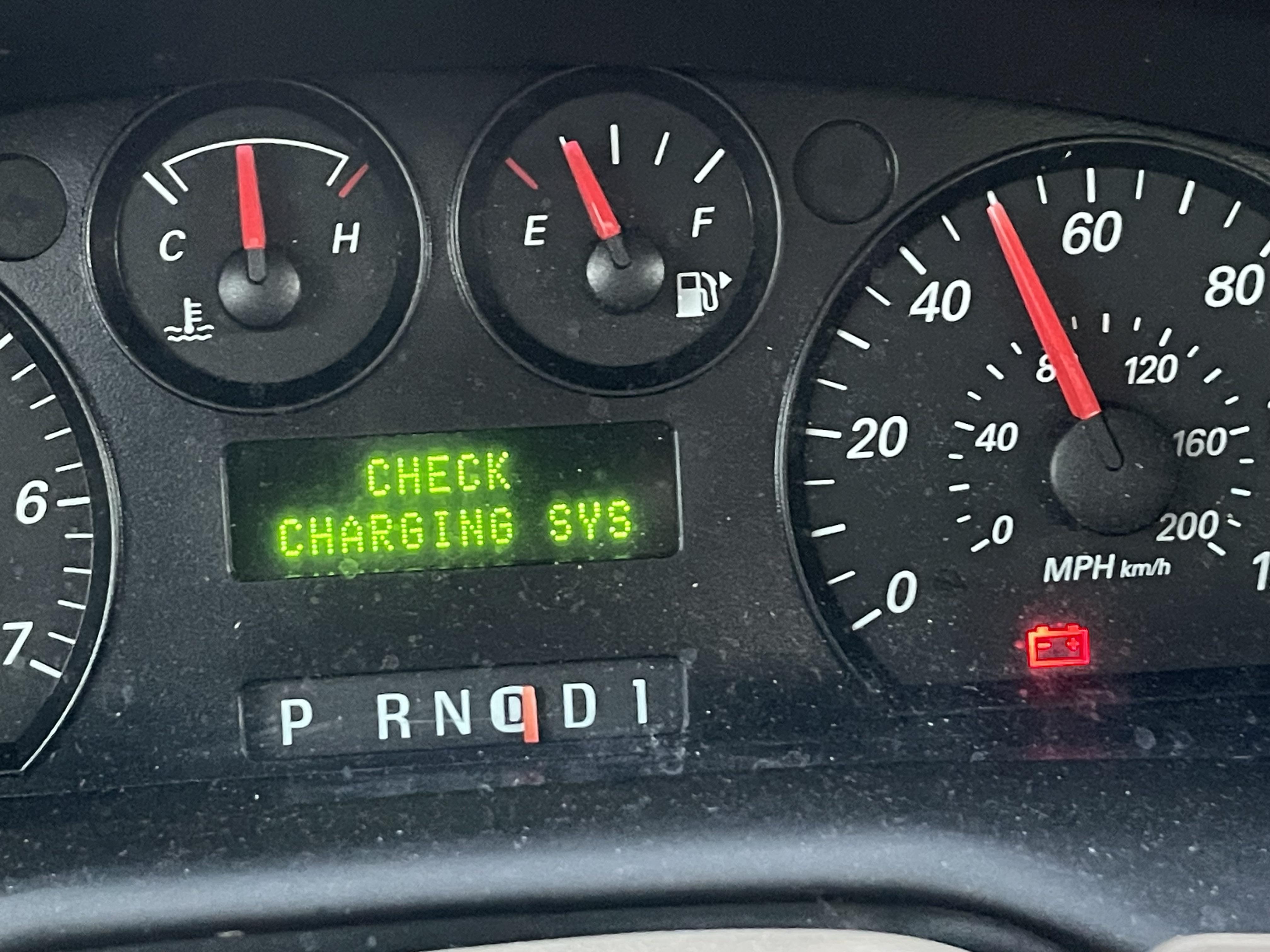
The “Check Charging System” warning on a Ford means the vehicle’s computer has detected a voltage problem, typically caused by a failing alternator, weak battery, or faulty wiring. You should test the system immediately to avoid being stranded with a dead battery.
What Does the Ford Check Charging System Warning Mean?
This warning is triggered by the Powertrain Control Module (PCM) when it detects system voltage is outside the normal operating range, usually between 13.5 and 14.7 volts. The PCM monitors the charging circuit constantly.
The warning signifies an active fault in the alternator, battery, or related wiring, not just a bulb check. Ignoring it will lead to a discharged battery and a no-start condition.
What Are the Most Common Causes of This Warning?
The primary culprits are a faulty alternator, a degraded battery, or corroded wiring. Less frequently, a defective battery sensor or PCM itself can be the root cause. It’s a system, so a failure in one component stresses the others.
1. Failing Alternator
The alternator is the heart of the charging system, and its failure is the most frequent reason for this warning. Internal components like the voltage regulator, diode trio, or brushes wear out over time.
- Symptoms: Dimming headlights at idle, whining noise from the engine, and a battery that won’t hold a charge even after replacement.
- Common Failure Points: On Ford F-150s and Explorers, alternators often fail between 100,000-150,000 miles. The internal voltage regulator is a known weak point.
- DIY Diagnosis: With the engine running, use a multimeter across the battery terminals. A healthy system reads 13.5-14.7V. If it’s below 13V or above 15V, the alternator is suspect. Also, check for AC voltage ripple; more than 0.5V AC indicates bad diodes.
2. Weak or Failing Battery
A battery that can’t hold a proper charge forces the alternator to overwork, eventually causing it to fail and trigger the warning. The warning can appear before the battery is completely dead.
- Symptoms: Slow engine crank, needing frequent jumps, and battery warning lights may accompany the charging message.
- The Misdiagnosis Trap: Many shops and owners replace the battery first. If the underlying issue is a weak alternator, the new battery will quickly die again. Always test both components together.
- DIY Test: Perform a load test. A healthy battery should maintain above 9.6 volts during a load test. Check the manufacturing date sticker; batteries over 4-5 years old are prime candidates for failure.
3. Corroded or Damaged Wiring and Connections
Poor electrical connections create high resistance, starving the system of power and confusing the PCM’s voltage readings. This is a frequently overlooked cause.
- Key Connection Points: The main power cable from the alternator to the battery, the battery terminals, the ground straps from the battery and engine to the chassis, and the connector at the alternator itself.
- Visual Inspection: Look for green/white corrosion on terminals, frayed wires near the alternator or battery, and heat-damaged insulation, especially on the positive wire running from the alternator.
- Fix: Clean all connections with a wire brush and a baking soda/water mixture. Apply dielectric grease after tightening to prevent future corrosion.
4. Defective Battery Monitoring Sensor (BMS)
Modern Fords (roughly 2011+) use a sensor on the negative battery cable to monitor current flow. A faulty BMS can send incorrect data to the PCM, triggering a false charging system warning even with good components.
- Symptoms: The warning appears intermittently, often with a good battery and alternator test. May be accompanied by incorrect state-of-charge readings on the dash display.
- Model-Specific Note: This is particularly common on Ford F-150s, Explorers, and Ford Escapes. After replacing a battery, the BMS often needs to be reset with a scan tool to recalibrate.
How to Diagnose the Ford Check Charging System Step-by-Step
Follow this logical sequence to isolate the problem without throwing parts at it.
- Check the Battery: With the engine off, a fully charged battery should read 12.4-12.7 volts. If it’s below 12.2V, charge it fully before proceeding.
- Test with Engine Running: Start the engine and check voltage at the battery. It should be 13.5-14.7V. If it’s low, the alternator isn’t charging.
- Load Test the System: With the engine idling and voltage stable, turn on the headlights, A/C blower, and rear defrost. The voltage should not drop below 13V. A significant drop points to a weak alternator.
- Check Wiring: Visually inspect and manually wiggle the main power wires and connectors while monitoring voltage. A fluctuation indicates a loose or corroded connection.
- Scan for Codes: Use an OBD-II scanner that can read Ford-specific codes (P0560-P0563 are common charging system codes). These can point directly to an alternator control circuit fault or a BMS issue.
Model-Specific Solutions and Common Fixes
While the diagnosis is similar, certain Ford models have known quirks.
Ford F-150 (2009-Present)
Look for a corroded alternator connector due to its location. The 3.5L EcoBoost engines are notorious for alternator failures. Also, check the main ground point on the driver’s side frame rail—it corrodes severely.
Ford Mustang (2005-2014)
The 4.6L and 5.0L engines often have issues with the alternator pulley overrunning decoupler. It seizes, causing belt slip, noise, and poor charging. Requires alternator replacement.
Ford Explorer (2011-2019)
The BMS reset is critical after any battery service. Failure to reset it can cause false warnings and premature battery failure due to incorrect charging strategy. Also, inspect the wiring harness that runs near the exhaust manifold.
Frequently Asked Questions
Can I drive my Ford with the Check Charging System light on?
You can drive for a short distance to a safe location, but not for long. The vehicle is running on battery power alone. Once the battery is depleted, the engine will stall, and you’ll be stranded.
How much does it cost to fix a Ford charging system?
Costs vary: A new alternator (parts + labor) ranges from $350 to $700 depending on the model. A new battery is $150-$250. Diagnosing and repairing a wiring issue can be $100-$200 if done at a shop.
Why did my new alternator not fix the warning?
The issue is likely elsewhere. Check the battery—it may have been damaged by the failed alternator.
Also, inspect all wiring and connections for corrosion or damage. A faulty voltage regulator connector can mimic alternator failure.
Do I need to reset the computer after fixing the charging system?
On most Ford models, the warning will clear itself after several successful drive cycles once the fault is resolved. However, if the BMS was disconnected, a reset with a scan tool is necessary for proper battery management.
What if the warning is on but the battery voltage tests normal?
This points to a sensor or communication issue. The PCM may not be receiving the correct signal from the alternator or the BMS. Check the alternator’s field control circuit wiring and the BMS sensor for faults.
Addressing the Ford Check Charging System warning promptly is crucial. By methodically testing the battery, alternator, and connections, you can pinpoint the exact cause, avoid unnecessary parts replacements, and prevent a complete breakdown. Remember, this warning is your vehicle’s early alert—use it to diagnose and fix the problem before it leaves you stranded.
Leave a Reply