
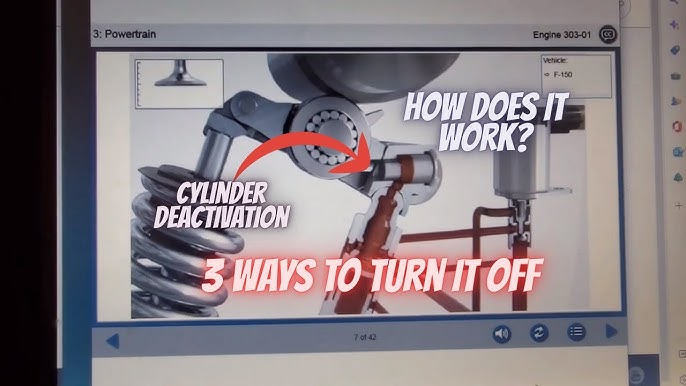
Ford cylinder deactivation is a fuel-saving technology used in the 5.0L Coyote V8 (2018+) and select EcoBoost engines that shuts down half the cylinders under light-load driving conditions. While it improves EPA fuel economy ratings by 1-2 MPG in real-world driving, it has been linked to lifter noise, increased oil consumption, vibration complaints, and potential long-term valvetrain wear—leading many owners to disable it entirely using aftermarket tuners.
What is Ford cylinder deactivation and how does it work?
Ford’s cylinder deactivation system, sometimes called Dynamic Cylinder Deactivation (CDA), mechanically disables specific cylinders during light-throttle cruising to reduce fuel consumption. On the 5.0L Coyote V8, the system deactivates four of eight cylinders, effectively turning it into a V4 under highway and coasting conditions.
The system works through special hydraulic roller lifters with collapsible elements controlled by oil pressure solenoids. When the engine computer determines the vehicle is under light load, it commands solenoids to alter oil flow to designated lifters. This causes the intake and exhaust valves on cylinders 1, 4, 6, and 7 to stop opening, while those cylinders continue to piston-cycle without contributing power.
Which Ford engines use cylinder deactivation?
- 5.0L Coyote V8 (Gen 3, 2018+): Found in the F-150 and Mustang GT. Deactivates 4 of 8 cylinders. Most widely discussed system among owners.
- 3.5L EcoBoost V6 (2024+): Select newer applications have incorporated CDA technology in updated variants.
- 2.7L EcoBoost V6: Some 2024+ applications include cylinder deactivation capabilities depending on trim and market.
- 1.5L EcoBoost I-3/I-4: Used in some compact Ford applications with cylinder deactivation on the three-cylinder variant, cutting one cylinder under light load.
How Ford’s system differs from GM’s AFM and DFM
GM’s Active Fuel Management (AFM) and Dynamic Fuel Management (DFM) deactivate cylinders in a flexible pattern across all eight cylinders. Ford’s system on the Coyote V8 is simpler—it consistently deactivates the same four cylinders every time. This fixed pattern means Ford’s system is mechanically less complex, but it also means those four deactivated cylinders and their lifters bear all the cycling stress repeatedly.
What are the most common Ford cylinder deactivation problems?
The most reported problems include lifter tick or knock, increased oil consumption, noticeable vibration during cylinder transition, rough idle, and in severe cases, complete lifter collapse requiring valvetrain repair. These issues are most prevalent on the 5.0L Coyote V8 in F-150s and Mustang GTs from 2018 onward.
1. Lifter tick, knock, and tap noise
This is the number one complaint across F-150 and Mustang forums. Owners report a distinct ticking or tapping sound that typically appears between 500 and 2,000 miles, though some develop it later. The noise is most noticeable at cold start and during light-throttle driving when the system cycles between V8 and V4 mode.
The root cause is the collapsible lifter mechanism. Unlike traditional solid or standard hydraulic lifters, cylinder deactivation lifters have internal locking pins and oil-filled chambers that allow the plunger to collapse on command. These internal components are precision-tight, and any manufacturing variance, oil viscosity issue, or debris can cause them to tick audibly.
Real-world note: Many owners report the tick comes and goes. If it only appears when the engine is cycling between V8 and V4, the lifter is likely functioning but not smoothly. Persistent ticking at all RPMs in V8 mode may indicate a more serious wear issue.
2. Increased oil consumption
Cylinder deactivation lifters can allow small amounts of oil to seep past internal seals when the lifter is in the collapsed position. Over time, this leads to measurable oil consumption between changes—typically 1 quart per 3,000 to 5,000 miles, though some owners report worse.
Additionally, the deactivated cylinders still experience piston ring cycling without combustion heat to properly seat the rings against the cylinder walls. This can allow oil to accumulate on cylinder walls and partially bypass the rings, contributing to consumption and potential carbon buildup over long periods.
3. Vibration and harshness during cylinder transitions
When the system activates or deactivates cylinders, there is a brief moment where the crankshaft experiences an uneven firing order. Ford uses active engine mounts and exhaust valve tuning to mask this, but owners with sensitive hands on the steering wheel or seat can still feel a subtle shudder or burp during the transition.
This is more noticeable in the F-150 than the Mustang due to the truck’s heavier drivetrain and different transmission calibration. Some owners describe it as a “hiccup” or “stumble” at 40-60 mph during steady cruising.
4. Exhaust manifold bolt failures (related issue)
While not directly caused by cylinder deactivation, the uneven thermal cycling of deactivated cylinders can contribute to exhaust manifold warping and bolt breakage on the Coyote V8. The deactivated cylinders run cooler, creating uneven heat distribution across the exhaust manifold surface. Over 60,000 to 100,000 miles, this thermal cycling stress can snap exhaust manifold bolts, causing an exhaust leak that sounds like a ticking—often misdiagnosed as a lifter problem.
5. Check engine light and misfire codes
If a deactivated lifter fails to fully collapse or re-engage, the engine computer will detect an imbalance and trigger codes such as P0300 (random misfire), P0301 through P0308 (cylinder-specific misfire), or P219A/P219B (air-fuel ratio imbalance). Dealerships often misdiagnose these as ignition or fuel injector problems before considering lifter failure.
How to disable Ford cylinder deactivation on the 5.0 Coyote
The most reliable way to disable Ford cylinder deactivation is through an aftermarket engine tuner or by using FORScan software to modify the PCM (Powertrain Control Module) calibration. This tells the engine computer to remain in full V8 mode at all times, preventing the lifter solenoids from ever commanding the collapsible mechanism.
Method 1: Aftermarket tuner (SCT, HP Tuners, or DiabloSport)
- Purchase a compatible device: SCT BDX or X4, HP Tuners MPVI3, or DiabloSport inTune i3 are the most commonly used. Ensure the device supports your specific year, engine, and transmission combination.
- Load a CDA-disable tune: Most custom tuners and several off-the-shelf calibrations include a cylinder deactivation disable option. This is typically listed as “AFM delete,” “CDA off,” or “V8 full-time mode.”
- Flash the tune to your PCM: Connect the device to your OBD-II port, follow the device instructions, and flash the calibration. The process takes 5-15 minutes.
- Verify the system is off: After flashing, monitor your active exhaust or instrument cluster. On the Mustang GT, the active exhaust will no longer switch between quiet and loud modes based on cylinder count. On the F-150, you will no longer see the “V4” indicator if equipped with the productivity screen display.
Method 2: FORScan (free or low-cost option)
- Get an OBD-II adapter: You need a compatible ELM327 adapter or an OBDLink MX+ for reliable Ford communication.
- Download FORScan: Available at forscan.org. The extended license (free trial or small donation) is required for PCM module changes.
- Navigate to PCM module configuration: Look for the cylinder deactivation or DOD/AFM-related parameter within the As-Built data or module configuration section.
- Disable the CDA function: Change the parameter from enabled to disabled. Save and write the change to the module.
- Clear codes and test drive: Clear any stored DTCs and drive the vehicle to confirm the system remains off permanently.
Method 3: Mechanical delete (hardware replacement)
For owners who want a permanent, tuner-free solution, replacing the cylinder deactivation lifters with standard non-collapsing lifters eliminates the problem at the hardware level. This requires removing the valve covers and, on some applications, the intake manifold for access to the lifter valley.
- Parts needed: 8 standard hydraulic roller lifters (non-AFM/CDA), lifter trays or guides compatible with standard lifters, and a gasket set.
- Cost estimate: $200-$400 in parts if doing it yourself. $800-$1,500 at an independent shop. $1,500-$2,500 at a dealership.
- Important: You must also disable CDA in the PCM via tuner or FORScan. If the PCM still commands the solenoids, oil pressure will still be directed to the lifter valley ports, which can cause oil pressure issues with standard lifters installed.
Does Ford cylinder deactivation cause long-term engine damage?
Based on owner reports and forum data accumulating since 2018, cylinder deactivation on the Ford 5.0 Coyote does not cause catastrophic engine damage in most cases, but it can accelerate valvetrain wear on the four deactivated cylinders. The most significant long-term concern is premature lifter failure, which can score camshaft lobes if not addressed early.
Evidence from high-mileage Coyote engines
These are trend observations from aggregated owner reports, not guaranteed outcomes. Many 2018+ Coyote engines have reached 100,000+ miles with zero lifter issues. However, the risk is elevated compared to pre-2018 Coyote engines that used no cylinder deactivation at all.
Ford cylinder deactivation and warranty coverage
Ford’s powertrain warranty covers cylinder deactivation lifter failures for 5 years or 60,000 miles on most vehicles. However, dealerships frequently deny claims by attributing lifter tick to “normal operating characteristics” or by blaming oil change history. If you are within warranty and experiencing lifter noise, document everything.
How to get a warranty claim approved
- Document the noise with video: Record the engine at idle with the hood open, capturing the tick clearly. Include the odometer reading in frame.
- Request a cylinder contribution test: This is a Ford IDS/FDRS diagnostic procedure that measures individual cylinder balance. A failing lifter will show reduced contribution on the affected cylinder.
- Ask for oil pressure readings: Low oil pressure on the CDA circuit can confirm a lifter issue. Request the technician document the readings on the repair order.
- Escalate to Ford corporate if denied: Call Ford Customer Relationship Center at 1-800-392-3673 and reference your case. Corporate can authorize goodwill repairs even after the dealer denies a claim.
Frequently asked questions about Ford cylinder deactivation
Can I disable cylinder deactivation without voiding my Ford warranty?
Technically, any PCM modification can give Ford grounds to deny warranty claims related to engine performance. However, disabling CDA only changes a fuel management parameter and does not alter timing, fuel delivery, or boost levels.
Many owners report no warranty issues after a simple CDA disable tune. If concerned, revert to stock before dealership visits.
Does disabling Ford cylinder deactivation hurt fuel economy?
Real-world impact is minimal. Most owners report a loss of 0.5 to 1.5 MPG on the highway after disabling CDA.
City driving is virtually unaffected since the system rarely activates in stop-and-go traffic anyway. Many owners consider the fuel cost insignificant compared to potential lifter repair bills.
Is the Ford 5.0 Coyote cylinder deactivation system the same as GM AFM?
No. While both use collapsible lifters controlled by oil pressure, Ford uses a fixed four-cylinder deactivation pattern while GM’s DFM can deactivate any combination of cylinders dynamically.
Ford’s system is mechanically simpler but uses similar lifter technology, which is why the failure modes look comparable. The parts are not interchangeable between brands.
Will a catch can help with Ford cylinder deactivation problems?
An oil catch can helps with intake valve carbon buildup on direct-injection engines but does not directly address cylinder deactivation lifter issues. However, cleaner intake air and reduced oil vapor in the intake can slightly improve overall engine health on the Coyote. It is a worthwhile mod for other reasons but not a fix for CDA lifter problems.
What year Ford F-150 has cylinder deactivation?
The 5.0L Coyote V8 in the Ford F-150 has used cylinder deactivation starting with the 2018 model year, which introduced the Gen 3 Coyote engine. All 2018, 2019, 2020, 2021, 2022, 2023, and 2024 F-150s equipped with the 5.0L V8 have this system. The 3.5L and 2.7L EcoBoost engines did not use CDA in earlier model years but have begun incorporating it in the latest 2024+ revisions.
Does the 2024 Ford Mustang GT have cylinder deactivation?
Yes. The 2024 Mustang GT uses the Gen 4 Coyote 5.0L V8, which retains cylinder deactivation. The seventh-generation Mustang carries over the CDA system from the previous generation, and the same lifter tick complaints have been reported by early S650 Mustang GT owners.
The bottom line on Ford cylinder deactivation
Ford’s cylinder deactivation is a legitimate fuel-saving technology that delivers modest real-world MPG gains, but it introduces a weak point in an otherwise proven engine. The Coyote V8 is one of the most reliable naturally aspirated V8s on the market—its Achilles’ heel is the CDA lifter system.
If you plan to keep your Ford truck or Mustang long-term, disabling cylinder deactivation early is cheap insurance against lifter wear, ticking, and potential camshaft damage down the road. A $400 tuner now can save you a $2,000+ valvetrain repair later.
Leave a Reply